Find the Best Septic Tank Pumping Contractors for Your Business
No obligation • Fast responses • Nationwide coverage

Why you can trust Septic Spot
Septic Spot is a leading United States resource for understanding and comparing septic services. Our editors review providers using consistent criteria and verify key business details. Listings and scores are independent, and companies cannot pay to influence our content.
Search providers near you
Best Septic Tank Pumping Contractors in Wyoming Ranked
Maintaining your septic system is a crucial responsibility for Wyoming homeowners. Regular septic tank pumping prevents system failures, protects your property value, and safeguards local groundwater from contamination. This guide provides clear, practical information on septic service schedules, state regulations, and costs to help you find qualified local professionals for this essential maintenance task.
Understanding Your Septic System and Wyoming Regulations
In Wyoming, the care and maintenance of a septic system falls squarely on the property owner. Unlike municipal sewer systems, you are responsible for all upkeep, repairs, and ensuring the system complies with state and local codes. The Wyoming Department of Environmental Quality (DEQ) oversees regulations for Small Wastewater Facilities, which include most residential septic systems.
A standard system consists of a septic tank and a drainfield (or leach field). Wastewater from your home flows into the tank, where solids settle as sludge, and oils float as scum. The liquid effluent then exits into the drainfield for further treatment in the soil. Pumping removes the accumulated sludge and scum before they can overflow and clog the drainfield, which is the most common cause of system failure.
Key Wyoming Regulatory Points
- Permits Are Required: A DEQ Small Wastewater Facility permit is mandatory for any new installation, major repair, or replacement of a septic system 1. Counties like Park and Fremont have local processes that work in conjunction with state rules 2 3.
- Access is Mandatory: Tanks must have accessible ports or risers for inspection and pumping. Regulations often specify a minimum diameter (e.g., 20 inches) for these access points to accommodate equipment.
- Proper Abandonment: If a septic tank is taken out of service, it must be properly abandoned-either pumped out and removed or filled with an inert material like sand or concrete-according to county guidelines to prevent safety hazards 4.
How Often Should You Pump Your Septic Tank in Wyoming?
There is no one-size-fits-all schedule, but a general rule for a typical household system is to pump the tank every 3 to 5 years. However, this is just a starting point. Several factors specific to your household can significantly alter this frequency.
Factors Influencing Pumping Frequency
- Household Size and Water Usage: The more people living in your home, the more wastewater is generated, filling the tank faster. High water-use appliances (like garbage disposals and whirlpool tubs) also increase the load.
- Septic Tank Size: Larger tanks hold more solids and therefore can go longer between pumpings. Knowing your tank's capacity (in gallons) is essential for planning.
- Total Wastewater Generated: This combines all water from toilets, showers, sinks, and laundry. Conserving water extends the time between necessary pumpings.
- System Type: Alternative systems with pumps, mechanical components, or advanced treatment stages typically require more frequent attention, often including an annual inspection and potentially more frequent pumping 5.
The most reliable method is to have your tank inspected by a professional. They can measure the sludge and scum layers to determine if pumping is needed, helping you move from a guesswork schedule to a proactive, condition-based plan 6.
Signs Your Wyoming Septic Tank Needs Pumping
Don't wait for a full-blown failure. Watch for these warning signs that your tank is reaching capacity or that there is a problem in the system:
- Slow Drains: Sinks, showers, and toilets that drain slowly, especially if gurgling sounds accompany them.
- Unpleasant Odors: Foul smells emanating from drains, the plumbing, or around the drainfield area outdoors.
- Sewage Backups: Wastewater backing up into household drains is a severe sign of blockage or failure.
- Lush, Wet Lawn: Spongy ground or unusually green, lush grass over the drainfield can indicate surfacing effluent.
- Standing Water: Puddles or soggy soil in the yard near the septic tank or drainfield.
If you notice any of these signs, contact a septic service provider promptly to assess the situation.
What to Expect: The Septic Pumping Process
Understanding the process can help you prepare for a service visit and ensure it's done correctly.
- Locating and Uncovering: The technician will locate your tank and dig to expose the access lids. Having a detailed map of your system's location can save time and money.
- Inspecting: Before pumping, a good technician will inspect the tank's inlet and outlet baffles (or tees) for damage and check for cracks or leaks. This is a critical step often required by local regulations to prevent solids from entering the drainfield 7.
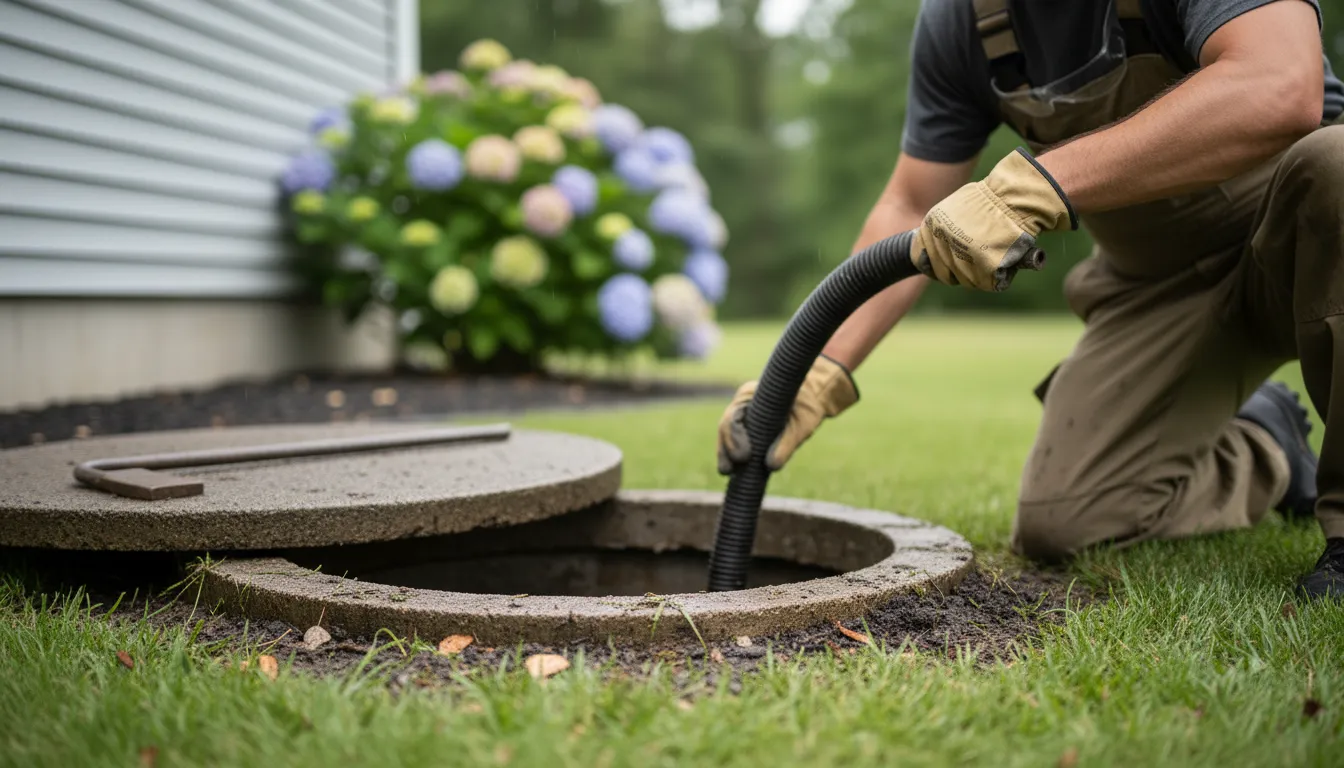
- Pumping: Using a large tank truck, the technician will vacuum out all the contents (sludge, scum, and liquid) from your tank.
- Final Check & Clean-up: After pumping, they may briefly run water from your house to ensure flow is normal, then securely replace the lids and backfill any excavated areas.
Important: "Pumping" is not the same as "cleaning." Simply pumping out the liquid is insufficient. A full service removes the accumulated solids. Also, avoid additives that claim to eliminate the need for pumping; they are not a substitute for mechanical removal and can sometimes harm your system 8.
Find the perfect septic tank pumping contractors for your needs
Get personalized recommendations and expert advice
Protecting Your Septic System and Drainfield
Regular pumping is the most important maintenance task, but daily habits play a huge role in your system's longevity. Follow these best practices to protect your investment:
- Conserve Water: Fix leaky faucets and toilets, spread out laundry loads, and install water-efficient fixtures.
- Mind What You Flush: Only human waste and toilet paper should go down the toilet. Never flush wipes (even "flushable" ones), feminine hygiene products, dental floss, diapers, or cooking grease.
- Use Drain Fields Carefully: Never drive or park vehicles, build structures, or plant trees on your drainfield. The weight can compact soil and crush pipes, while tree roots can infiltrate and clog them 9 10.
- Divert Runoff: Ensure roof drains, sump pumps, and other surface water are directed away from the septic tank and drainfield area.
- Limit Harsh Chemicals: Minimize the use of heavy-duty cleaners, antibacterial soaps, and solvents, which can kill the beneficial bacteria in your tank that break down waste.
Cost of Septic Tank Pumping in Wyoming
The cost for routine septic tank pumping in Wyoming typically ranges from $300 to over $600 11 12. Several variables influence the final price:
- Tank Size and Volume: Larger tanks (1,500 gallons vs. 1,000 gallons) cost more to pump.
- Accessibility: If the tank is buried deep, under a deck, or far from where the truck can park, the job will require more labor and time, increasing the cost.
- Location: Travel distances in a rural state like Wyoming can affect pricing.
- Condition of the Tank: If the tank has not been pumped in many years, the extra sludge and potential for hardened solids may require more work.
- Additional Services: An inspection-only visit costs less, but most homeowners combine inspection with pumping. Costs for repairs, installing risers for easier future access, or dye tests are extra.
Always get a detailed estimate before work begins. While price is a factor, choosing a licensed, insured, and reputable provider is more important for a job done correctly.
Choosing a Septic Service Provider in Wyoming
When it's time to schedule pumping, selecting the right professional is key. Look for providers who:
- Are licensed by the state of Wyoming to perform septic work.
- Carry adequate liability insurance.
- Have a good local reputation and can provide references.
- Offer a clear, written estimate detailing the scope of work (pumping, inspection, etc.).
- Explain the process and answer your questions thoroughly.
A qualified professional is a partner in maintaining your home's essential wastewater system.
Frequently asked questions
Sources
Footnotes
-
Small Wastewater Systems - Wyoming Department of Environmental Quality - https://deq.wyoming.gov/water-quality/water-wastewater/permitting/small-wastewater-systems/ ↩
-
Wastewater Management - https://fremontcountywy.org/government/departments/planning_department/wastewater_management.php ↩
-
Small Wastewater Systems - Park County Wyoming - https://parkcounty-wy.gov/planning-and-zoning/small-wastewater-systems/ ↩
-
Environmental Quality, Dept. of - Big Horn County - https://www.bighorncountywy.gov/images/Septic_System_Guidelines_WY_DEQ_Chapter_25.pdf ↩
-
How to Care for Your Septic System | US EPA - https://www.epa.gov/septic/how-care-your-septic-system ↩
-
Homeowner's Guide to Septic Systems - https://marionhealth.org/wp-content/uploads/2024/02/EPA_Homeowner_Guide_Septic_Systems.pdf ↩
-
Septic Systems - Wyoming, MN - https://www.wyomingmn.org/septicsystems ↩
-
Frequent Questions on Septic Systems | US EPA - https://www.epa.gov/septic/frequent-questions-septic-systems ↩
-
Understanding and Maintaining Your Septic System - https://www.uwyo.edu/barnbackyard/_files/documents/magazine/2012guide/0712guideseptic.pdf ↩
-
Homeowner Septic System Operation and Maintenance Guide - https://woodcountyhealth.org/wp-content/uploads/2021/04/Operation-and-Maintenance-Guide_2021.pdf ↩
-
Septic Tank Pumping Cost: Guide & Pricing in 2025 - Splash Plumbing - https://www.splashplumbing.com/how-much-does-it-cost-to-pump-septic-tank-understanding-pricing-and-factors-involved/ ↩
-
How Much Does It Cost To Pump a Septic Tank in 2025? - https://alphaenvironmental.net/blog/how-much-does-it-cost-to-pump-a-septic-tank/ ↩