Find the Best Drain Field Repair Companies for Your Business
No obligation • Fast responses • Nationwide coverage

Why you can trust Septic Spot
Septic Spot is a leading United States resource for understanding and comparing septic services. Our editors review providers using consistent criteria and verify key business details. Listings and scores are independent, and companies cannot pay to influence our content.
Search providers near you
Best Drain Field Repair Companies in North Dakota Ranked
A failing drain field is a serious issue that can lead to sewage backups, foul odors, and environmental contamination. In North Dakota, repairing or replacing this critical component of your septic system is a regulated process that requires specific permits and licensed professionals. This guide explains the essential steps, regulations, and costs involved, helping you navigate the process to restore your property's wastewater treatment system efficiently and in compliance with state law.
Understanding Your Septic System and Drain Field
A septic system is an on-site wastewater treatment system commonly used in rural and suburban areas without centralized sewer service. It consists of two main parts: the septic tank and the drain field (also called a leach field or absorption field). The tank holds solid waste, allowing it to decompose, while the treated liquid effluent flows out into the drain field. Here, it percolates through soil, where natural processes provide final treatment before it rejoins the groundwater.
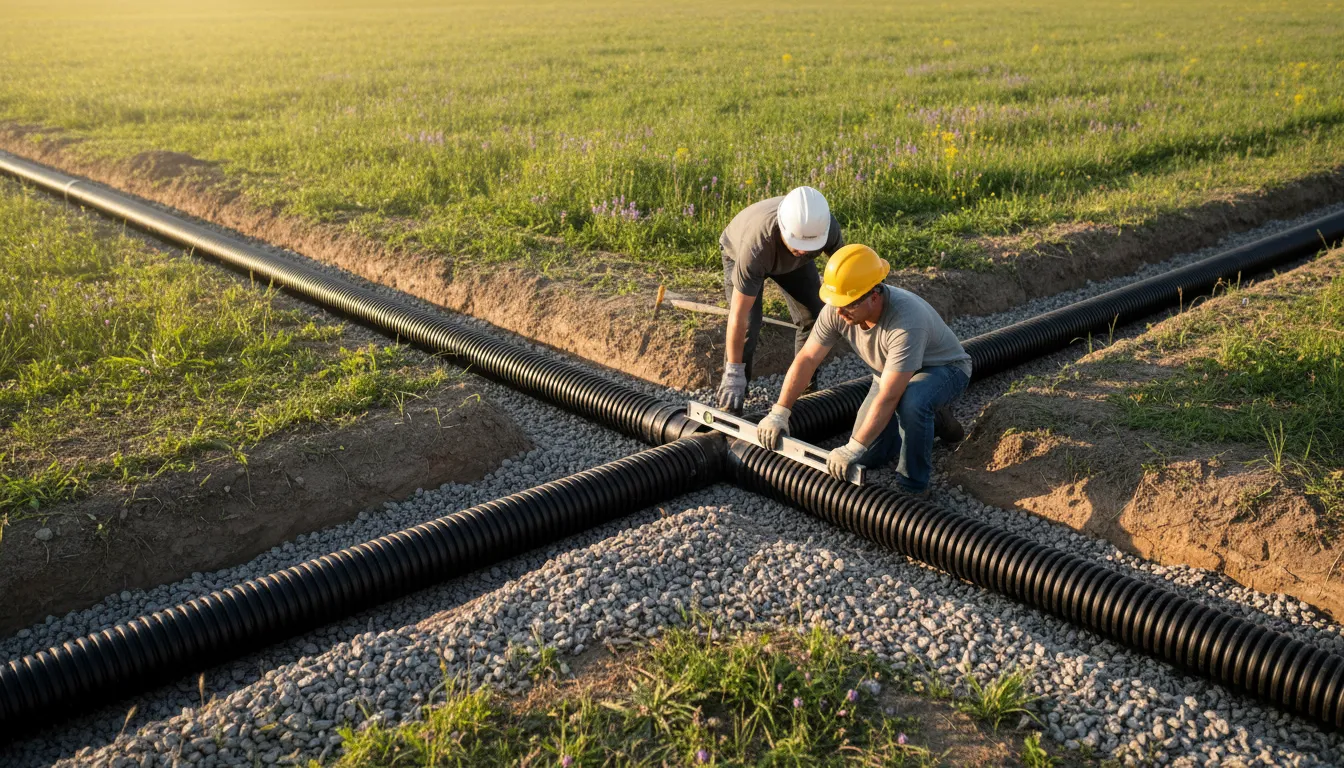
The drain field is a network of perforated pipes buried in gravel-filled trenches. When this area fails, signs become apparent. Recognizing these symptoms early can prevent more extensive damage and higher repair costs.
Signs You Need Drain Field Repair or Replacement
How do you know if your drain field is failing? Look for these common warning signs:
- Sewage Backups: The most alarming sign is sewage backing up into household drains or toilets.
- Slow Drains: Sinks, showers, and tubs that drain very slowly, especially if this is a widespread issue in the home.
- Foul Odors: Persistent sewage smells in your yard, particularly around the drain field area.
- Soggy Lawn: Unusually wet, spongy, or lush green patches of grass directly over the drain field, even during dry weather.
- Standing Water: Puddles of grey, foul-smelling water on the surface above the drain field.
If you notice any of these issues, it's crucial to act quickly. Continuing to use a failing system can create a health hazard and lead to environmental violations.
North Dakota Regulations and Permit Requirements
In North Dakota, all septic system work, including drain field repair and replacement, is regulated by the North Dakota Department of Environmental Quality (NDDEQ) and enforced by your local public health unit. State law (NDCC 23.1-07.1) sets uniform standards for system design and installation to protect public health and water quality 1 2.
The most important rule: you must obtain a permit from your local public health unit before beginning any repair or replacement work on your drain field. This is not a suggestion-it's a legal requirement. The permit process ensures the proposed solution meets state codes for proper sizing, placement, and construction.
The Role of Licensed Professionals
Major repairs or a full drain field replacement must be performed by a licensed sewer contractor. A licensed installer understands the specific soil requirements, trench depth limits (often not exceeding 4 feet), and necessary separations from water tables and wells (typically a minimum of 100 feet from a water well) 3. They will also handle the necessary paperwork and coordinate the required inspections with the local health department, which must inspect the system before it is covered.
Find the perfect drain field repair companies for your needs
Get personalized recommendations and expert advice
The Process: From Failure to Function
Navigating a drain field project involves several key steps. Following this process ensures a compliant and long-lasting solution.
- Assessment and Diagnosis: Contact a licensed septic contractor to inspect your system. They will perform tests, often including a "perc" (percolation) test on your soil, to determine the exact cause of failure and the best course of action.
- Design and Permit Application: Your contractor will design a repair or replacement system that complies with NDDEQ standards. They, or you as the homeowner, will submit the design and a permit application to the local health unit for approval 4 5.
- Excavation and Installation: Once the permit is issued, the contractor will excavate the old drain field (if necessary) and install the new system. This may involve creating new trenches, laying gravel and perforated pipe, and installing protective barrier fabric.
- Final Inspection: Before the new drain field is covered with soil, a representative from the local Health Department will inspect the installation to verify it matches the permitted design and meets all code requirements 6.
- Restoration: After passing inspection, the contractor will backfill the trenches and restore your landscape as agreed.
Cost Considerations for Drain Field Work
The cost to address drain field issues in North Dakota varies significantly based on the scope of work, soil conditions, system size, and the type of system required (e.g., standard trench vs. a raised mound system for challenging soils).
- Minor Repairs: Addressing issues like a clogged distribution box, broken pipe, or baffle repair can range from $500 to $1,500 or more.
- Complete Drain Field Replacement: This is a major undertaking. Homeowners can expect costs typically between $3,000 and $10,000+7 8. Factors that increase cost include poor soil percolation (requiring a larger or engineered system), difficult site access, and the need for heavy equipment.
While this is a significant investment, a properly permitted and installed drain field is crucial for your property's value, your family's health, and environmental protection.
Homeowner Responsibilities and Maintenance
As a septic system owner in North Dakota, you are legally responsible for its proper operation, maintenance, and compliance with regulations. Proactive maintenance is the best way to avoid premature drain field failure.
- Regular Pumping: Have your septic tank pumped by a professional typically every 3 to 5 years to prevent solids from flowing into and clogging the drain field 9 10.
- Protect the Drain Field: Never drive, park, or build structures (like sheds or patios) over your drain field. Avoid planting trees nearby, as roots can invade and damage pipes.
- Water Conservation: Spread out water use and fix leaks. Overloading the system with too much water at once can flood the drain field.
- Mind What You Flush: Only human waste and toilet paper should go down the drain. Avoid chemicals, grease, diapers, and wipes (even those labeled "flushable").
- Keep Records: Maintain a file with your system's "as-built" design diagram, all permit records, and receipts for pumping and service work 11 12. This is invaluable for future repairs or if you sell your home.
Frequently asked questions
Sources
Footnotes
-
North Dakota Senate Bill 2267: What You Need to Know - NDOWRA - https://ndowra.org/north-dakota-senate-bill-2267-what-you-need-to-know/ ↩
-
North Dakota Century Code Title 61. Waters § 61-28-04.1 | FindLaw - https://codes.findlaw.com/nd/title-61-waters/nd-cent-code-sect-61-28-04-1/ ↩
-
Florida Well and Septic System Placement Regulations for New Construction (2025 Guide) - https://flengineeringllc.com/florida-well-septic-placement-2025/ ↩
-
Septic System Permit Application - Burleigh County - https://www.burleigh.gov/media/txclqlmr/septic-system-permit-application.pdf ↩
-
NDPDES Permits - North Dakota Department of Environmental Quality - https://deq.nd.gov/WQ/2_NDPDES_Permits/ ↩
-
Septic Systems - https://deq.nd.gov/WQ/2_NDPDES_Permits/7_SepticSystems/Septic.aspx ↩
-
The Ultimate Guide to Replacing a Septic Drain Field - https://www.rciseptic.com/the-ultimate-guide-to-replacing-a-septic-drain-field ↩
-
How Much Does a Leach or Drain Field Replacement Cost? (2026) - https://homeguide.com/costs/drain-leach-field-replacement-cost ↩
-
Individual Home Sewage Treatment Systems - First District Health Unit - https://fdhu.org/wp-content/uploads/2021/06/NDSU-Extension-Service-Individual-Home-Sewage-Treatment-Systems.pdf ↩
-
Frequent Questions on Septic Systems | US EPA - https://www.epa.gov/septic/frequent-questions-septic-systems ↩
-
On-Site Sewage Treatment Systems (OSTS) | City of Grand Forks, ND - https://www.grandforksgov.com/government/city-departments/public-health/environmental-health/on-site-sewage ↩
-
Frequent Questions on Septic Systems | US EPA - https://www.epa.gov/septic/frequent-questions-septic-systems ↩