Find the Best Drain Field Repair Companies for Your Business
No obligation • Fast responses • Nationwide coverage

Why you can trust Septic Spot
Septic Spot is a leading United States resource for understanding and comparing septic services. Our editors review providers using consistent criteria and verify key business details. Listings and scores are independent, and companies cannot pay to influence our content.
Search providers near you
Best Drain Field Repair Companies in Nebraska Ranked
A failing drain field is a serious issue that can threaten your property, health, and the environment. Drain field repair or replacement involves addressing the underground network of perforated pipes and soil that provides the final treatment for wastewater from your septic tank. In Nebraska, this work is strictly regulated and must be performed by certified professionals. This guide explains the critical regulations, processes, and costs involved, helping you understand your responsibilities and how to connect with qualified local experts for your project.
Understanding Your Nebraska Drain Field
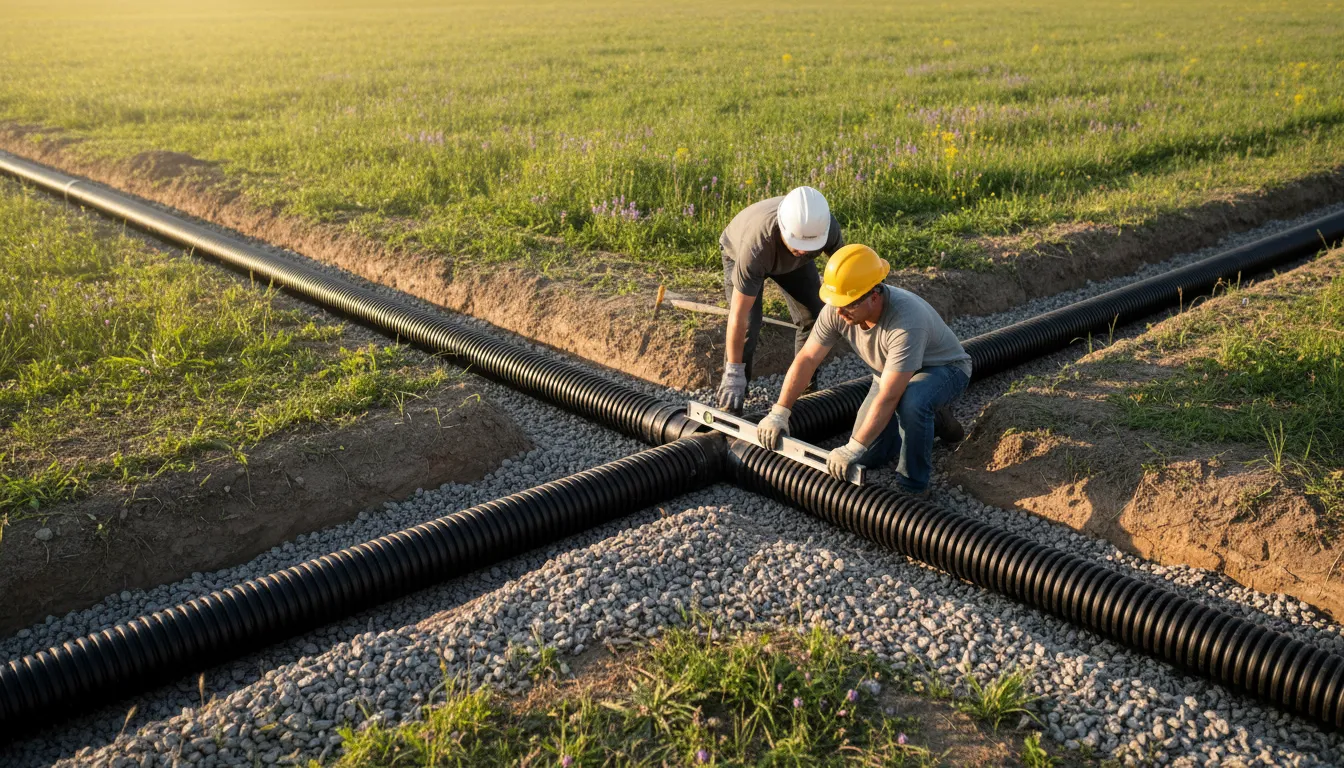
The drain field, also known as a leach field or absorption field, is the most vital and vulnerable component of your onsite wastewater system. After solids settle in the septic tank, liquid effluent flows into a distribution box and out through a series of perforated pipes buried in trenches filled with gravel. This effluent slowly percolates through the soil, where natural processes remove harmful bacteria, viruses, and nutrients before the water rejoins the groundwater.
A properly functioning drain field is essential for protecting Nebraska's groundwater, which is a primary drinking water source for many residents. When a drain field fails, untreated sewage can surface, back up into your home, or contaminate nearby wells and waterways, creating significant public health risks and environmental damage.
Signs of a Failing Drain Field in Nebraska
Recognizing early warning signs can save you from a more costly, full replacement. Contact a certified professional immediately if you notice:
- Sewage Surfacing: Wet, soggy areas or standing water over the drain field, especially with a foul odor.
- Slow Drains & Backups: Toilets, showers, and sinks that drain very slowly or back up, particularly after rainy weather.
- Unusually Green Grass: Patches of grass over the drain field that are much lusher and greener than the rest of the lawn.
- Nitrate Contamination: Test results from your well showing elevated nitrate levels, which can indicate septic system effluent.
In Nebraska, a system is officially considered "failed" if it causes surfacing sewage, contamination of groundwater or surface water, or is not maintained according to state standards.
Nebraska Regulations: Permits and Professional Certification
All septic system work in Nebraska is governed by the Nebraska Department of Environment and Energy (NDEE) under Title 124 regulations. You cannot legally repair or replace your drain field without following these rules.
Certification is Mandatory: Any inspection, repair, alteration, or installation of a septic system component must be performed by a professional certified by the NDEE 1. This includes:
- Master Installers
- Inspectors
- Soil Evaluators
Hiring a certified pro ensures the work meets state code, protects your investment, and safeguards public health. Always verify a contractor's NDEE certification before starting any work.
Permits Are Required: For most drain field repairs or replacements-especially those that alter the system's size, location, or design-you must obtain a permit. The process typically involves:
- Site Evaluation: A certified Soil Evaluator assesses your property's soil type, percolation rate, and topography.
- System Design: A certified professional designs a system that complies with NDEE standards based on the evaluation.
- Permit Application: Your professional submits the design and application, along with the required fee, to the NDEE or your local county health department. Some counties, like Lancaster, have additional or stricter requirements 2 3.
- Approval & Installation: Once the permit is issued, the certified installer can begin work.
State Permit Fees: The NDEE charges a $140 registration fee for system construction or modification permits. Late submissions incur significant penalties: $150 if 46-90 days late, and $450 if more than 90 days late 4 5.
The Drain Field Repair & Replacement Process
The specific course of action depends on the cause and extent of the failure. A certified inspector will diagnose the problem to determine the best solution.
Common Repair Options
- Jet Cleaning: High-pressure water can clear minor clogs in drain field pipes.
- Lateral Line Repair: If only one section of the drain field is damaged, it may be possible to replace just those trenches.
- Adding a New Field (Alternating System): In some cases, a new drain field can be installed adjacent to the old one. The system is then alternated between the two fields, allowing the original field to "rest" and recover.
Complete Drain Field Replacement
If the soil is permanently clogged (a condition called biomat saturation) or the system is undersized, a full replacement is often necessary. This is a major project that involves:
- Excavation: Heavy equipment removes the old gravel and pipes.
- Soil Evaluation & System Design: A new percolation test is performed. Trenches must be designed for soils with a percolation rate between 5 and 60 minutes per inch. Faster or slower soils require engineered solutions like lined fields or pressure distribution.
- Tank Inspection: State regulations often require inspecting and possibly replacing the existing septic tank during a major repair to ensure it is watertight. Old metal or concrete block tanks typically must be upgraded 6 7.
- New Installation: New perforated pipes are laid in gravel-filled trenches according to the permitted design, maintaining required setbacks (typically 100 feet from wells and surface water) 8 9.
- Final Inspection: The certified installer contacts the permitting authority for a final inspection before the system is covered.
Find the perfect drain field repair companies for your needs
Get personalized recommendations and expert advice
Cost Factors for Drain Field Work in Nebraska
Costs vary widely based on the scope of work, soil conditions, and system size. Simple jet cleaning may cost a few hundred dollars, while a complete drain field replacement is a significant investment.
- Major Factor: Soil & Site Conditions. Difficult soils (e.g., heavy clay or fast-draining sand) require more complex, engineered systems, increasing costs substantially 10.
- Permit & Design Fees: Include the $140 state fee plus potential local fees and the cost for the required soil evaluation and system design.
- Excavation & Labor: The largest portion of cost for a replacement, dependent on accessibility and depth.
- Materials: Includes gravel, pipe, distribution boxes, and possibly a new septic tank.
- Restoration: Landscaping and reseeding the yard after construction.
While specific prices aren't listed in state documents, homeowners should be prepared for repair costs to range from several thousand dollars for significant repairs to $10,000 or more for a full engineered drain field replacement. Always get detailed, written estimates from multiple certified professionals.
Homeowner Responsibilities and Maintenance
As a Nebraska homeowner with a septic system, you are legally responsible for all operation, maintenance, and repair costs 11. Preventing drain field failure starts with proper care:
- Conserve Water: Excessive water flow is a leading cause of failure. Fix leaks, spread out laundry loads, and install water-efficient fixtures.
- Mind What You Flush: Never flush grease, oil, coffee grounds, diapers, wipes (even "flushable" ones), or chemicals. These can clog the drain field.
- Protect the Area: Never drive or park vehicles over the drain field, and avoid planting trees nearby whose roots can invade pipes.
- Regular Inspections & Pumping: Have your septic tank pumped regularly (typically every 3-5 years) by a certified professional and consider periodic inspections of the entire system to catch problems early 12.
Finding and Working with a Certified Professional
Start your search by contacting the NDEE Onsite Wastewater Program or your local county health department for lists of certified professionals in your area. When interviewing contractors:
- Ask for proof of their current NDEE certification (Master Installer, etc.).
- Request references from recent, similar jobs.
- Ensure they will handle the entire permit process.
- Get a detailed, written contract outlining the work scope, timeline, costs, and warranties.
Frequently asked questions
Sources
Footnotes
-
Onsite Wastewater Treatment Facilities: Just for Homeowners - https://dee.nebraska.gov/water/surface-water/wastewater/just-homeowners ↩
-
regulating on-site wastewater treatment systems - Lancaster.ne.gov - https://www.lancaster.ne.gov/DocumentCenter/View/1829/R-15-0004-PDF ↩
-
Source - Nebraska Legislature - https://nebraskalegislature.gov/laws/statutes.php?statute=81-15,248 ↩
-
Onsite Wastewater Fees, Certifications, & Permits | NDEE NE - https://dee.nebraska.gov/water-quality/wastewater/onsite-wastewater-program/professional-certification/onsite-wastewater-fees-certifications-permits ↩
-
EC01-798 Residential On-site Wastewater Treatment: An Overview - https://digitalcommons.unl.edu/cgi/viewcontent.cgi?article=2400&context=extensionhist ↩
-
All About NDEE: Onsite Septic Systems - https://dee.nebraska.gov/news-events/press-releases/all-about-dwee-onsite-septic-systems ↩
-
12-036 Septic and Holding Tank Fact Sheet. ... - https://dee.nebraska.gov/sites/default/files/publications/12-036%20Septic%20and%20Holding%20Tank%20Fact%20Sheet.pdf ↩
-
PRIVATE ONSITE WASTEWATER TREATMENT FACILIITY ... - https://dee.nebraska.gov/sites/default/files/publications/22-060-GTS220000-Traditional-System.pdf ↩
-
Residential Onsite Wastewater Treatment: Traditional Drainfields for ... - https://extensionpubs.unl.edu/publication/g1479/na/pdf/view ↩
-
Traditional Drainfields for Effluent Treatment - https://extensionpubs.unl.edu/publication/235/html/view ↩
-
Frequent Questions on Septic Systems | US EPA - https://www.epa.gov/septic/frequent-questions-septic-systems ↩
-
Septic Tank and Drainfield Maintenance - https://extensionpublications.unl.edu/assets/html/g1424/build/g1424.htm ↩