Find the Best Septic System Repair Companies for Your Business
No obligation • Fast responses • Nationwide coverage

Why you can trust Septic Spot
Septic Spot is a leading United States resource for understanding and comparing septic services. Our editors review providers using consistent criteria and verify key business details. Listings and scores are independent, and companies cannot pay to influence our content.
Search providers near you
Top Septic System Repair Companies in Spanish Fork, Utah Ranked
A properly functioning septic system is essential for protecting your home's plumbing, your property value, and the local environment in Spanish Fork. When your onsite wastewater system fails, it requires prompt, professional repair to comply with strict Utah County and state health regulations. This guide explains the common types of septic repairs, the local permitting process, and how to find certified professionals to restore your system to safe operation.

Understanding Septic System Failures
A septic system failure is more than just a slow drain; it's a public health concern. In Spanish Fork, a malfunctioning system that causes sewage to surface, back up into your home, or create a nuisance odor must be abated immediately by law 1. Failures often stem from a lack of regular maintenance, age, soil saturation, or physical damage to system components. Recognizing early signs-like soggy ground or unusually lush grass over the drain field, slow drains, gurgling pipes, or sewage odors-can help you address problems before they become emergencies and require more extensive, costly fixes.
The Regulatory Landscape: Utah County and State Rules
All septic system repair work in Spanish Fork is governed by regulations from the Utah County Health Department and the Utah Department of Environmental Quality (UDEQ) 2. A core rule is that any repair, alteration, or replacement of a septic system requires a permit from the Health Department before work begins 3. Furthermore, the actual repair work must be performed by a state-certified professional; homeowners are not permitted to conduct their own repairs. This ensures that repairs meet strict design and public health standards.
Another critical regulation involves public sewer availability. If a public sewer line becomes available within 300 feet of your property line, you are generally required to connect to it within a specified timeframe, abandoning your septic system 4. It is also unlawful to maintain a system that is not operating as designed, emphasizing the importance of timely, professional intervention when problems arise 5 6.
The Step-by-Step Repair Process
A professional septic repair follows a structured process to diagnose and fix the issue correctly.
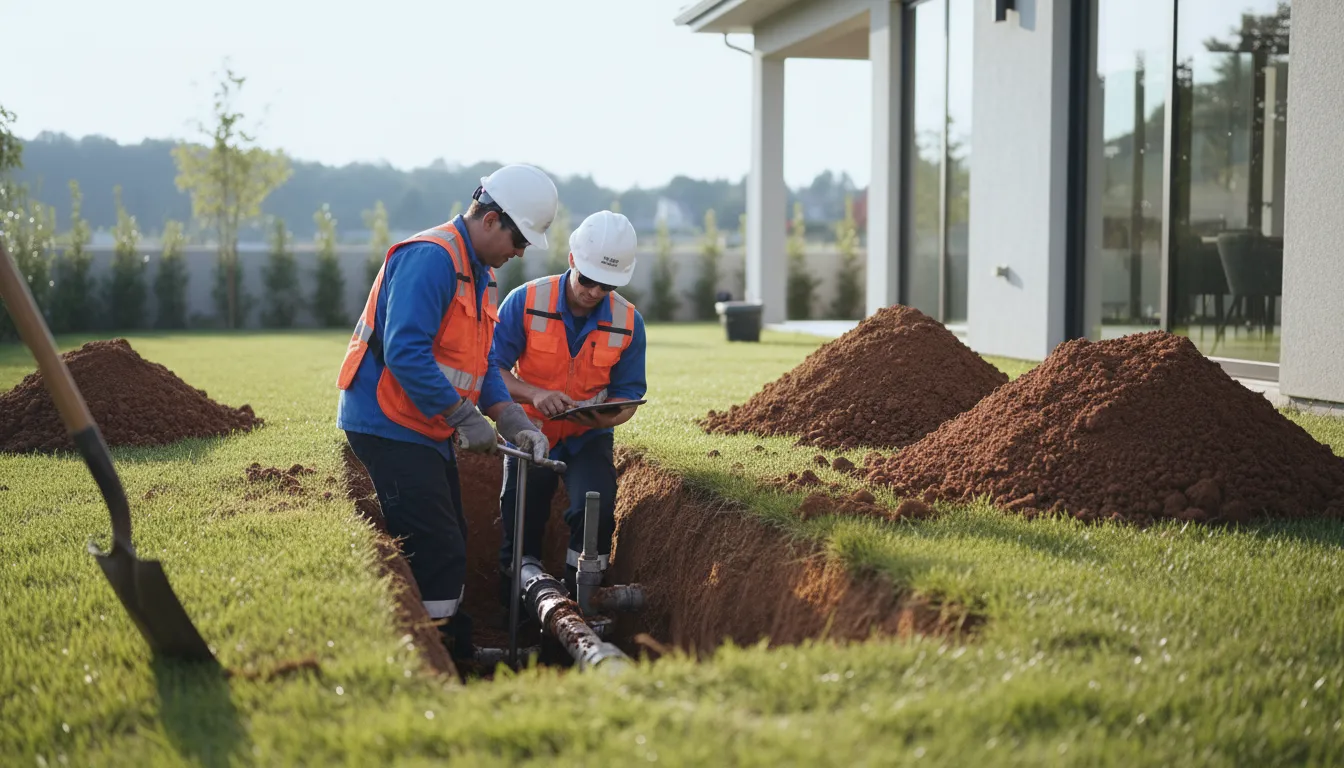
- System Location & Access: The technician will first locate your tank and drain field, often using property records or by probing for sunken areas or tank lids. They will then excavate to expose the manhole covers for inspection.
- Tank Pumping & Inspection: A state-certified technician must pump out the tank to properly examine the interior. They will check for cracks, assess the water level, and inspect critical components like the inlet and outlet baffles.
- Comprehensive Diagnosis: The entire system is evaluated. This includes inspecting the distribution box (if present) and assessing the drain field for signs of failure, such as saturated soil or surfacing effluent 7.
- Permitting & Repair Execution: Once the problem is identified, your contractor will obtain the necessary repair permit from the Health Department. The certified repair work is then performed.
- Final Inspection: Before the repaired system can be backfilled and put back into use, a final inspection by the health department is mandatory to ensure the work complies with all codes.
Common Types of Septic Repairs in Spanish Fork
The scope of your septic repair can vary widely based on the diagnosis. Here are the most common services performed by local professionals:
- Pumping and Line Cleaning: For minor issues like clogs in the inlet or outlet pipes, a thorough pumping and jetting of the lines may be all that's needed to restore flow.
- Riser Installation: Adding watertight risers that bring the tank access lids up to ground level is a common upgrade. This makes future pumping, inspection, and minor repairs much easier and less costly 8.
- Baffle Replacement: The concrete or plastic baffles in your tank prevent solids from escaping into the drain field. If they are broken or deteriorated, they must be replaced to prevent premature drain field failure 9.
- Drain Field (Leach Field) Repair: This is often the most complex and expensive repair. Options can include repairing or replacing collapsed pipes, using additives to temporarily restore soil permeability, or installing a completely new drain field line 10.
- System Upgrade or Replacement: If a conventional drain field cannot function on your property due to soil conditions or space constraints, the repair may involve installing an advanced treatment system. These can include mound systems, sand filters, or aerobic treatment units (ATUs) that provide higher levels of treatment before effluent is dispersed 11.
Find the perfect septic system repair companies for your needs
Get personalized recommendations and expert advice
What to Expect: Costs and Financial Considerations
Repair costs depend entirely on the problem's severity. Routine maintenance like pumping and inspection typically ranges from $250 to $500 12. Minor repairs, such as replacing baffles or installing risers, often cost in the hundreds of dollars. Major repairs, particularly those involving the drain field, can run into the thousands or even tens of thousands of dollars, as they may require heavy equipment, new piping, and significant excavation.
Be aware that the Health Department charges fees for permit reviews and re-inspections, which can be around $93 or more 13. On a helpful note, Spanish Fork City has a specific "Sewer Backup No-Fault Assistance" policy. In instances where a city sewer main issue causes backup damage to a private septic system, the city may provide financial assistance (up to $4,000 for cleanup and $3,500 for repair) 14. Always check with the city's Public Works department to see if your situation qualifies.
Choosing a Certified Repair Professional
Selecting the right contractor is crucial. Always verify that the company or individual holds current wastewater system certification from the state of Utah 15. They should be familiar with local Utah County Health Department procedures and willing to pull all required permits on your behalf. Ask for references, proof of insurance, and a detailed written estimate that outlines the diagnostic process, the proposed repair solution, and all costs. A reputable professional will also discuss long-term maintenance plans to help prevent future failures.
Maintaining Your System Post-Repair
After a successful repair, protecting your investment through proper maintenance is key. This includes having the tank pumped regularly (typically every 3-5 years, but follow your professional's advice), conserving water to avoid overloading the system, and avoiding flushing harmful chemicals or non-biodegradable materials. A well-maintained system can last for decades, making routine care far more economical than emergency repairs.
Frequently asked questions
Sources
Footnotes
-
TriCounty Health Department TCHD-WW-0317 Wastewater Regulation - https://www.utah.gov/pmn/files/938461.pdf ↩
-
Utah County Code 10-1 - CHAPTER 10. HEALTH - https://www.utahcounty.gov/apps/WebLink/Dept/ATTY/Chap10_7.pdf ↩
-
Chapter 13.35 SEPTIC AND WASTEWATER DISPOSAL ... - https://www.codepublishing.com/UT/EagleMountain/html/EagleMountain13/EagleMountain1335.html ↩
-
17.36.170: REPAIR OR REPLACEMENT OF SEWERS - https://codelibrary.amlegal.com/codes/saltlakecityut/latest/saltlakecity_ut/0-0-0-58784 ↩
-
Septic Systems - Southwest Utah Public Health Department - https://swuhealth.gov/septic-systems/ ↩
-
Onsite Wastewater Regulation - https://seuhealth.gov/wp-content/uploads/2024/01/Onsite-Wastewater-Regulation-2021.pdf ↩
-
Can You Dig a Septic System Yourself in Utah? - https://www.mwranches.com/blog/can-you-dig-a-septic-system-yourself-in-utah ↩
-
HEALTH REGULATION #12 WASTEWATER DISPOSAL - Utah.gov - https://www.utah.gov/pmn/files/880427.pdf ↩
-
THE BEST 10 SEPTIC SERVICES in UTAH COUNTY, UT - Yelp - https://m.yelp.com/search?cflt=septicservices&find_loc=Utah+County%2C+UT ↩
-
R317-4, Onsite Wastewater Systems - Utah Administrative Rules - https://rules.utah.gov/publicat/code/r317/r317-004.htm ↩
-
Utah Admin. Code R317-4-6 - Design Requirements - https://www.law.cornell.edu/regulations/utah/Utah-Admin-Code-R317-4-6 ↩
-
Homeowners Guide to Septic Systems Brochure - Alpine, UT - https://www.alpineut.gov/DocumentCenter/View/136/Private-Septic-System-Care-PDF ↩
-
SEPTIC SYSTEM APPLICATION CHECKLIST v03-2023 - https://swuhealth.org/wp-content/uploads/2023/03/SEPTIC-SYSTEM-APPLICATION-CHECKLIST_2023-03.pdf ↩
-
Sewer Backup No-Fault Assistance - Spanish Fork City - https://www.spanishfork.gov/document_center/Ordinances-Resolutions/2015/RES%2015-11%20Changing%20the%20Sewer%20Backup%20No%20Fault%20Assistance%20Policy.pdf ↩
-
Wastewater Certification Permit Guide - Utah Department of ... - https://deq.utah.gov/permits/permit-guide/wastewater-certification-permit-guide ↩