Find the Best Septic Tank Inspection Companies for Your Business
No obligation • Fast responses • Nationwide coverage

Why you can trust Septic Spot
Septic Spot is a leading United States resource for understanding and comparing septic services. Our editors review providers using consistent criteria and verify key business details. Listings and scores are independent, and companies cannot pay to influence our content.
Search providers near you
Best Septic Tank Inspection Companies in Wyoming Ranked
A septic system inspection is a critical evaluation of your onsite wastewater treatment system's components and overall health. In Wyoming, where many homes rely on these private systems, regular inspections are not just a good idea-they are often a regulatory requirement to protect public health and the state's groundwater. This process helps identify potential failures early, saving you from costly emergency repairs and environmental contamination. You can use this guide to understand the requirements, process, and benefits of professional septic inspections to find qualified local specialists who can ensure your system operates safely and efficiently.
Why Septic Inspections Are Essential in Wyoming
Wyoming's vast landscapes mean many residences are beyond municipal sewer lines, making septic systems a common necessity. These systems treat household wastewater on your property. An inspection is the primary tool for assessing whether this treatment is happening correctly. Without regular check-ups, hidden problems like clogs, leaks, or a failing drainfield can lead to sewage backing up into your home or surfacing in your yard, creating health hazards and environmental damage. Proactive inspections are far more economical than reacting to a full system failure.
State and county regulations, enforced by the Wyoming Department of Environmental Quality (DEQ) and local planning departments, mandate that systems be inspected by professionals every 1 to 3 years. This frequency ensures compliance with permits and helps maintain the long-term viability of your property's wastewater management.
Understanding Wyoming's Regulatory Framework
Septic system oversight in Wyoming is a shared responsibility between state and county authorities. The Wyoming DEQ establishes the minimum standards through its Chapter 25 rules, which govern the design, installation, and maintenance of small wastewater systems (those treating less than 2,000 gallons per day).
Key State-Level Requirements:
- Permits: A permit is required for all new installations, repairs, or replacements of a septic system 1. You cannot legally begin this work without county approval.
- Design Standards: Systems must be built to code, including requirements that access openings (risers) for inspection be at least 20 inches in diameter and terminate no more than 6 inches below the ground surface to allow for easy access 2.
- Tank Sizing: For residential use, a minimum 1,000-gallon tank is required for homes with up to four bedrooms, with an additional 150 gallons needed for each extra bedroom.
County-Level Implementation: Permitting and enforcement are handled at the county level. This means you will work directly with your local county planning department (e.g., Fremont County, Johnson County, Campbell County) to submit your Small Wastewater Facility Application and obtain necessary approvals 3 4. Always check with your local county office before starting any project, as some local requirements may be more stringent than state minimums.
What a Professional Inspection Involves
A comprehensive septic system evaluation goes beyond just looking at the tank. A qualified inspector will perform a series of checks to give you a complete picture of your system's health.
Standard Inspection Components:
- Locating & Accessing the System: The inspector will locate the tank and drainfield, often using county records and probing tools.
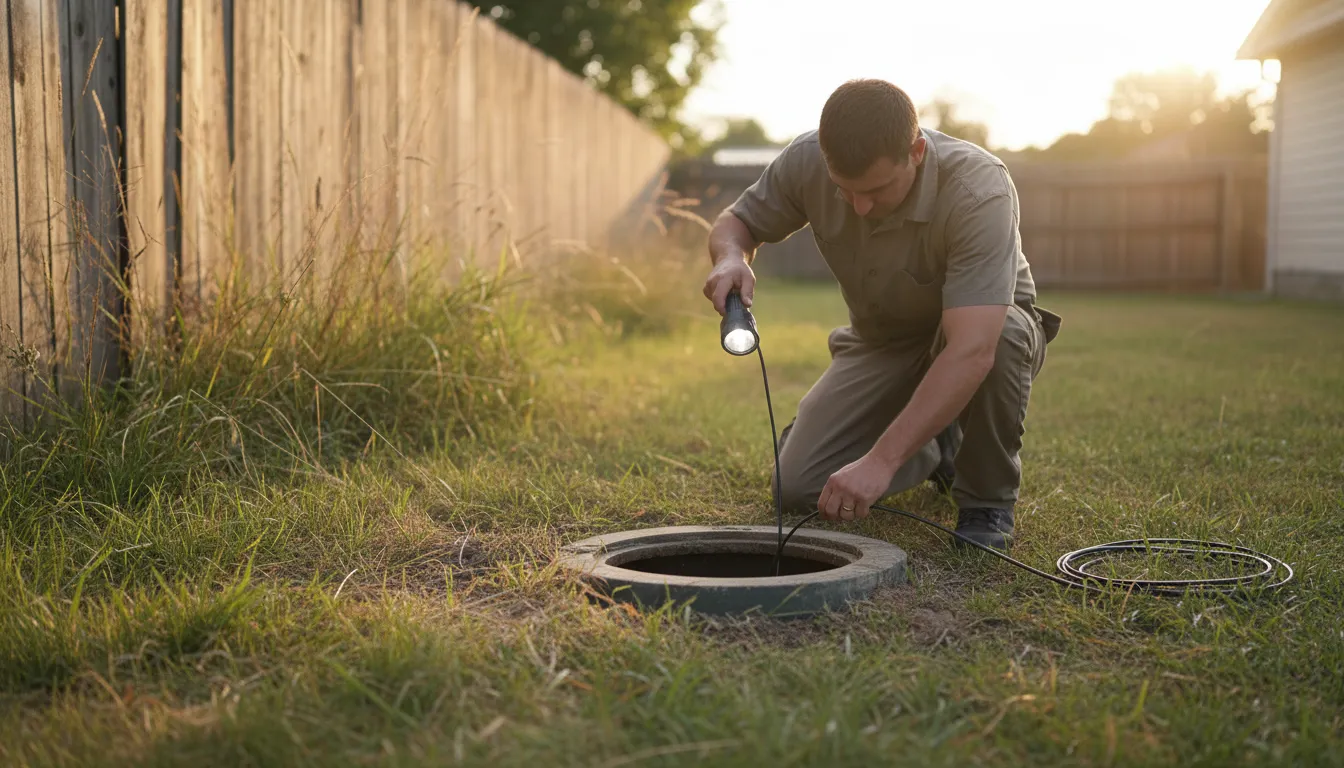
- Tank Inspection: This is the core of the service. The inspector will open the access ports (manholes and inspection pipes) to:
- Measure the levels of sludge (solid waste at the bottom) and scum (floating fats and greases). These measurements determine if pumping is needed.
- Inspect the baffles or tees (inlet and outlet devices) for damage or blockages.
- Check the tank's structural integrity for cracks, leaks, or signs of corrosion.
- Drainfield Assessment: The inspector will examine the soil absorption area (drainfield) for signs of failure, such as soggy ground, foul odors, or surfacing sewage 5.
- Component Check: All mechanical parts, including pumps, alarms, and distribution boxes, are tested for proper operation.
- Reporting: You should receive a detailed report outlining the findings, any issues discovered, and recommended actions (such as pumping or repairs).
Find the perfect septic tank inspection companies for your needs
Get personalized recommendations and expert advice
Inspection Frequency and Pumping Schedule
Adhering to a regular maintenance schedule is the best way to extend the life of your septic system, often for decades.
- Inspection Frequency: The EPA and Wyoming guidelines recommend having your system inspected at least every three years 6. However, systems with electrical components (like pumps or aerators) or those under heavier use may require annual inspections 6. Wyoming's regulatory guidance specifically notes systems should be inspected by professionals every 1-3 years.
- Pumping Frequency: Pumping is needed when solids fill the tank to a certain level, which is typically every 3 to 5 years for an average household 7. The exact interval depends on your tank size, the number of people in your home, and your water usage habits. Never wait until you have a problem to pump; it is a routine part of ownership.
Costs Associated with Septic Inspections in Wyoming
The cost of a septic inspection in Wyoming can vary based on the system's complexity, its accessibility, and the extent of the evaluation.
- Full System Inspection & Permit Fee: For a comprehensive inspection that often satisfies permit or property transfer requirements, costs are frequently around $375.
- Partial Inspection or Site Visit: A simpler check or site evaluation may cost approximately $65 per trip 8.
- Additional Factors: These base costs can increase if the inspection requires the inspector to excavate to uncover buried tank lids, or if the inspection reveals an immediate need for pumping, which is a separate service with its own cost.
Recognizing Signs of Septic System Trouble
Between professional inspections, be vigilant for warning signs that indicate a potential problem. Early detection can prevent a minor issue from becoming a major failure.
Common red flags include:
- Slow drains or gurgling sounds in household plumbing.
- Sewage backups in toilets, showers, or sinks.
- Wet, spongy, or bright green grass over the drainfield, especially during dry weather.
- Standing water or foul odors near the septic tank or drainfield area 9 10.
- Alarms from pump or treatment system control panels.
If you notice any of these signs, contact a septic professional promptly for an assessment.
The Importance of Proper System Care
Your daily habits directly impact your septic system's performance. Good practices include:
- Conserving water to avoid hydraulically overloading the system.
- Avoiding flushing anything besides human waste and toilet paper (no wipes, feminine products, grease, or chemicals).
- Keeping heavy vehicles and structures off the drainfield area.
- Directing rainwater drainage from roofs and driveways away from the septic system.
Following these guidelines, along with scheduling regular professional inspections and pumping, is the most effective strategy for protecting your investment and your environment 11 12.
Frequently asked questions
Sources
Footnotes
-
Small Wastewater Systems - Wyoming Department of Environmental Quality - https://deq.wyoming.gov/water-quality/water-wastewater/permitting/small-wastewater-systems/ ↩
-
Wyoming Administrative Code, Chapter 25, Section 25-10 - Septic ... - https://regulations.justia.com/states/wyoming/agency-020/sub-agency-0011/chapter-25/section-25-10/ ↩
-
Wastewater Management - Welcome to Fremont County, WY - https://fremontcountywy.org/government/departments/planning_department/wastewater_management.php ↩
-
Septic System Permitting | Departments | Johnson County Wyoming - https://www.johnsoncowy.gov/departments/septic-system-permitting ↩
-
Presented by - washakie county conservation district - https://www.washakiecd.com/uploads/4/6/2/9/46293003/septic_system_manual.pdf ↩
-
Frequent Questions on Septic Systems | US EPA - https://www.epa.gov/septic/frequent-questions-septic-systems ↩ ↩2
-
Septic Systems - Land Planning - https://www.bighorncountywy.gov/departments/land-planning/septic-feasibility ↩
-
SMALL WASTEWATER FACILITY APPLICATION PACKET - https://clcpublichealth.org/wp-content/uploads/2023/09/Residential-Small-Wastewater-System-Information-Packet-2022.pdf ↩
-
Septic Systems - Wyoming, MN - https://www.wyomingmn.org/septicsystems ↩
-
020-25 Wyo. Code R. §§ 25-10 - Septic Tanks and Other Treatment Tanks - https://www.law.cornell.edu/regulations/wyoming/020-25-Wyo-Code-R-SS-25-10 ↩
-
How to Care for Your Septic System | US EPA - https://www.epa.gov/septic/how-care-your-septic-system ↩
-
Understanding and Maintaining Your Septic System - https://www.uwyo.edu/barnbackyard/_files/documents/magazine/2012guide/0712guideseptic.pdf ↩