Find the Best Septic Tank Installation & Replacement Contractors for Your Business
No obligation • Fast responses • Nationwide coverage

Why you can trust Septic Spot
Septic Spot is a leading United States resource for understanding and comparing septic services. Our editors review providers using consistent criteria and verify key business details. Listings and scores are independent, and companies cannot pay to influence our content.
Search providers near you
Best Septic Tank Installation & Replacement Contractors in South Dakota Ranked
Installing or replacing a septic system is a significant investment in your property's long-term functionality and value. In South Dakota, this process is governed by specific state and local regulations designed to protect public health and the environment. This guide provides a clear overview of the steps, rules, and costs involved in septic system work in South Dakota, helping you understand what to expect and how to find qualified local professionals to ensure your project is completed correctly and legally.
Understanding South Dakota's Regulatory Framework
All new septic system installations and major replacements in South Dakota must comply with the state's Administrative Rules, specifically 74:53:01. The South Dakota Department of Agriculture and Natural Resources (DANR) provides oversight, but the permitting and enforcement are typically handled at the county level by local planning or environmental health departments 1. This means while state rules set the minimum standards, your specific county may have additional requirements or procedures.
A cornerstone of the regulatory process is the requirement for professional design. Your septic system must be designed by a South Dakota licensed professional engineer or another qualified professional approved by the local authority 2. This design is not a suggestion-it's a mandatory blueprint that the certified installer must follow exactly. The installer you hire must also be certified by the state, which involves passing examinations administered by the South Dakota Plumbing Commission 3 4. Never hire an uncertified individual for this work, as it will likely result in permit denial, fines, and an unsafe system.
The Step-by-Step Process: From Plan to Approval
Navigating a septic installation project involves a series of defined steps. Skipping any can lead to costly delays or failures.
1. Site Evaluation and Design Before any digging begins, a thorough site evaluation is required. This involves a soil profile analysis or a percolation ("perc") test to determine the soil's absorption rate and identify the seasonal high-water table. These results are critical for your design professional to engineer a system that will function properly on your specific property. The design will specify the tank size, drainfield type and size, and all other components.
2. Obtaining Permits With a completed design in hand, you or your contractor must apply for a permit through your county's planning or health department 5. The permit application will include the engineered design plans for review. Permit fees in South Dakota generally range from $150 to $500. Work cannot legally commence until the permit is issued.
3. Installation According to Code The certified installer must follow the approved design and state installation rules. Key requirements include:
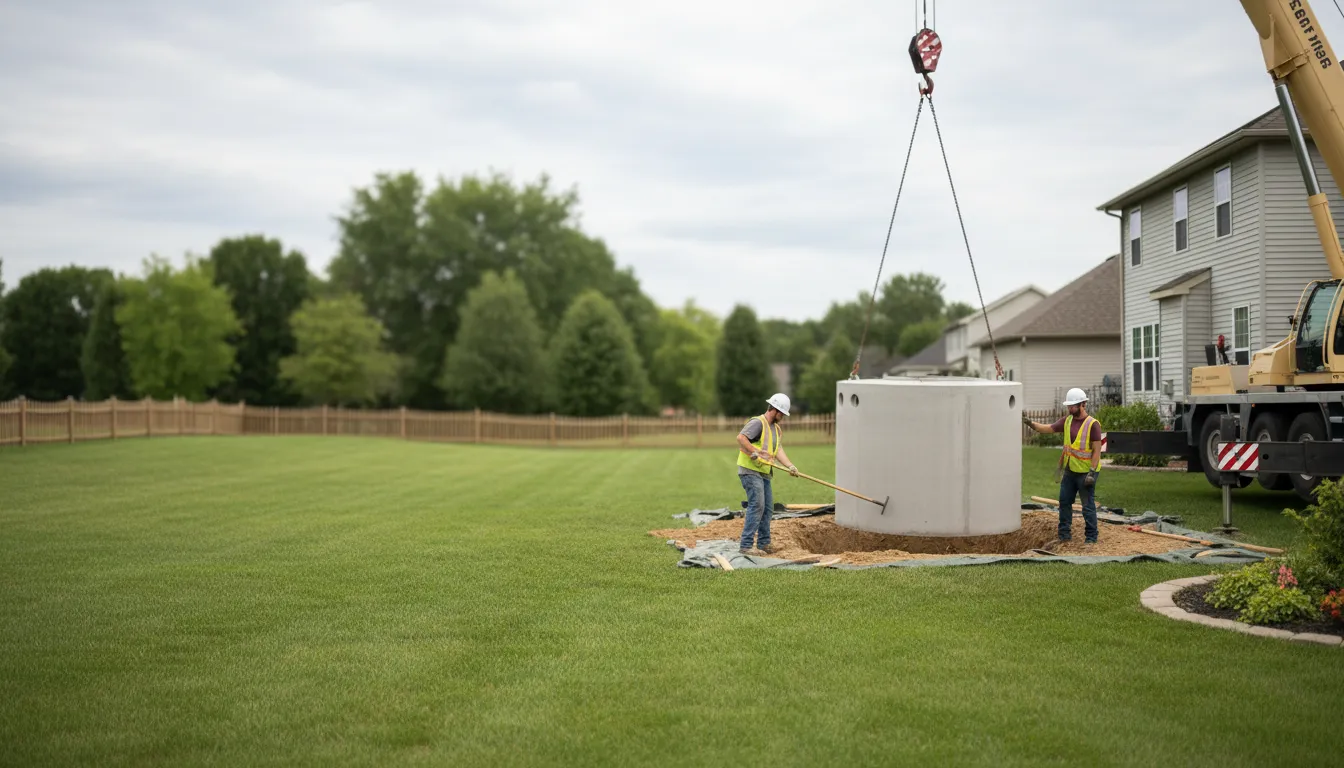
- Tank Placement: Tanks must be set on a solid, level base. Access covers (risers) must be installed and finish between 6 to 12 inches below the final grade for easy service access 6.
- Tank Specifications: All tanks must be watertight. In areas with high groundwater, flotation collars are required to prevent the tank from floating out of the ground.
- System Sizing: Tank capacity must accommodate the estimated daily sewage flow from the home. If a garbage disposal is used, the tank's liquid capacity must be increased by at least 20% 7. For a typical three-bedroom home, this often means a 1,000 to 1,500-gallon tank is required.
- Drainfield Construction: The absorption field (leach field) must be built precisely as designed, based on the soil evaluation.
4. Inspections and Final Approval The design engineer or a county inspector must inspect the installation-typically the excavation, the placed tank, and the finished system-to verify it matches the approved plans 8. After passing inspection, the engineer submits a Post-Installation Report. Finally, a formal letter of approval or compliance is issued for the county records, usually required within 30 days of installation 9. This documentation is crucial for your property file and any future real estate transactions.
Find the perfect septic tank installation & replacement contractors for your needs
Get personalized recommendations and expert advice
System Components and Key Considerations
A standard septic system in South Dakota consists of three primary parts:
- Building Sewer: The pipe that carries wastewater from your home to the septic tank.
- Septic Tank: A buried, watertight container (typically concrete, fiberglass, or polyethylene) where solids settle and begin to decompose. It has an inlet and outlet baffle to separate scum and sludge from the liquid effluent.
- Drainfield: A subsurface system of perforated pipes or chambers in gravel-filled trenches that allows the pre-treated liquid effluent to seep safely into the soil for final treatment and disposal.
When planning your system, consider:
- Tank Material: Concrete is common and durable but heavy. Fiberglass and plastic are lighter and resistant to corrosion but may be more susceptible to damage during installation.
- Alternative Systems: If your soil fails a perc test or space is limited, alternative systems like mound systems, aerobic treatment units (ATUs), or sand filters may be necessary. These are more complex and expensive but can make a challenging site buildable.
- Future Maintenance: Ensure your installer includes accessible risers to the tank lids. This small upfront cost saves significant time and money every time the tank needs to be pumped or inspected.
Cost Breakdown for South Dakota
The total cost for a complete septic system installation or full replacement in South Dakota typically ranges from $5,000 to $15,000, though complex systems or difficult sites can exceed this. This wide range is due to variables like soil conditions, system type, tank material, and local labor rates.
Here's a more detailed look at where the money goes:
- Septic Tank Unit: The tank itself is a major component. For example, a 1,000-gallon concrete tank typically costs between $500 and $900 for just the unit.
- System Upgrades: Increasing tank size adds cost, generally about $50 to $150 per additional 100 gallons of capacity 10.
- Professional Services: This includes the site evaluation/soil testing ($300-$1,000), engineering design ($500-$2,000), and permit fees ($150-$500) 11 12.
- Excavation and Labor: The cost to dig, place the tank, construct the drainfield, and backfill. This is highly dependent on site accessibility and soil type.
- Additional Components: Costs for distribution boxes, gravel, pipe, and other necessary materials.
Remember, while cost is a factor, the quality of the installation is paramount. A poorly installed system can fail within a few years, leading to repair costs that far exceed the price of doing it right the first time.
Maintaining Your New System
Once your new system is installed, proper maintenance is your responsibility. The South Dakota State University Extension recommends having the tank pumped every 3 to 5 years, depending on usage and tank size 13. Avoid pouring grease, chemicals, or non-biodegradable items down the drain. Also, never drive or build over the drainfield. A well-maintained system can last 25 to 30 years or more, protecting your investment and the environment.
Frequently asked questions
Sources
Footnotes
-
South Dakota Feedlot Permit Program - Septic Tank Systems - https://danr.sd.gov/Agriculture/Livestock/FeedlotPermit/Septic/default.aspx ↩
-
Recommended Design Criteria Manual Wastewater Collection ... - https://danr.sd.gov/PlansSpecifications/docs/DesignCriteriaManual.pdf ↩
-
Planning & Zoning - Minnehaha County, South Dakota Official Website - https://www.minnehahacounty.gov/dept/pl/septicSystem/05faqs.php ↩
-
South Dakota Septic License & Certification - ServiceTitan - https://www.servicetitan.com/licensing/septic/south-dakota ↩
-
Septic System Information | Lawrence County, SD - https://www.lawrence.sd.us/214/Septic-System-Information ↩
-
S.D. Admin. R. 74:53:01:24 - Installation requirements for septic tanks | State Regulations - https://www.law.cornell.edu/regulations/south-dakota/ARSD-74-53-01-24 ↩
-
Administrative Rule 74:53:01 | South Dakota Legislature - https://sdlegislature.gov/Rules/Administrative/74:53:01 ↩
-
Septic System Checklist (PDF) - Lawrence County, SD - https://www.lawrence.sd.us/215/Septic-System-Checklist-PDF ↩
-
§ II-9.008 SEPTIC SYSTEM PERMIT PROCESS. - https://codelibrary.amlegal.com/codes/lawrencecounty/latest/lawrencecty_sd_land/0-0-0-2373 ↩
-
Complete Guide: Installing a Septic System from Start to Finish - https://www2.parklanejewelry.com/how-to-put-in-a-septic-system/ ↩
-
Residential Septic Tank Pricing | Homeowner's Guide to Costs - https://www.ntotank.com/blog/residential-septic-tank-pricing ↩
-
Understanding Septic Tank Permits and Regulations - https://westcoastsanitationinc.com/understanding-septic-tank-permits-and-regulations/ ↩
-
Septic System Maintenance - South Dakota State University - https://www.sdstate.edu/sites/default/files/2017-01/ExEx1018.pdf ↩