Find the Best Drain Field Repair Companies for Your Business
No obligation • Fast responses • Nationwide coverage

Why you can trust Septic Spot
Septic Spot is a leading United States resource for understanding and comparing septic services. Our editors review providers using consistent criteria and verify key business details. Listings and scores are independent, and companies cannot pay to influence our content.
Search providers near you
Top Drain Field Repair Companies in Bristol, Connecticut Ranked
A failing drain field is a serious issue for any Bristol homeowner with a septic system. When this critical component stops absorbing wastewater, it can lead to sewage backups, soggy yards, and environmental health hazards. Drain field repair or replacement is a complex, regulated process that requires professional engineering and licensed installation. This guide explains the local requirements, process, and considerations for addressing septic leaching system issues in Bristol, helping you understand the steps to restore your property's wastewater treatment.
Understanding Your Septic System and Drain Field Failure
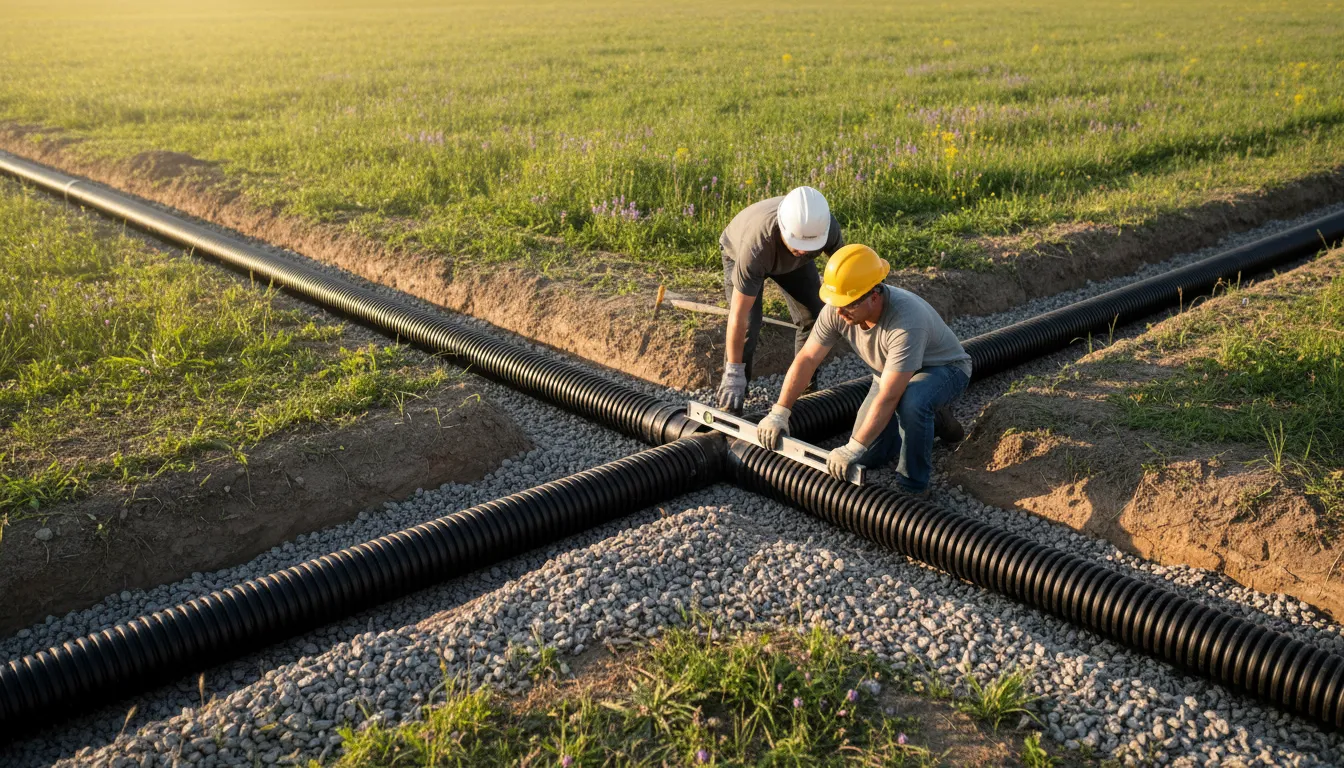
Your septic system is a two-part wastewater treatment plant located on your property. The tank holds solids, while the leach field (or absorption area) is a network of perforated pipes buried in trenches filled with gravel. This area is responsible for dispersing and filtering the liquid effluent into the soil. Failure occurs when the soil becomes clogged or saturated, preventing absorption. Common signs in Bristol include:
- Sewage backing up into household drains.
- Damp, soggy, or spongy soil over the drain field area, even in dry weather.
- Unpleasant odors around the yard or septic tank.
- Unusually green, lush grass over the drain field.
- Slow-draining sinks and toilets.
In Bristol, any system failure-defined as sewage backing up or surfacing-legally requires a permitted repair or full system replacement 1. Ignoring these signs can create a public health nuisance and lead to enforcement action by the local health district.
Bristol's Regulatory Authority: The Bristol-Burlington Health District
All work on subsurface sewage disposal systems in Bristol is regulated and permitted by the Bristol-Burlington Health District (BBHD). The BBHD enforces the Connecticut Public Health Code, specifically Section 19-13-B103 and the 2024 Technical Standards. Their oversight ensures that repairs and replacements protect public health and groundwater quality. Key regulations homeowners must know include:
- Permits Are Mandatory: An "Approval to Construct" permit from BBHD is required before any excavation or work begins. Starting work without a permit can result in stop-work orders and fines.
- Licensed Professionals Only: Only a State of Connecticut licensed septic installer can perform the construction work. Design typically requires a professional engineer or registered sanitarian.
- System Records: The BBHD maintains records (also called "as-builts" or "record drawings") for most homes with septic systems in Bristol. Contacting the BBHD should be your first step to obtain any existing plans for your property 2.
- Building Additions: If you are adding a bedroom, deck, pool, or accessory structure, you must have the project reviewed by BBHD (a B100a review). This ensures the addition does not encroach on the legally required "reserved" area for future septic expansion or repair 3 4.
The Step-by-Step Process for Repair or Replacement
Addressing a failed leaching system is a multi-stage process involving evaluation, design, permitting, and construction.
1. Site Evaluation and Soil Testing
A licensed installer or engineer will evaluate your property. The cornerstone of this evaluation is soil testing, which must be witnessed by a BBHD Sanitarian 5. This typically involves:
- Deep Test Pits: Two pits, dug to at least 10 feet deep, to examine soil layers and determine the seasonal high groundwater table 6.
- Percolation Tests: Measures how quickly water drains through the soil to size the new absorption area 7 8.
The results dictate the system design. Critical code requirements include maintaining at least 18 inches of separation between the bottom of the new leaching system and both the groundwater table and any ledge rock 9. Strict setbacks from property lines, wells, buildings, and water lines must also be met 10.
2. Design and Plan Submission
Based on the soil tests, a design professional creates a repair or replacement plan. For most full replacements, this requires a professional engineer. The plan must identify a "Code-Complying Area" or replacement area on your lot that is suitable for a future system. This plan is then submitted to the BBHD for review.
3. Permit Approval and Pre-Construction
Once BBHD approves the plans, they issue the "Approval to Construct" permit 11. Before digging, you must call 811 for a "Call Before You Dig" (CBYD) utility markout to avoid hitting underground lines 12.
4. Construction and Inspections
The licensed installer executes the plan. The BBHD will conduct a construction inspection while the new drain field is open and before it is backfilled 13. This ensures it's built according to the approved design.
5. Final Approval
After construction, a "record drawing" (as-built) of the installed system is submitted to BBHD. Following a final inspection, BBHD issues a "Permit to Discharge," authorizing the use of the new system 14 15.
Find the perfect drain field repair companies for your needs
Get personalized recommendations and expert advice
Understanding Costs for Drain Field Work in Bristol
Costs for leaching system work vary widely based on soil conditions, system size, site accessibility, and the extent of the failure. The figures below are estimates based on Connecticut averages and should be used as a guideline 16 17 18.
- Permit Fees: Ranging from approximately $460 to $2,770, depending on the scope of the project (e.g., minor repair vs. full replacement).
- Soil Testing & Design: Professional soil testing (perc and deep pits) and engineering design fees can range from $1,500 to $5,000+.
- Leach Field Replacement (Components & Labor): The cost to install a new absorption area typically falls between $3,000 and $15,000+. Complex sites with poor soil or difficult access will be on the higher end.
- Total System Replacement: For a complete septic system (tank and drain field), homeowners in Bristol should budget between $25,000 and $50,000+. Exceptionally difficult sites can exceed this range 19 20.
- Minor Repairs: Addressing issues like a clogged distribution box or replacing inlet/outlet baffles may cost between $600 and $3,000 21 22.
Maintaining Your New or Repaired Drain Field
Protecting your investment is crucial. Proper maintenance can extend the life of your new leaching system for decades.
- Pump Regularly: Have your septic tank pumped every 3-5 years by a licensed pumper. This prevents solids from flowing into and clogging the new drain field 23.
- Protect the Area: Never park vehicles, build sheds, or pave over the drain field. The weight can compact soil and crush pipes. Avoid planting trees or shrubs with deep roots in the area 24 25.
- Conserve Water: Spread out laundry loads and fix leaky fixtures to avoid hydraulically overloading the system.
- Mind What You Flush: Only human waste and toilet paper should go down the drain. Avoid chemicals, grease, wipes, and other non-biodegradables.
Frequently asked questions
Sources
Footnotes
-
Environmental Engineering - Subsurface Sewage - CT.gov - https://portal.ct.gov/dph/environmental-health/environmental-engineering/environmental-engineering----subsurface-sewage ↩
-
Septic and Sewage - Bristol - Burlington Health District - https://bbhd.org/septic-and-sewage/ ↩
-
Public Health Code Regulations 19-13-B100a ... - CT.gov - https://portal.ct.gov/-/media/Departments-and-Agencies/DPH/dph/environmental_health/environmental_engineering/Phase_1_fall_2018/Regulations-Outline-Handout.pdf ↩
-
State of Connecticut Regulation of Department of Public Health ... - https://eregulations.ct.gov/eRegsPortal/Search/getDocument?guid=%7B70603D95-0000-C454-B302-90D8CF431A50%7D ↩
-
Bristol Water and Sewer Department - http://www.bristolwaterdept.org/DocumentCenter/View/42987/Combined-Specifications-1032023 ↩
-
Septic Developers - North Central Distict Health Department - https://www.ncdhd.org/septic-developers ↩
-
Septic and Sewage - Bristol - Burlington Health District - https://bbhd.org/septic-and-sewage/ ↩
-
CONNECTICUT PUBLIC HEALTH CODE On-site Sewage Disposal ... - https://portal.ct.gov/dss/-/media/departments-and-agencies/dph/dph/environmental_health/environmental_engineering/2023-uploads/ts-master-2023-1242023a.pdf?rev=ff2a02fba994441d8db4a5690867a002&hash=2D14379B100C20B1BBAC8FC9835A1FE6 ↩
-
CONNECTICUT PUBLIC HEALTH CODE On-site Sewage Disposal ... - https://portal.ct.gov/-/media/Departments-and-Agencies/DPH/dph/environmental_health/environmental_engineering/2023-uploads/TS-Master-2023-1242023A.pdf ↩
-
Septic Systems Reports, Regulations, Guidance, and Manuals - https://www.epa.gov/septic/septic-systems-reports-regulations-guidance-and-manuals ↩
-
Connecticut Septic Tank Requirements - https://www.ntotank.com/blog/connecticut-septic-tank-requirements ↩
-
SEWER PERMITS | Bristol, CT - Official Website - https://www.bristolct.gov/1217/SEWER-PERMITS ↩
-
Septic Developers - North Central Distict Health Department - https://www.ncdhd.org/septic-developers ↩
-
Septic System Design: What CT Homeowners Need to Know - https://andersonseptic.com/septic-system-design-guide/ ↩
-
19-13-B104c. General provisions - Connecticut eRegulations System - https://eregulations.ct.gov/eRegsPortal/Browse/RCSA/Title_19Subtitle_19-13Section_19-13-b104c/ ↩
-
Subsurface Drainage System 101: A Guide for Homeowners - https://www.bluecollarscholars.net/subsurface-drainage-systems/ ↩
-
How Much Does It Cost to Replace a Septic Tank and Drain Field? - https://www.bobvila.com/articles/cost-to-replace-septic-tank-and-drainfield/ ↩
-
Septic Drain Field Replacement Cost - https://dillonseptic.com/septic-drain-field-replacement-cost/ ↩
-
How Much Does a Septic System & Septic Tank Cost - https://www.nexgenseptics.com/septic-system-cost/ ↩
-
Septic replacement costs? : r/Connecticut - Reddit - https://www.reddit.com/r/Connecticut/comments/1dldqq7/septic_replacement_costs/ ↩
-
How Much Does Septic Tank Repair Cost? [2026 Data] | Angi - https://www.angi.com/articles/how-much-does-repairing-septic-tank-cost.htm ↩
-
How much does septic tank system repair cost? - HomeGuide - https://homeguide.com/costs/septic-tank-repair-cost ↩
-
Operation and Maintenance - CT.gov - https://portal.ct.gov/dph/environmental-health/environmental-engineering/operation-and-maintenance ↩
-
Connecticut Septic Tank Requirements - https://www.ntotank.com/blog/connecticut-septic-tank-requirements ↩
-
SEPTIC SYSTEMS - CT.gov - https://portal.ct.gov/-/media/Departments-and-Agencies/DPH/dph/environmental_health/environmental_engineering/pdf/SepticSystems101pdf.pdf ↩