Find the Best Drain Field Repair Companies for Your Business
No obligation • Fast responses • Nationwide coverage

Why you can trust Septic Spot
Septic Spot is a leading United States resource for understanding and comparing septic services. Our editors review providers using consistent criteria and verify key business details. Listings and scores are independent, and companies cannot pay to influence our content.
Search providers near you
Top Drain Field Repair Companies in Gaithersburg, Maryland Ranked
A failing septic drain field is a serious issue that can lead to unpleasant odors, soggy yards, and environmental contamination. In Gaithersburg, addressing this problem involves navigating specific county and state regulations to ensure the work is done safely and legally. This guide explains the process, costs, and key considerations for drain field restoration, helping you understand what's required to find qualified local professionals for your project.
Understanding Drain Field Failure
A drain field, also known as a leach field or absorption area, is the final stage of a septic system where treated wastewater is dispersed into the soil. When it fails, it can no longer absorb liquid. Common signs include sewage odors in your yard, soggy ground or standing water over the field, slow-draining household fixtures, and unusually green grass over the area 1. In most cases, a failed leach field cannot be repaired and must be completely replaced with a new system in a different location 2. This is because the soil in the original area has become clogged or "biomat-ed" and can no longer properly treat effluent.
The Regulatory Landscape in Montgomery County
All septic system work in Gaithersburg requires permits and strict adherence to codes enforced by the Montgomery County Department of Permitting Services (DPS) and the Maryland Department of the Environment (MDE).
- Permit Mandate: A septic system permit is mandatory for any repair or replacement work. This ensures the project protects public health and meets environmental standards.
- State Standards: Maryland's MDE sets the overall guidelines for onsite wastewater systems, which Montgomery County implements and enforces through its local permit process.
Step-by-Step: The Permit and Installation Process
Navigating the official process is critical. Skipping steps or using an unlicensed installer can result in fines, an unusable system, and problems when selling your home.
1. Initial Evaluation and Soil Testing
Before any application, a site evaluation is necessary. This almost always includes a percolation (perc) test, which measures how quickly water drains through your soil 3. The results determine the soil's absorption rate and dictate the size and type of system required. In Gaithersburg's varied soils, rocky or high-clay conditions may necessitate a more advanced (and costly) treatment system.
2. Applying for the Permit
You or your chosen licensed installer must apply for a permit through the Montgomery County DPS, typically using their online services 4 5. The application includes the site evaluation report, soil test results, and a detailed plan for the new absorption area. Permit fees can range from $450 to $2,000 depending on the project's complexity.
3. Working with a Licensed Professional
Crucially, installation work must be performed by a professional registered with the Maryland Board of On-Site Wastewater Professionals. They will handle much of the permit process and are responsible for building the system to code. A pre-construction meeting with the county inspector and your installer is often required.
4. Installation and Inspections
The new drain field must often be constructed in a new, undisturbed soil location, as the original area is spent. Modern regulations frequently require designating a reserve area-a space set aside for a future drain field-as part of the overall system plan 6. County inspectors will conduct mandatory checks during construction and a final inspection before issuing a certificate of completion 7.
Find the perfect drain field repair companies for your needs
Get personalized recommendations and expert advice
Cost Breakdown for Drain Field Projects
Drain field replacement is a significant investment. Costs in the Gaithersburg area are influenced by soil conditions, system size, and the type of technology needed.
- Full System Replacement: Replacing both the septic tank and drain field typically ranges from $8,000 to over $25,000, with a common range for standard systems being $12,000 to $18,000.
- Drain Field Replacement: If only the leach field needs replacement (and the tank is sound), costs often start around $7,000 but can rise quickly with complexity.
- Percolation Test: Conducting the required soil perc test averages around $1,300.
- Permit Fees: As noted, plan for $450 to $2,000 in county permit fees 8 9.
These figures are estimates; obtaining multiple quotes from licensed installers is essential for an accurate budget.
Choosing the Right System for Your Property
Not all drain fields are the same. The right solution depends on your lot size, soil, and budget.
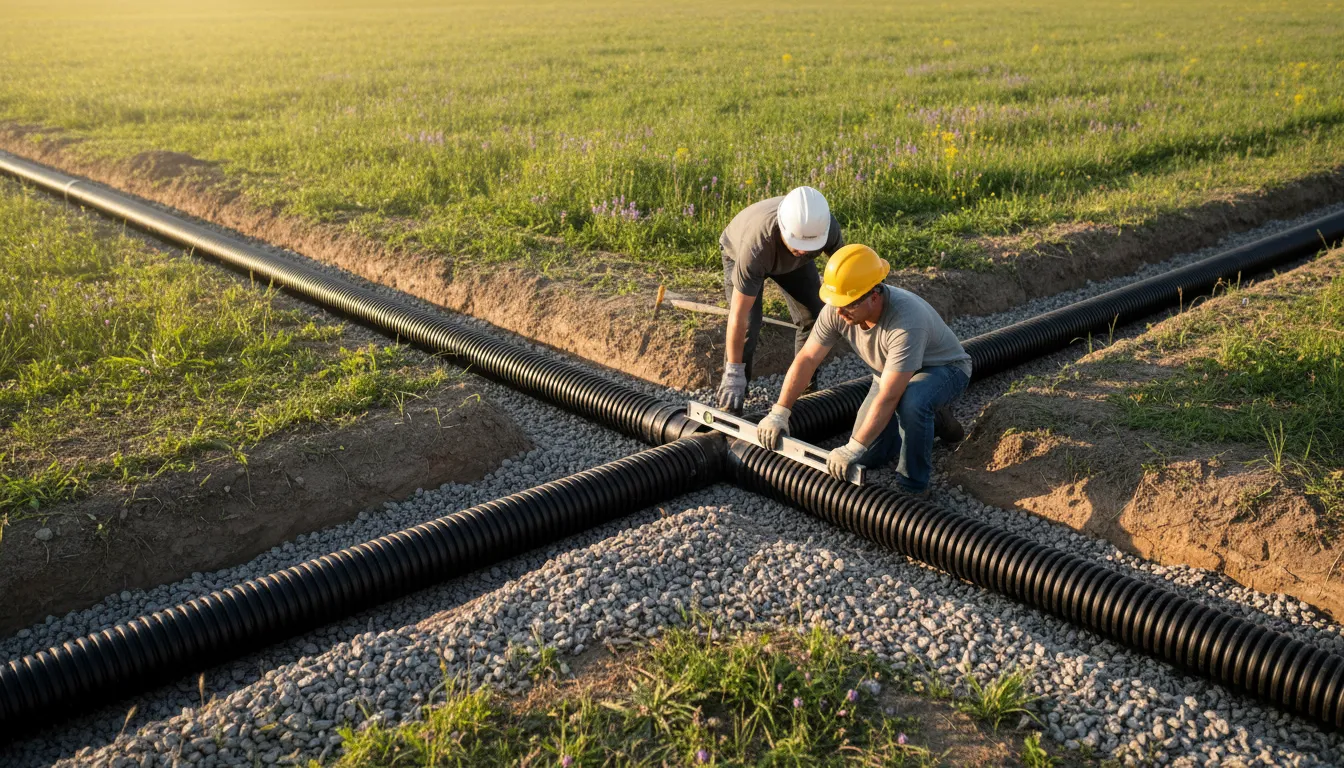
- Conventional Trenches: The most common type, involving a series of gravel-filled trenches. They require suitable soil depth and percolation rates.
- Advanced Treatment Systems: For challenging sites with poor soil, high groundwater, or small lots. These systems provide extra treatment before effluent reaches the drain field and can be more expensive to install and maintain.
- Alternative Technologies: Options like drip irrigation fields or sand mounds may be prescribed based on the site evaluation.
Your licensed installer and the county inspector will help determine the MDE-approved system that fits your property's constraints.
Maintenance: Protecting Your New Investment
Once your new leach field is installed, proper maintenance is key to longevity. This includes regular septic tank pumping (every 3-5 years), conserving water to avoid overloading the system, and never driving or building over the absorption area. Keeping detailed records of inspections, pumping, and the as-built system diagram is also recommended.
Frequently asked questions
Sources
Footnotes
-
10 Signs Your Septic System is Failing (And What to Do About It) - https://www.atsenvironmental.com/blog/10-signs-your-septic-system-is-failing-and-what-to-do-about-it/ ↩
-
Septic System Inspections: What Every Homeowner Needs to ... - https://www.coxenterprisesllc.com/septic-system-inspections-homeowner-guide/ ↩
-
A Guide to Septic Systems and Maintenance - https://mde.maryland.gov/programs/water/BayRestorationFund/OnsiteDisposalSystems/Documents/Onsite%20Systems/Uof%20MD%20Septic%20Records%20and%20Maintenance%20Guidelines.pdf ↩
-
DPS - Septic System Repair Permit Process - Department of Permitting Services - Montgomery County, Maryland - https://www.montgomerycountymd.gov/DPS/Process/ld/septic-repair-permit.html ↩
-
DPS - Septic Permit Process - Montgomery County - https://www.montgomerycountymd.gov/DPS/Process/ld/septic-permit.html ↩
-
Septic Systems, DEP, Montgomery County, MD - https://www.montgomerycountymd.gov/DEP/water/water-supply-wastewater/septic-systems.html ↩
-
Septic System Repair Guidelines - Montgomery County - https://www.montgomerycountymd.gov/DPS/Resources/Files/Land_Development/Guideline_Septic%20System%20Repair.pdf ↩
-
Septic System Replacement Maryland: Signs, Costs & What to Expect (2025) - https://www.coxenterprisesllc.com/septic-system-replacement/ ↩
-
Cost to Replace Septic Tank and Drain Field [2026 Data] | Angi - https://www.angi.com/articles/how-much-new-drain-fields-foot.htm ↩