Find the Best Drain Field Repair Companies for Your Business
No obligation • Fast responses • Nationwide coverage

Why you can trust Septic Spot
Septic Spot is a leading United States resource for understanding and comparing septic services. Our editors review providers using consistent criteria and verify key business details. Listings and scores are independent, and companies cannot pay to influence our content.
Search providers near you
Top Drain Field Repair Companies in Elmhurst, Illinois Ranked
A failing drain field is a serious issue for any home with a septic system, leading to unpleasant odors, soggy yards, and potential health hazards. Drain field repair and replacement involves diagnosing the cause of system failure and installing new absorption lines or a completely new leach field to restore proper wastewater treatment. In Elmhurst, this process is strictly regulated due to local soil conditions, making it essential to work with knowledgeable, licensed professionals. This guide will help you understand the local requirements, process, and costs for leach field work, empowering you to find qualified experts to address your system's needs.
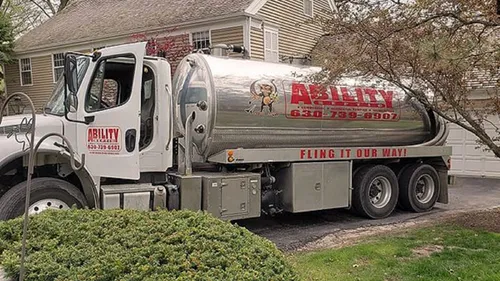
Ability Septic
801 N Raddant Rd, Batavia, IL 60510
Ability Septic is a family-owned septic service provider based near Aurora, IL, serving Batavia and surrounding areas. With over 65 years of experience since 1956, they offer a full range of septic services including pumping, inspection, installation, repair, and drain field maintenance. Their team uses advanced Lenzyme bio-products for eco-friendly septic system solutions and provides 24/7 emergency services to address urgent needs promptly.

Zeilinga Services, Inc.
850 Meadowview Crossing #9, West Chicago, IL 60185
Zeilinga Services, Inc. is a septic system company based in Chicago, IL. They provide septic tank pumping, inspection, repair, and installation services, along with drain field repair and septic pump replacement. Their work includes servicing various septic units such as Aqua 02, AquaKleer, and Norweco systems. They perform thorough maintenance tasks like cleaning pumps, changing filters, checking alarms, and conducting sludge tests to determine pumping needs. Zeilinga Services also offers specialized capabilities including jetting, lift station work, TV camera line inspections, and root control treatments.
JW Trenching, Inc.
28074 W Industrial Ave, Barrington, IL 60010
JW Trenching, Inc. is a septic system repair and installation company serving Chicago, IL. They provide a range of services including soil testing for septic suitability, septic field locating, system design, and consulting. Their capabilities include septic tank replacement and repair, lift station pump replacement, and septic field repair or replacement. They also install various septic systems such as stone trench, chamber trench, mound systems, sand filter, raised filter bed, constructed wetland, textile filter, peat filter, and drip irrigation systems.
Understanding Your Septic System's Drain Field
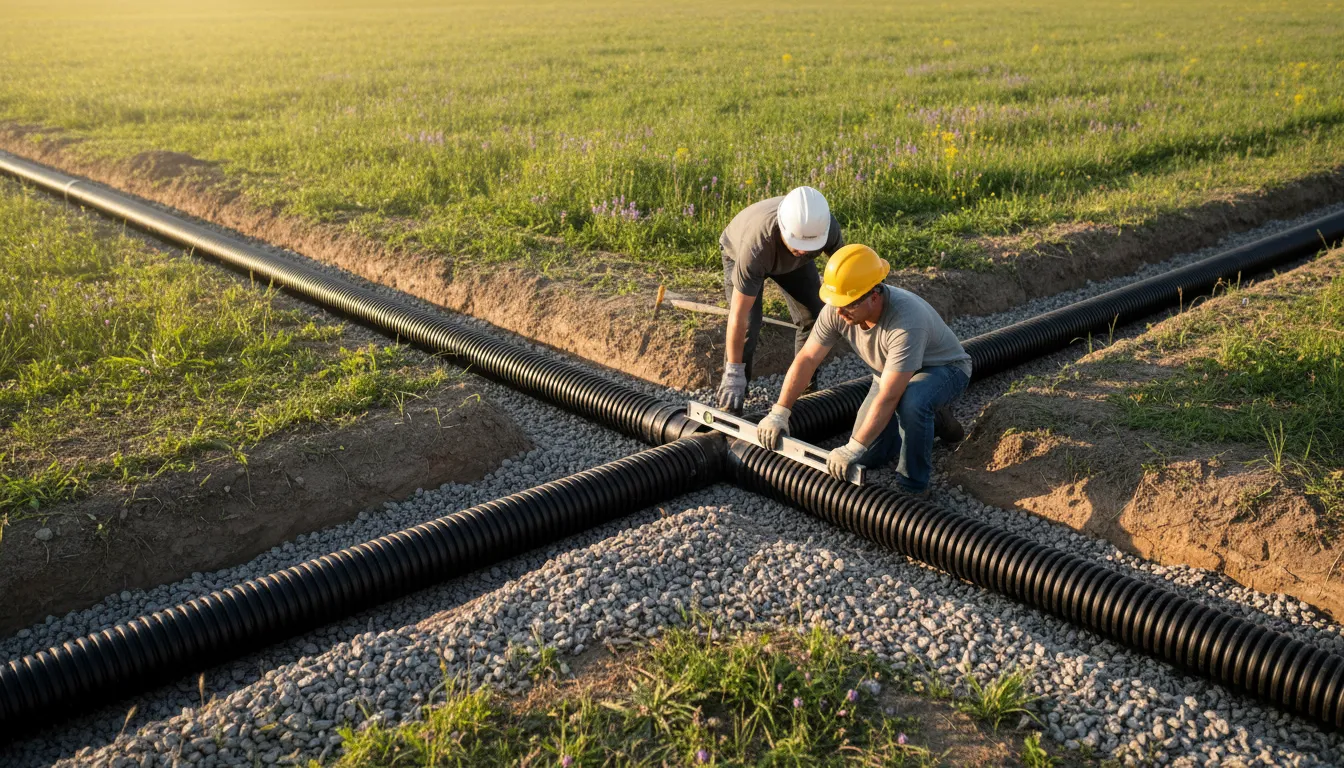
The drain field, also known as a leach field or soil absorption system, is the final and most critical stage of a septic system. After solids settle in the septic tank, liquid effluent flows into a network of perforated pipes buried in trenches filled with gravel or proprietary chambers. This effluent slowly percolates into the soil, where natural biological processes treat and filter it before it rejoins the groundwater. When this area fails, untreated wastewater can surface, creating health risks and environmental contamination.
Why Elmhurst Presents Unique Challenges
Elmhurst and the broader DuPage County area have specific geological and regulatory factors that heavily influence drain field projects.
Clay Soils and High Water Tables: The region is known for its heavy clay soils, which have very slow permeability. This means water drains poorly, easily leading to saturation and system failure. Additionally, high water tables can further limit the soil's ability to absorb effluent. These conditions often necessitate larger drain fields or engineered solutions like mound systems, where suitable native soil is built up with specific fill material to create a proper treatment area.
Strict Local Regulations: All septic system work in DuPage County is overseen by the DuPage County Health Department, which enforces the Illinois Private Sewage Disposal Code 1. You cannot begin any repair or replacement without a permit from the county. Only state-licensed Private Sewage Disposal Installation Contractors are legally allowed to perform this work, and all installations require inspections by the health department 2 3.
The Step-by-Step Process for Repair or Replacement
Addressing a failed leach field is a multi-step process that requires patience and adherence to code.
-
System Evaluation & Diagnosis: A licensed contractor will perform a thorough inspection to determine the exact cause of failure. This could be clogged pipes, compacted soil from driving or construction over the field, hydraulic overloading, or a biomat buildup. They will also assess whether a repair is possible or if a full replacement is necessary.
-
Soil Evaluation & Design: For a replacement, a percolation (perc) test is mandatory to determine the soil's absorption rate 4. Based on these results and local setback requirements (distances from wells, property lines, and buildings), an engineered design is created. If native soil is inadequate, the design may specify bringing in approved fill material, which may need to settle for up to 12 months before installation can proceed 5 6.
-
Permitting: Your contractor will submit the engineered plans to the DuPage County Health Department to obtain the necessary repair or installation permit. This step is non-negotiable and ensures the proposed work meets all safety and environmental standards.
-
Site Preparation & Installation: The work area is marked and protected to prevent further soil compaction. The old drain field may be excavated. New trenches are dug, and new distribution pipes, gravel, and/or chambers are installed according to the approved plan. Illinois code often requires that a replacement system be installed in a new, previously undisturbed area of the property to ensure proper function 7 8.
-
Final Inspection & Restoration: Before the new trenches are backfilled, a county inspector must visit the site to approve the installation 9 10. Once approved, the area is covered with soil and restored with sod or seed.
Find the perfect drain field repair companies for your needs
Get personalized recommendations and expert advice
Recognizing the Signs of Drain Field Failure
Early detection can sometimes mean the difference between a minor repair and a costly full replacement. Be alert for these warning signs:
- Soggy Ground or Standing Water: Puddles or consistently wet, spongy soil over the drain field area, especially when it hasn't rained.
- Foul Odors: The smell of sewage in your yard or near the drain field.
- Slow Drains and Backups: Gurgling pipes, slow-draining sinks and toilets, or sewage backing up into your home 11.
- Unusually Green Grass: Patches of grass over the drain field that are much lusher and greener than the rest of the lawn, indicating a nutrient surge from surfacing effluent.
- Algae Blooms: Increased algae growth in nearby ponds or ditches can indicate nutrient-rich runoff from a failing system 12.
Cost Factors for Drain Field Work in Elmhurst
Costs can vary widely based on the scope of work, soil conditions, and system design. Labor typically accounts for about 60% of the total project cost 13.
- Permits: Fees for permits from the DuPage County Health Department can range from $450 to $2,000.
- Percolation Testing & Design: Professional soil testing and the creation of engineered plans can cost between $1,000 and $2,300 14.
- Minor Drain Field Repair: Fixing a clogged pipe or a small section may cost between $1,000 and $5,000 15.
- Complete Drain Field Replacement: This is a major project. In Elmhurst, due to clay soils and regulatory needs, homeowners can expect to pay between $5,000 and $20,000 or more for a full leach field replacement 16 17.
- Engineered Systems: If a mound system or other alternative technology is required due to poor soil, costs will be at the higher end of the spectrum or even exceed it.
Maintaining Your New Drain Field
Protecting your investment is crucial. Practice good septic habits: conserve water, avoid pouring grease or chemicals down drains, and never drive or park vehicles on the drain field area. Have your septic tank pumped regularly by a professional (typically every 3-5 years) to prevent solids from escaping into and clogging the new leach field 18 19.
Frequently asked questions
Sources
Footnotes
-
Private Sewage Disposal - Illinois Department of Public Health - https://dph.illinois.gov/topics-services/environmental-health-protection/private-sewage-disposal.html ↩
-
§ 51.05 SEWAGE TREATMENT OR DISPOSAL SYSTEMS. - https://codelibrary.amlegal.com/codes/willcounty/latest/willcounty_il/0-0-0-31672 ↩
-
Buying and Selling Homes | Septic Systems - Illinois Extension - https://extension.illinois.edu/septic-systems/buying-and-selling-homes ↩
-
Illinois Administrative Code, Part 905, Section 905.60 - Subsurface ... - https://regulations.justia.com/states/illinois/title-77/part-905/section-905-60/ ↩
-
Illinois Septic Tank Requirements - https://www.ntotank.com/blog/illinois-septic-tank-requirements ↩
-
septic-systems.pdf - Illinois Environmental Protection Agency - https://epa.illinois.gov/content/dam/soi/en/web/epa/documents/water/conservation/lake-notes/septic-systems.pdf ↩
-
Guidelines for Addressing a Failing Septic System - https://www.lakecountyil.gov/DocumentCenter/View/4182/Failing-Systems-Brochure-PDF?bidId= ↩
-
Section 905 - Illinois General Assembly - https://www.ilga.gov/ftp/JCAR/AdminCode/077/077009050000200R.html ↩
-
Guidelines for Addressing a Failing Septic System - https://www.lakecountyil.gov/DocumentCenter/View/4182/Failing-Systems-Brochure-PDF?bidId= ↩
-
Sewage | DuPage County Health, IL - https://www.dupagehealth.org/254/Sewage ↩
-
10 Signs Your Septic System is Failing (And What to Do About It) - https://www.atsenvironmental.com/blog/10-signs-your-septic-system-is-failing-and-what-to-do-about-it/ ↩
-
Learning Center - https://siterightexcavationllc.com/learning-center/ ↩
-
Leach Field Replacement: Cost Breakdown - Aqua Pro Solutions - https://www.aquaprosolutions.com/resources/leach-field-replacement-cost-breakdown/ ↩
-
Septic Drain Field Replacement Costs Vs. Long-Term Savings - https://www.theseptictankman.com/blog/septic-drain-field-replacement-costs-vs-long-term-savings ↩
-
How Much Does a Septic System & Septic Tank Cost - NexGen Septics - https://www.nexgenseptics.com/septic-system-cost/ ↩
-
Cost to Replace Septic Tank and Drain Field [2026 Data] | Angi - https://www.angi.com/articles/how-much-new-drain-fields-foot.htm ↩
-
How much does a leach or drain field replacement cost? - HomeGuide - https://homeguide.com/costs/drain-leach-field-replacement-cost ↩
-
Septic System Maintenance | Lake County, IL - https://www.lakecountyil.gov/2280/Septic-System-Maintenance ↩
-
Homeowners Guide for Well and Septic Systems - https://www.dupagehealth.org/DocumentCenter/View/9711/Homeowners-Guide-for-Well-and-Septic-Systems---English-PDF ↩