Find the Best Drain Field Repair Companies for Your Business
No obligation • Fast responses • Nationwide coverage

Why you can trust Septic Spot
Septic Spot is a leading United States resource for understanding and comparing septic services. Our editors review providers using consistent criteria and verify key business details. Listings and scores are independent, and companies cannot pay to influence our content.
Search providers near you
Top Drain Field Repair Companies in Evanston, Illinois Ranked
A failing drain field, also known as a leach field or absorption field, is a serious issue for any home with a septic system. This critical component is responsible for safely dispersing and filtering treated wastewater into the soil. When it malfunctions, it can lead to sewage backups, soggy yards, and environmental contamination. This guide explains the process, regulations, and costs specific to Evanston and Cook County, helping you understand your options for restoring your septic system's vital function.

Zeilinga Services, Inc.
850 Meadowview Crossing #9, West Chicago, IL 60185
Zeilinga Services, Inc. is a septic system company based in Chicago, IL. They provide septic tank pumping, inspection, repair, and installation services, along with drain field repair and septic pump replacement. Their work includes servicing various septic units such as Aqua 02, AquaKleer, and Norweco systems. They perform thorough maintenance tasks like cleaning pumps, changing filters, checking alarms, and conducting sludge tests to determine pumping needs. Zeilinga Services also offers specialized capabilities including jetting, lift station work, TV camera line inspections, and root control treatments.
JW Trenching, Inc.
28074 W Industrial Ave, Barrington, IL 60010
JW Trenching, Inc. is a septic system repair and installation company serving Chicago, IL. They provide a range of services including soil testing for septic suitability, septic field locating, system design, and consulting. Their capabilities include septic tank replacement and repair, lift station pump replacement, and septic field repair or replacement. They also install various septic systems such as stone trench, chamber trench, mound systems, sand filter, raised filter bed, constructed wetland, textile filter, peat filter, and drip irrigation systems.
Understanding Your Drain Field
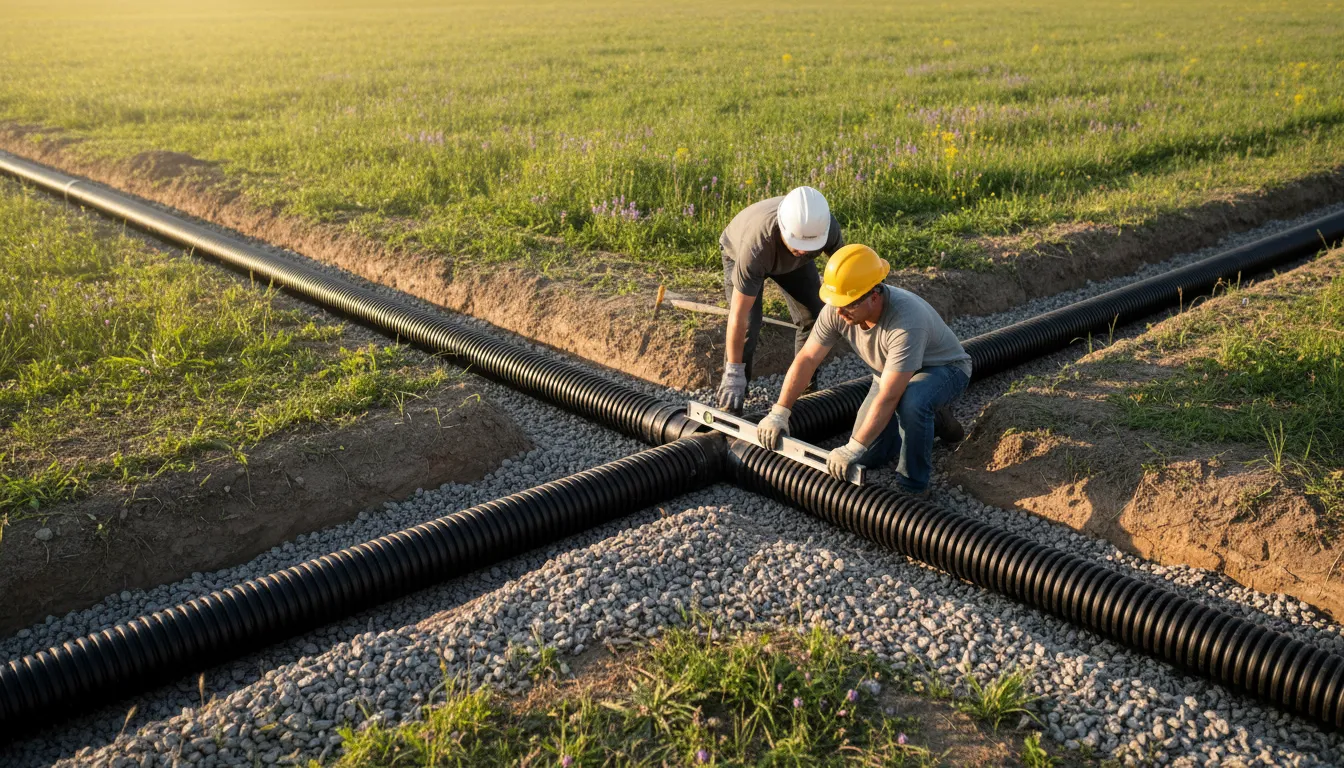
The drain field is the final stage of your onsite wastewater treatment system. After solids settle in the septic tank, the liquid effluent flows through pipes into a network of perforated tubes buried in trenches filled with gravel. This effluent slowly percolates down through the soil, where natural processes provide final treatment before the water rejoins the groundwater. A properly functioning leach field is essential for protecting your property value and local water quality.
Common signs of a failing absorption area include:
- Sewage odors in the yard or home.
- Soggy, spongy, or persistently wet soil over the field, even in dry weather.
- Lush, green grass growing over the field compared to the rest of the lawn.
- Slow-draining household fixtures or sewage backups.
If you notice any of these issues, it's crucial to act quickly to prevent further damage and potential health hazards.
Evanston and Cook County Regulations
All work on a septic system in Evanston requires compliance with strict local and state codes. The Cook County Department of Public Health (CCDPH) is the permitting authority, and all systems must meet the Illinois Private Sewage Disposal Code (77 Ill. Adm. Code 905) 1.
Key regulatory requirements include:
- Permit Required: A permit from the CCDPH is mandatory for any repair, replacement, or alteration of a septic system, including the drain field.
- Licensed Professionals: All design and construction must be performed by Illinois-licensed contractors and designers.
- Site Evaluation: A comprehensive site evaluation, including a soil analysis (perc test), is required before any permit can be issued.
- Separation Distances: Systems must be located specific distances from property lines, wells, water bodies, and structures. For example, a minimum of 200 feet from a potable water supply is often required2.
- Final Inspection: The health department must perform a final inspection and approve the work before the system is covered (backfilled).
Attempting a repair without the proper permits and professional help can result in fines, an improperly functioning system, and liability for environmental damage.
The Site Evaluation and Soil Analysis
The suitability of your property for a conventional leach field depends almost entirely on the soil conditions. This is why a professional site evaluation is the non-negotiable first step.
Soil Percolation Test: Often called a "perc test," this measures how quickly water drains through the soil. The results determine the size and type of system your property can support.
Ideal soils for conventional systems are well-drained, such as sandy or loamy soils3. Problematic soils in our region can include heavy clay or areas with a high water table, which drain too slowly. If the soil is unsuitable for a standard field, you may need an alternative or engineered system, such as an aerobic treatment unit (ATU) or a mound system.
Critical Site Factors:
- Soil Depth: A minimum of 48 inches of acceptable soil is typically required above any limiting layer (like bedrock or clay) for a conventional system4.
- Water Table: The system must be installed well above the seasonal high groundwater level.
- Space: The drain field must be clear of structures, driveways, patios, and large trees.
Find the perfect drain field repair companies for your needs
Get personalized recommendations and expert advice
The Step-by-Step Process for Repair or Replacement
Navigating a drain field project involves a clear sequence of steps to ensure legal and functional success.
- System Evaluation: A licensed professional inspects your entire septic system-both tank and leach field-to diagnose the exact problem and confirm that the drain field is the source of failure5.
- Soil Analysis & Site Plan: A licensed designer or engineer conducts the required soil tests and creates a detailed site plan based on the findings 6.
- Permit Application: The design plan is submitted to the Cook County Department of Public Health for review and permit approval.
- Construction: Once permitted, a licensed excavation contractor performs the repair or replacement. This involves carefully excavating the old field (if necessary) and installing new distribution pipes, gravel, and soil cover according to the approved plan.
- Final Inspection: A CCDPH inspector visits the site to verify the installation complies with the permit and state code before the trenches are finally backfilled7 8.
Cost Considerations for Drain Field Work
Costs can vary widely based on soil conditions, system size, and the extent of the problem. The figures below are estimates to help you budget.
- System Inspection: A professional inspection to diagnose issues typically costs around $530.
- Soil Evaluation & Perc Test: The mandatory site and soil analysis can cost approximately $1,300.
- Permit Fees: Fees paid to the health department can range from $450 to over $2,000, depending on the project's complexity.
- Drain Field Repair: Addressing a specific issue like a clogged pipe may range from $600 to $2,0009.
- Complete Drain Field Replacement: This is a major excavation and installation project. In the Evanston area, full leach field replacement often starts at roughly $7,000 and can increase significantly for larger homes or difficult sites10.
Maintaining Your New or Repaired System
Protecting your investment is key. Proper maintenance can extend the life of your drain field for decades.
- Pump Regularly: Have your septic tank pumped every 3 to 5 years by a licensed service to prevent solids from escaping into and clogging the drain field 11.
- Conserve Water: Reduce hydraulic overload on the system by fixing leaks and spreading out laundry loads.
- Mind What You Flush: Only human waste and toilet paper should go down the drain. Avoid chemicals, grease, wipes, and feminine hygiene products.
- Protect the Area: Never drive, park, or build over the absorption field. Keep large trees and shrubs with deep roots away from the area.
- Divert Water: Ensure roof drains, sump pumps, and surface runoff are directed away from the drain field to prevent saturation12 13.
Frequently asked questions
Sources
Footnotes
-
Private Sewage Disposal - Illinois Department of Public Health - https://dph.illinois.gov/topics-services/environmental-health-protection/private-sewage-disposal.html ↩
-
Schedule I - Septic Tank Seepage Field System - https://epa.illinois.gov/content/dam/soi/en/web/epa/documents/epa-forms/water/wastewater/permits/schedule-i.pdf ↩
-
Best Soils for Septic Systems and Drain Fields - https://advancedsepticservicesfl.com/soils-for-septic-systems/ ↩
-
Septic Systems: Site Evaluation and Testing - Soil Depth - https://mseptic.com/understanding-onsite-wastewater/2019/7/19/septic-systems-site-evaluation-and-testing-soil-depth ↩
-
Guidelines for Addressing a Failing Septic System - https://www.lakecountyil.gov/DocumentCenter/View/4182/Failing-Systems-Brochure-PDF?bidId= ↩
-
Buying and Selling Homes | Septic Systems - Illinois Extension - https://extension.illinois.edu/septic-systems/buying-and-selling-homes ↩
-
Illinois Septic Tank Requirements - https://www.ntotank.com/blog/illinois-septic-tank-requirements ↩
-
Illinois Septic Tank Requirements - https://www.ntotank.com/blog/illinois-septic-tank-requirements ↩
-
How Much Does a Septic Inspection Cost? [2026 Data] - Angie's List - https://www.angi.com/articles/septic-inspection-cost.htm ↩
-
Cost to Replace Septic Tank and Drain Field [2026 Data] | Angi - https://www.angi.com/articles/how-much-new-drain-fields-foot.htm ↩
-
Septic System Maintenance | Lake County, IL - https://www.lakecountyil.gov/2280/Septic-System-Maintenance ↩
-
septic-systems.pdf - Illinois Environmental Protection Agency - https://epa.illinois.gov/content/dam/soi/en/web/epa/documents/water/conservation/lake-notes/septic-systems.pdf ↩
-
Frequent Questions on Septic Systems | US EPA - https://www.epa.gov/septic/frequent-questions-septic-systems ↩