Find the Best Drain Field Repair Companies for Your Business
No obligation • Fast responses • Nationwide coverage

Why you can trust Septic Spot
Septic Spot is a leading United States resource for understanding and comparing septic services. Our editors review providers using consistent criteria and verify key business details. Listings and scores are independent, and companies cannot pay to influence our content.
Search providers near you
Top Drain Field Repair Companies in Mount Prospect, Illinois Ranked
A failing septic system drain field is a serious issue for any homeowner, leading to soggy yards, unpleasant odors, and potential environmental contamination. In Mount Prospect, addressing this problem requires navigating specific local regulations and working with certified professionals. This guide explains the essential steps, costs, and local requirements for leach field repair or replacement, helping you understand the process and connect with qualified experts in your area.
Ability Septic
801 N Raddant Rd, Batavia, IL 60510
Ability Septic is a family-owned septic service provider based near Aurora, IL, serving Batavia and surrounding areas. With over 65 years of experience since 1956, they offer a full range of septic services including pumping, inspection, installation, repair, and drain field maintenance. Their team uses advanced Lenzyme bio-products for eco-friendly septic system solutions and provides 24/7 emergency services to address urgent needs promptly.

Zeilinga Services, Inc.
850 Meadowview Crossing #9, West Chicago, IL 60185
Zeilinga Services, Inc. is a septic system company based in Chicago, IL. They provide septic tank pumping, inspection, repair, and installation services, along with drain field repair and septic pump replacement. Their work includes servicing various septic units such as Aqua 02, AquaKleer, and Norweco systems. They perform thorough maintenance tasks like cleaning pumps, changing filters, checking alarms, and conducting sludge tests to determine pumping needs. Zeilinga Services also offers specialized capabilities including jetting, lift station work, TV camera line inspections, and root control treatments.
JW Trenching, Inc.
28074 W Industrial Ave, Barrington, IL 60010
JW Trenching, Inc. is a septic system repair and installation company serving Chicago, IL. They provide a range of services including soil testing for septic suitability, septic field locating, system design, and consulting. Their capabilities include septic tank replacement and repair, lift station pump replacement, and septic field repair or replacement. They also install various septic systems such as stone trench, chamber trench, mound systems, sand filter, raised filter bed, constructed wetland, textile filter, peat filter, and drip irrigation systems.
Understanding Your Septic System's Drain Field
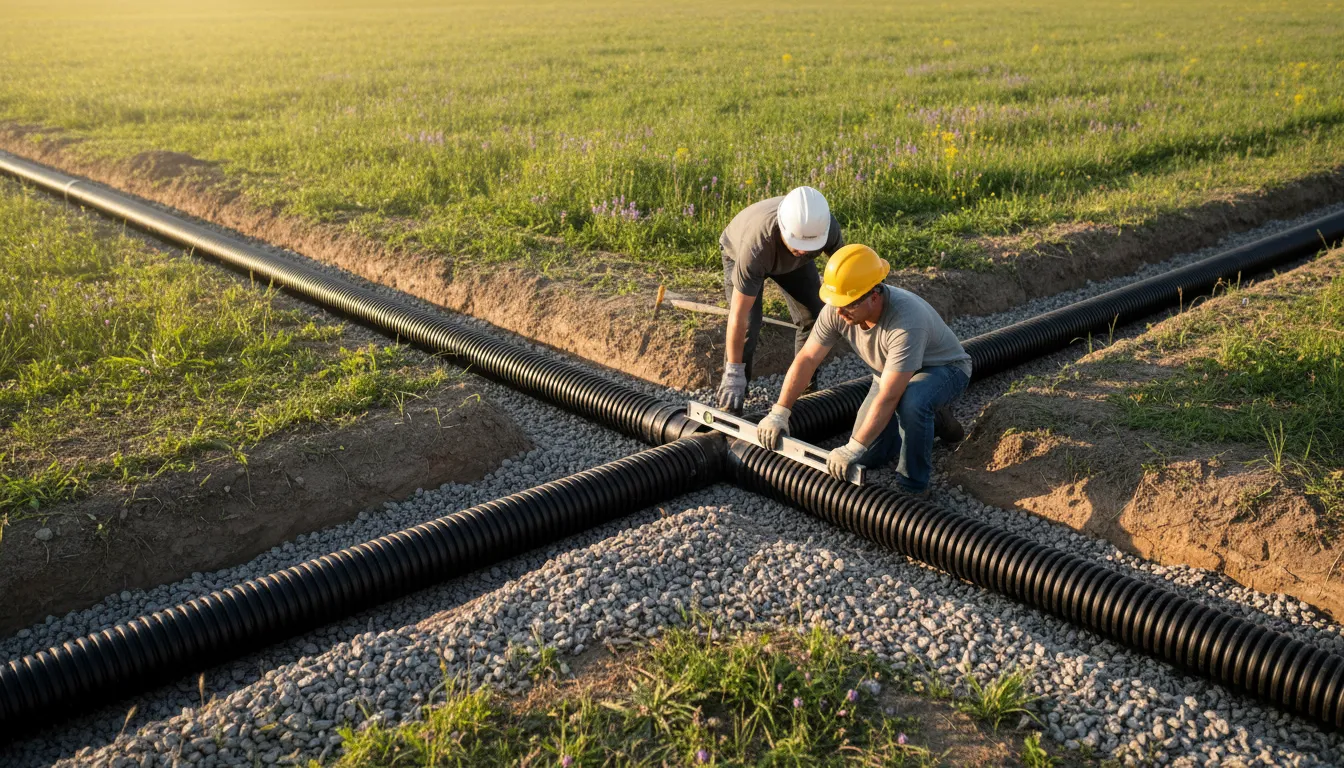
The drain field, also known as a leach field or soil absorption system, is the final and most critical stage of a septic system. After solids settle in the tank, liquid effluent flows into a network of perforated pipes buried in trenches. This effluent is then filtered and treated by the surrounding soil. When this area fails, wastewater can no longer be properly absorbed, leading to surface pooling and system backups. Common causes of failure include soil compaction, hydraulic overloading, and biomat clogging over time 1.
In the dense residential neighborhoods of Mount Prospect, a malfunctioning absorption field is not just a private nuisance; it's a public health concern. Cook County regulations are designed to protect groundwater and prevent the spread of waterborne diseases, making compliance non-negotiable.
Local Regulations and Permit Requirements
All work on a septic system in Mount Prospect falls under the jurisdiction of the Cook County Department of Public Health (CCDPH), which enforces the Illinois Private Sewage Disposal Licensing Act and Code 2.
- Permit Mandatory: A permit from the CCDPH is required for any construction, repair, or alteration of a septic system, including the drain field. You cannot legally begin any excavation or repair work without this permit.
- Licensed Professionals: The actual work must be performed by a State-licensed and County-registered Private Sewage Installer 3. Hiring an unlicensed contractor can result in failed inspections and costly rework.
- Code Compliance: Repairs must bring the entire system up to current code standards for new systems 4. This often means you cannot simply patch a small section of a failing field; the entire design may need to be upgraded or replaced with a larger, modern system.
- System Abandonment: If a drain field is being replaced, the old septic tank must be properly abandoned-either removed or filled with an inert material like sand or gravel after being pumped out 5.
The Critical Role of Soil Evaluation
Before any permit is issued, a professional soil evaluation is required. This is arguably the most important step in the process, as the soil's ability to absorb and treat wastewater (its "percolation" or "loading" rate) dictates the entire system design.
- The Process: A licensed soil classifier or professional engineer will conduct soil borings at the proposed site to determine soil texture, depth to limiting layers (like clay or bedrock), and seasonal high groundwater table.
- Why It Matters in Mount Prospect: The region's common clay soils have a slow permeability, which means they absorb effluent very slowly 6. A soil evaluation will determine if the existing field size is sufficient or if a much larger area or an alternative technology (like a mound system) is needed to handle the daily wastewater flow from your home 7.
Site Constraints and Setback Rules
Your property's layout will heavily influence the repair or replacement options. Cook County enforces strict setback distances to protect water sources and structures 8:
- Water Wells: A new or replacement drain field must be at least 75 to 100 feet from any water well 9.
- Structures: A minimum of 10 feet from your home and 5 feet from property lines.
- Expansion Area: A crucial and often challenging requirement is the 100% expansion area. This is a dedicated, undisturbed space on your property that must be reserved for a future replacement drain field. It must have soil conditions suitable for a septic system and meet all the same setback rules 10. This requirement can be a significant constraint on smaller lots.
Step-by-Step Process for Repair or Replacement
Navigating a drain field project involves a clear sequence of steps:
- Initial Assessment & Hire a Pro: Contact a licensed installer to diagnose the failure. They will confirm if repair is possible or if a full replacement is necessary.
- Soil Evaluation & Design: Your contractor will arrange for the mandatory soil investigation. Using these results, a site plan and system design are created.
- Permit Application: Your installer will submit the design, site plan, and a letter of intent to the Cook County Health Department's Environmental Health Division, typically at their Rolling Meadows office 11. The application includes fees for the site evaluation and the permit itself.
- Construction & Inspection: Once the permit is issued, construction can begin. A critical inspection by a county health inspector is required before the tank or drain field trenches are backfilled 12. A $100 inspection deposit is usually required for residential projects 13.
- Final Approval: After passing the inspection and the system is covered, the county provides final approval for use.
Find the perfect drain field repair companies for your needs
Get personalized recommendations and expert advice
Understanding the Costs Involved
Drain field work is a significant investment. Costs are broken down into several components:
- Permit and Fees: A Cook County repair permit costs approximately $90, which includes a $45 site evaluation fee and a $45 permit fee 14. The professional soil evaluation is an additional cost paid directly to the soil classifier.
- Project Cost: A complete drain field replacement is the most extensive and costly option for fixing a septic failure 15. In Mount Prospect, total costs can range widely from $5,000 to over $20,000. The final price depends on:
- System Size: Dictated by your home's size and soil loading rates.
- Soil Conditions: Poor soils (heavy clay) require more complex, expensive systems.
- System Type: A conventional trench system is less costly than an elevated sand mound or aerobic treatment unit, which may be required on difficult sites.
- Site Accessibility: Tight lots or difficult terrain increase labor and equipment costs.
- Financial Assistance: While the Village of Mount Prospect offers some cost-sharing programs for private drainage improvements, these generally apply to stormwater drainage issues, not septic system failures 16.
Maintenance: Preventing Future Failure
Once your new or repaired leach field is installed, proper maintenance is key to its longevity. Illinois state law recommends that septic tanks be inspected and pumped every 3 to 5 years to prevent solids from escaping into and clogging the drain field 17. Regular pumping is the single most effective way to protect your new investment and avoid another costly failure.
Frequently asked questions
Sources
Footnotes
-
Can a Septic Drain Field Be Repaired - Benjamin Franklin Plumbing - https://www.benjaminfranklinplumbing.com/league-city/blog/2025/april/can-a-septic-drain-field-be-repaired-key-considerations-and-solutions/ ↩
-
Private Sewage Disposal - Illinois Department of Public Health - https://dph.illinois.gov/topics-services/environmental-health-protection/private-sewage-disposal.html ↩
-
Article 7. Requirements for Sewer Construction Page 7-1 - https://mwrd.org/sites/default/files/documents/Article_7_0.pdf ↩
-
Guidelines for Addressing a Failing Septic System - https://www.lakecountyil.gov/DocumentCenter/View/4182/Failing-Systems-Brochure-PDF?bidId= ↩
-
Illinois Septic Tank Requirements - https://www.ntotank.com/blog/illinois-septic-tank-requirements?srsltid=AfmBOoqjyqAuWVaTfyOGAnvQrPUJMgFbJ12JcSS7JDt6afzncGnXMEfZ ↩
-
Illinois Septic Tank Requirements - https://www.ntotank.com/blog/illinois-septic-tank-requirements?srsltid=AfmBOor2k9zSo1p36AjwA5duUfVhY9ySOl1ktD958kcNnK29-rQG1lXB ↩
-
What is the best septic system if your land fails a perc test? - https://www.premiertechaqua.com/en-us/blog/best-septic-system-failed-perc-test ↩
-
INVESTIGATE BEFORE YOU INVEST - https://www.kendallhealth.org/wp-content/uploads/2015/06/EH_INVESTIGINVEST.pdf ↩
-
Private Wells Should Be Sited Far from Septic Tanks and Field Lines - https://www.apecwater.com/blogs/water-quality/j8-08-private-water-wells-sited-from-septic-tanks-fieldlines ↩
-
Soil Evaluation for Septic System - Illinois Extension - https://extension.illinois.edu/septic-systems/soil-evaluation-septic-system ↩
-
Septic - Cook County Department of Public Health - https://cookcountypublichealth.org/environmental-health/water-and-sewage/septic/ ↩
-
Septic Repair/Installation - Lake County, Illinois - https://www.lakecountyil.gov/830/Septic-RepairInstallation ↩
-
Building and Zoning Building Permits - Cook County - https://www.cookcountyil.gov/service/building-permits ↩
-
Cook County Septic Tank/Well Permit Application Process - https://southhealthdistrict.com/wp-content/uploads/2021/12/Application-for-Septic-TankWell-Permit-1-1.pdf ↩
-
The Ultimate Guide to Replacing a Septic Drain Field - https://www.rciseptic.com/the-ultimate-guide-to-replacing-a-septic-drain-field ↩
-
Private Property Drainage | Village of Mount Prospect, IL - https://www.mountprospect.org/departments/public-works/village-infrastructure-projects/private-property-drainage ↩
-
State Law Requires Maintenance of Onsite Wastewater ... - https://www.medinatownship.org/wp-content/uploads/2018/04/SepticTankStatLaw.pdf ↩