Find the Best Drain Field Repair Companies for Your Business
No obligation • Fast responses • Nationwide coverage

Why you can trust Septic Spot
Septic Spot is a leading United States resource for understanding and comparing septic services. Our editors review providers using consistent criteria and verify key business details. Listings and scores are independent, and companies cannot pay to influence our content.
Search providers near you
Top Drain Field Repair Companies in Schaumburg, Illinois Ranked
A failing septic system drain field is a serious issue that requires immediate professional attention to protect your property, health, and the local environment. In Schaumburg, repairing or replacing a leach field is a highly regulated process involving permits, licensed contractors, and specific engineering standards. This guide explains the local requirements, typical procedures, and costs to help you understand the steps involved in addressing a failing absorption field or soil treatment area.
Ability Septic
801 N Raddant Rd, Batavia, IL 60510
Ability Septic is a family-owned septic service provider based near Aurora, IL, serving Batavia and surrounding areas. With over 65 years of experience since 1956, they offer a full range of septic services including pumping, inspection, installation, repair, and drain field maintenance. Their team uses advanced Lenzyme bio-products for eco-friendly septic system solutions and provides 24/7 emergency services to address urgent needs promptly.

Zeilinga Services, Inc.
850 Meadowview Crossing #9, West Chicago, IL 60185
Zeilinga Services, Inc. is a septic system company based in Chicago, IL. They provide septic tank pumping, inspection, repair, and installation services, along with drain field repair and septic pump replacement. Their work includes servicing various septic units such as Aqua 02, AquaKleer, and Norweco systems. They perform thorough maintenance tasks like cleaning pumps, changing filters, checking alarms, and conducting sludge tests to determine pumping needs. Zeilinga Services also offers specialized capabilities including jetting, lift station work, TV camera line inspections, and root control treatments.
JW Trenching, Inc.
28074 W Industrial Ave, Barrington, IL 60010
JW Trenching, Inc. is a septic system repair and installation company serving Chicago, IL. They provide a range of services including soil testing for septic suitability, septic field locating, system design, and consulting. Their capabilities include septic tank replacement and repair, lift station pump replacement, and septic field repair or replacement. They also install various septic systems such as stone trench, chamber trench, mound systems, sand filter, raised filter bed, constructed wetland, textile filter, peat filter, and drip irrigation systems.
Understanding Your Septic System's Drain Field
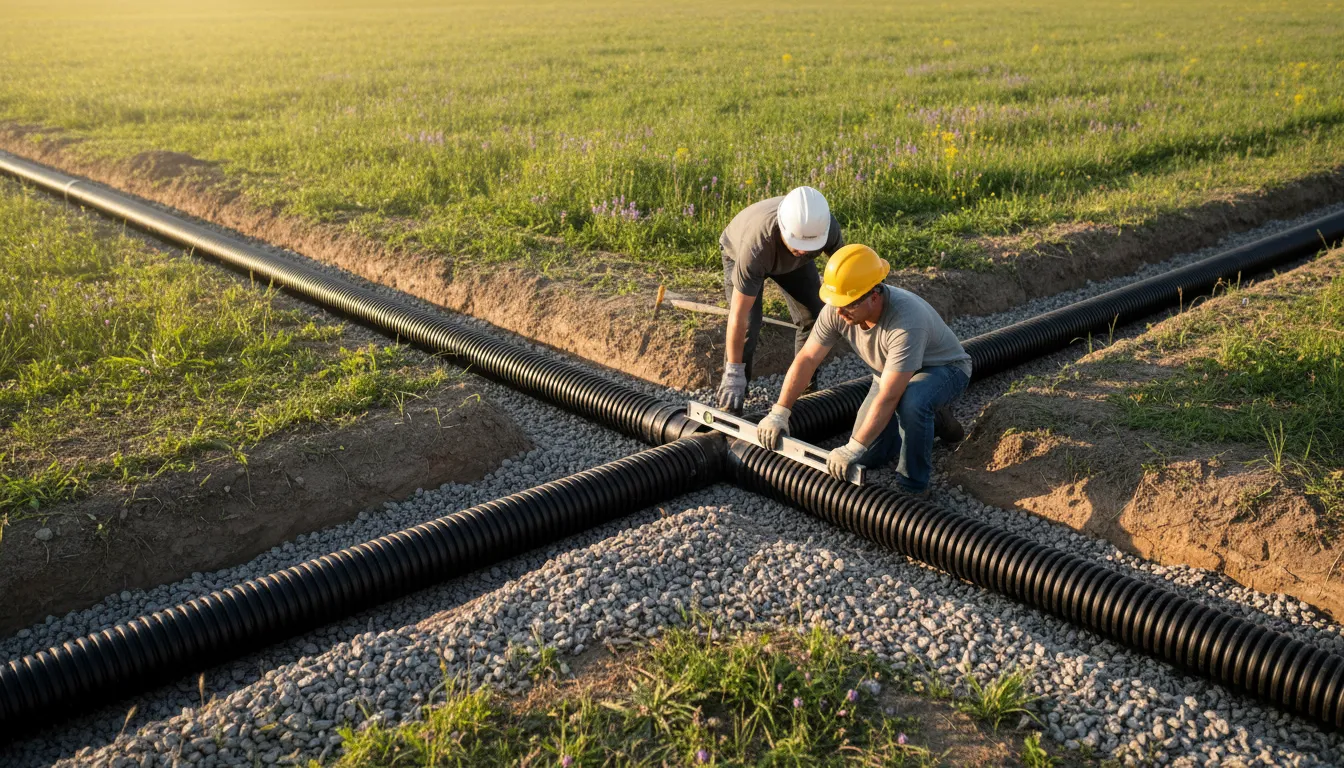
The drain field, also known as a leach field or soil absorption system, is the final and most critical stage of a private sewage disposal system. After solids settle in the septic tank, the liquid effluent flows into a network of perforated pipes buried in gravel-filled trenches. This effluent slowly percolates into the soil, where natural processes provide final treatment. When this area fails-indicated by soggy ground, sewage odors, or plumbing backups-the entire system's function is compromised, necessitating repair or full replacement.
Schaumburg's Regulatory Framework for Septic Work
All repair or replacement of a private sewage disposal system in Schaumburg requires a permit from the Village's Community Development Department. This is not a simple DIY project; the work must be performed by a contractor holding a valid Contractor's Business License with the village, and the actual installation must be done by an Illinois-licensed plumber or septic system installation contractor 1. The village enforces these rules to safeguard groundwater, which is a drinking water source for many in the region.
Before any work begins, a professional engineer or certified designer must create a detailed design drawing for the replacement system. Furthermore, if village enforcement discovers a system failure, they may require the homeowner to have the septic tank pumped by a licensed pumper as part of the initial corrective steps.
The Critical First Step: Site and Soil Evaluation
A professional evaluation of the failing system is mandatory. This often includes a soil evaluation, commonly called a percolation or "perc" test, which is required for any system replacement or modification that moves the leach field to a new area. This test determines the soil's ability to absorb and treat effluent. The entire system must then be designed based on the worst-case soil and high groundwater conditions observed on the property 2.
Local setback requirements (often a minimum of 5 feet from property lines) must be strictly adhered to, and replacement fields cannot be placed in areas subject to flooding or in designated wetlands 3 4. A key planning requirement is the identification of a 100% replacement area-a suitable spot on your property reserved for a future drain field should the new one eventually fail 4.
The Repair and Replacement Process
Once a design is approved, the licensed contractor will submit the plan and obtain the necessary repair permit. The installation process is closely monitored:
- Excavation: New trenches are dug, typically to a minimum depth of 18 inches and a width of 16 inches 5.
- Installation: Perforated pipes are laid in a bed of specific gravel, often CA-7 washed gravel, to create the new absorption trenches 6.
- Inspections: Village inspectors will check the trench dimensions and the proper installation of pipes and gravel before the system is covered. A final inspection is required before the new field is backfilled with soil 7.
Find the perfect drain field repair companies for your needs
Get personalized recommendations and expert advice
What to Expect: Costs for Drain Field Work in Schaumburg
The cost for drain field rehabilitation can vary significantly based on the extent of the failure, soil conditions, and the size of the system needed for your home. It's important to budget for both professional services and municipal fees.
- Soil Evaluation/Perc Testing: Approximately $1,300.
- Septic Permit Fees: These can range from $450 to $2,000 depending on the project's scope and complexity.
- Replacement Drain Field (Materials & Labor): Starting around $7,000 and increasing from there.
- Total Project Cost: A full system replacement project can easily exceed $10,000. Labor typically accounts for about 60% of the total project cost 8.
Protecting Your New Drain Field
After a significant investment in a new soil treatment area, proper maintenance is crucial for its longevity. Critical rules include:
- No Pavement: Never construct driveways, patios, or parking areas over the drain field, as this compacts the soil and prevents the necessary evaporation and air exchange 9.
- Divert Water: Do not connect roof drains, foundation drains, or sump pumps to the septic system, as this can flood the field 10.
- Mind the Landscape: Avoid planting trees or shrubs with deep, aggressive root systems near the drain field lines, as roots can clog and damage the pipes 11.
- Regular Pumping: Have your septic tank pumped regularly by a licensed professional (typically every 3-5 years) to prevent solids from escaping into and clogging the new field.
Disclaimer: For specific requirements pertaining to your property, contact the Schaumburg Community Development Department at 847-923-4420.
Frequently asked questions
Sources
Footnotes
-
Village of Schaumburg Plumbing Code, Chapter 156 - https://schaumburg.novusagenda.com/AgendaPublic/AttachmentViewer.ashx?AttachmentID=11122&ItemID=5936 ↩
-
--- INVESTIGATE BEFORE YOU INVEST --- - https://www.kendallhealth.org/wp-content/uploads/2015/06/EH_INVESTIGINVEST.pdf ↩
-
4-7-5: PROTECTION OF SEPTIC FIELD AREAS DURING THE ... - https://codelibrary.amlegal.com/codes/southbarringtonil/latest/southbarrington_il/0-0-0-3436 ↩
-
Schedule I - Septic Tank Seepage Field System - https://epa.illinois.gov/content/dam/soi/en/web/epa/documents/epa-forms/water/wastewater/permits/schedule-i.pdf ↩ ↩2
-
Illinois Septic Tank Requirements - https://www.ntotank.com/blog/illinois-septic-tank-requirements?srsltid=AfmBOorkM0hhJcTRC4nzy1FWPPEYBUnFgNmgJ3mvEJVAa9kbMASQisQN ↩
-
Drain Tile/Drainage Resource Guide | Schaumburg, IL - https://www.villageofschaumburg.com/government/community-development/permit-services/residential-permits/drain-tile-drainage-resource-guide ↩
-
Drain Tile/Drainage Resource Guide - Schaumburg, IL - https://www.villageofschaumburg.com/government/community-development/permit-services/commercial-permits/drain-tile-drainage-resource-guide ↩
-
Cost to Replace Septic Tank and Drain Field [2026 Data] | Angi - https://www.angi.com/articles/how-much-new-drain-fields-foot.htm ↩
-
Septic System Maintenance | Lake County, IL - https://www.lakecountyil.gov/2280/Septic-System-Maintenance ↩
-
Homeowners Guide for Well and Septic Systems - https://www.dupagehealth.org/DocumentCenter/View/9711/Homeowners-Guide-for-Well-and-Septic-Systems---English-PDF ↩
-
septic-systems.pdf - Illinois Environmental Protection Agency - https://epa.illinois.gov/content/dam/soi/en/web/epa/documents/water/conservation/lake-notes/septic-systems.pdf ↩