Find the Best Drain Field Repair Companies for Your Business
No obligation • Fast responses • Nationwide coverage

Why you can trust Septic Spot
Septic Spot is a leading United States resource for understanding and comparing septic services. Our editors review providers using consistent criteria and verify key business details. Listings and scores are independent, and companies cannot pay to influence our content.
Search providers near you
Top Drain Field Repair Companies in Wheaton, Illinois Ranked
A failing septic system drain field is a serious concern for any Wheaton homeowner. This critical component, also known as a leach field or absorption field, is responsible for safely filtering and dispersing treated wastewater into the soil. When it malfunctions, it can lead to sewage backups, soggy yards, foul odors, and environmental contamination. Navigating the repair or replacement of a leach field involves strict local regulations, professional assessments, and significant planning. This guide explains the process, local rules, and key considerations to help you understand your options and connect with qualified, licensed professionals in the Wheaton area.
Ability Septic
801 N Raddant Rd, Batavia, IL 60510
Ability Septic is a family-owned septic service provider based near Aurora, IL, serving Batavia and surrounding areas. With over 65 years of experience since 1956, they offer a full range of septic services including pumping, inspection, installation, repair, and drain field maintenance. Their team uses advanced Lenzyme bio-products for eco-friendly septic system solutions and provides 24/7 emergency services to address urgent needs promptly.

Zeilinga Services, Inc.
850 Meadowview Crossing #9, West Chicago, IL 60185
Zeilinga Services, Inc. is a septic system company based in Chicago, IL. They provide septic tank pumping, inspection, repair, and installation services, along with drain field repair and septic pump replacement. Their work includes servicing various septic units such as Aqua 02, AquaKleer, and Norweco systems. They perform thorough maintenance tasks like cleaning pumps, changing filters, checking alarms, and conducting sludge tests to determine pumping needs. Zeilinga Services also offers specialized capabilities including jetting, lift station work, TV camera line inspections, and root control treatments.
JW Trenching, Inc.
28074 W Industrial Ave, Barrington, IL 60010
JW Trenching, Inc. is a septic system repair and installation company serving Chicago, IL. They provide a range of services including soil testing for septic suitability, septic field locating, system design, and consulting. Their capabilities include septic tank replacement and repair, lift station pump replacement, and septic field repair or replacement. They also install various septic systems such as stone trench, chamber trench, mound systems, sand filter, raised filter bed, constructed wetland, textile filter, peat filter, and drip irrigation systems.
Understanding Your Septic System's Drain Field
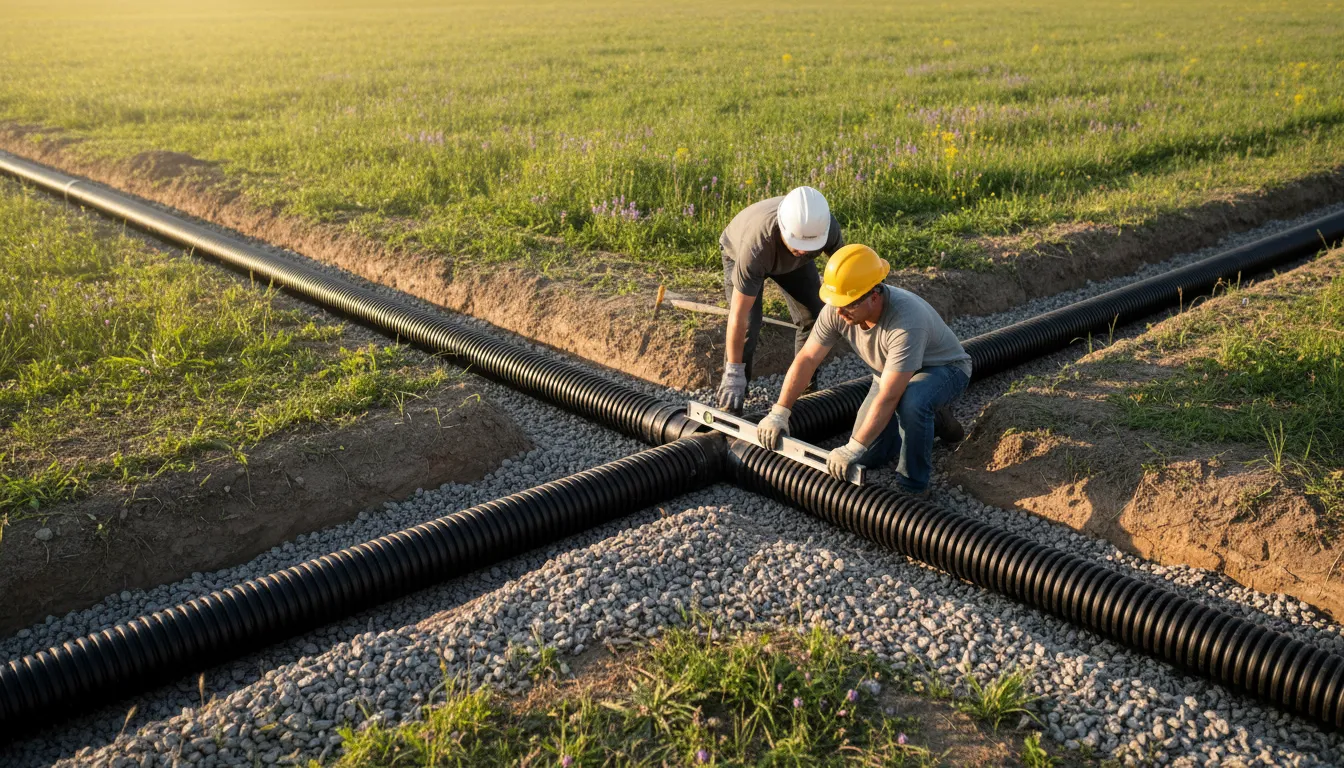
The drain field is the final stage of a conventional septic system. After solids settle in the tank, liquid effluent flows into a distribution box and is channeled through a network of perforated pipes buried in trenches filled with gravel. This effluent slowly seeps into the soil, where natural processes provide final treatment. A system fails when the soil can no longer absorb the liquid, often due to clogging, compaction, or high groundwater.
Common signs of drain field failure include:
- Sewage odors in the yard or home.
- Standing water or persistently soggy soil over the field area.
- Gurgling sounds in plumbing fixtures.
- Slow drains or sewage backups in the house.
- Unusually green, lush grass over the field.
If you notice these signs, it's crucial to act quickly to protect your property, health, and comply with local health codes.
Wheaton and DuPage County Regulations You Must Know
Residential septic system drain field repair and replacement in Wheaton is strictly regulated to protect public health and groundwater, primarily governed by the DuPage County Health Department and Illinois Department of Public Health (IDPH) codes. Any significant repair or full replacement requires permits, site evaluations, and licensed contractors.
Permits Are Mandatory: Before any excavation, repair, or alteration, a permit must be obtained from the DuPage County Public Works or Health Department. Starting work without a permit can result in fines and orders to stop.
Licensed Professionals Only: In Illinois, only IDPH-licensed Private Sewage Disposal Installation Contractors may install or repair systems. Always verify a contractor's state license.
Critical Setback Requirements: New or replacement drain fields must maintain specific distances from property features. Key setbacks include at least 50 feet from water wells, 10 feet from dwellings, and 5 feet from side lot lines 1 2. These rules are non-negotiable for permit approval.
Inspections Are Required: New or repaired systems must pass a final inspection by the Health Authority before being covered or put into use. Furthermore, in many cases, septic systems must be evaluated by a licensed professional upon the transfer of real estate in Illinois 3.
The Professional Assessment and Site Evaluation Process
Before a repair strategy is determined or a permit is issued, a thorough site evaluation is required. This isn't a simple visual check; it's a technical investigation to understand why the field failed and what the property can support.
Soil Investigation: A licensed professional will conduct soil borings to determine soil classification, percolation (absorption) rates, and the seasonal high-water table level 4 5. This data dictates the size and type of system allowed.
Water Table Constraints: Illinois code states that the bottom of the seepage field cannot be installed where the high-water table is less than 4 feet below the trench, unless special engineering solutions are approved 6.
Protecting the Soil: The designated area for a new leach field must be protected from traffic, soil addition, or compaction during any construction on your property. Compaction drastically reduces the soil's infiltration capacity and can doom a new system from the start 7.
Floodplain Restrictions: Systems generally cannot be installed in areas subject to flooding 8.
What a Comprehensive System Inspection Involves
To diagnose a problem, a professional will conduct a detailed inspection:
- Locating and Opening the System: Finding the septic tank, distribution box, and drain field lines. Modern systems should have risers bringing tank lids to the surface for easy access.
- Tank Inspection: Checking the tank for structural integrity, inspecting inlet/outlet baffles, and measuring sludge and scum levels to determine if pumping is needed 9.
- Dye Testing: Introducing a fluorescent dye into the system and checking the drain field area for breakthroughs, which indicate surfacing effluent and field failure 10 11.
- Distribution Box Check: Ensuring effluent is flowing evenly to all drain lines from the distribution box 12.
- Drain Field Assessment: Visually assessing the field for soggy soil, odors, or standing water, and may use a probe to check soil saturation 13.
Find the perfect drain field repair companies for your needs
Get personalized recommendations and expert advice
Repair vs. Replacement: Understanding Your Options
The solution depends on the failure's cause and extent.
Possible Repairs: Sometimes, issues are isolated. A clogged pipe might be jetted, or a damaged distribution box might be replaced. If only one section of the field is saturated, a process called "resting" the field might help. However, most complete failures require more extensive work.
Full Replacement: This is often necessary for older systems or severe failures. It involves designing a new leach field in a suitable location on your property, obtaining permits, and installing a completely new absorption system. This is a major landscaping and construction project.
Advanced Treatment Systems: If your soil fails percolation tests or lot size is limited, you may need an alternative or engineered system, like a mound system or an aerobic treatment unit (ATU). These are more complex and expensive but can work where conventional fields cannot.
Financial Considerations and Local Assistance
Drain field work is a significant investment. While costs vary widely based on system size, soil conditions, and technology, a full leach field replacement typically costs several thousand dollars 14.
Wheaton's Sanitary Sewer Service Line Reimbursement Program: For homeowners whose properties are connected to or eligible for the city sewer main, Wheaton offers a potential financial assistance program. If you are repairing or replacing a failing private sewer line to connect to the city system, you may be reimbursed for up to 65% of the cost, not to exceed $13,000, based on the lowest bid 15 16 17. This program highlights the city's focus on moving properties from septic to municipal sewer where possible.
Permit Fees: Be prepared for administrative costs. The City of Wheaton typically requires a $150 inspection fee for sewer line disconnects, reconnects, or repairs 18.
Getting Quotes: Always get multiple detailed quotes from licensed IDPH contractors. The quote should include all costs: permitting, site evaluation, excavation, materials, installation, and final inspection.
Choosing a Licensed Contractor in Wheaton
Selecting the right professional is the most important step.
- Verify the License: Confirm the contractor holds a current IDPH Private Sewage Disposal Installation Contractor license.
- Check References and Reviews: Ask for local references and check online reviews for Wheaton or DuPage County projects.
- Get Everything in Writing: The contract should detail the scope of work, materials, timeline, total cost, payment schedule, and who is responsible for obtaining permits and scheduling inspections.
- Ask About Experience: Inquire about their experience with similar properties in Wheaton and with the DuPage County Health Department's permit process.
Maintaining Your New or Repaired System
Protect your investment with proper care:
- Pump the Tank Regularly: Typically every 3-5 years, depending on usage.
- Conserve Water: Spread out laundry loads and fix leaks to avoid hydraulically overloading the field.
- Mind What You Flush: Only human waste and toilet paper. No grease, wipes, chemicals, or medications.
- Protect the Area: Never drive or park over the drain field, and avoid planting trees with deep roots nearby.
Frequently asked questions
Sources
Disclaimer: Regulations in Illinois regarding septic systems can change. Always contact the DuPage County Health Department to confirm current codes and requirements before planning any repair or replacement project.
Footnotes
-
Illinois Septic Tank Requirements - https://www.ntotank.com/blog/illinois-septic-tank-requirements ↩
-
§ 51.05 SEWAGE TREATMENT OR DISPOSAL SYSTEMS. - https://codelibrary.amlegal.com/codes/willcounty/latest/willcounty_il/0-0-0-31672 ↩
-
Buying and Selling Homes | Septic Systems | Illinois Extension | UIUC - https://extension.illinois.edu/septic-systems/buying-and-selling-homes ↩
-
Illinois Septic Tank Requirements - https://www.ntotank.com/blog/illinois-septic-tank-requirements ↩
-
Schedule I - Septic Tank Seepage Field System - https://epa.illinois.gov/content/dam/soi/en/web/epa/documents/epa-forms/water/wastewater/permits/schedule-i.pdf ↩
-
ADMINISTRATIVE CODE - Illinois General Assembly - https://www.ilga.gov/agencies/JCAR/EntirePart?titlepart=07700905 ↩
-
§ 51.03 RESIDENTIAL AND/OR INDUSTRIAL SUBDIVISIONS. - https://codelibrary.amlegal.com/codes/willcounty/latest/willcounty_il/0-0-0-31630 ↩
-
8-4-12: UNSUITABLE SOILS: - American Legal Publishing - https://codelibrary.amlegal.com/codes/kildeeril/latest/kildeer_il/0-0-0-6655 ↩
-
How to Inspect a Private Septic System - https://www.youtube.com/watch?v=URhIPaX-csA&t=20 ↩
-
Frequent Questions on Septic Systems | US EPA - https://www.epa.gov/septic/frequent-questions-septic-systems ↩
-
septic-systems.pdf - Illinois Environmental Protection Agency - https://epa.illinois.gov/content/dam/soi/en/web/epa/documents/water/conservation/lake-notes/septic-systems.pdf ↩
-
Septic System Inspection and Maintenance - https://www.youtube.com/watch?v=uzksFrBBlzM&t=36 ↩
-
Well and Septic | Home Inspectors Elgin, Lakewood, Chicago - https://www.echohomeinspections.com/pages/side-nav/well-and-septic ↩
-
How Much Does a Leach or Drain Field Replacement Cost? (2026) - https://homeguide.com/costs/drain-leach-field-replacement-cost ↩
-
City of Wheaton Sanitary Sewer Service Line Reimbursement Program - https://www.wheaton.il.us/DocumentCenter/View/769/Sanitary-Sewer-Service-Line-Reimbursement-Program-PDF ↩
-
Sanitary Sewer Service Line Reimbursement Program - Wheaton, IL - https://www.wheaton.il.us/235/Sanitary-Sewer-Service-Line-Reimbursemen ↩
-
Sanitary Sewer Line Reimb Shared Cost Program Packet - https://www.wheaton.il.us/DocumentCenter/View/769/Sanitary-Sewer-Service-Line-Reimbursement-Program-PDF ↩
-
Sewer and Water Permits | DuPage Co, IL - https://www.dupagecounty.gov/government/departments/public_works/sewer_and_water_permits.php ↩