Find the Best Drain Field Repair Companies for Your Business
No obligation • Fast responses • Nationwide coverage

Why you can trust Septic Spot
Septic Spot is a leading United States resource for understanding and comparing septic services. Our editors review providers using consistent criteria and verify key business details. Listings and scores are independent, and companies cannot pay to influence our content.
Search providers near you
Best Drain Field Repair Companies in Kansas Ranked
A failing drain field is a serious issue for any Kansas homeowner with a septic system. This critical component, also known as a leach field or absorption field, is responsible for safely dispersing and filtering treated wastewater into the soil. When it malfunctions, it can lead to sewage backups, soggy yards, and environmental contamination. Understanding the repair and replacement process, along with Kansas-specific regulations, is essential for protecting your property, health, and investment. This guide provides the practical information you need to navigate local standards, find qualified professionals, and ensure your system is restored to proper working order.
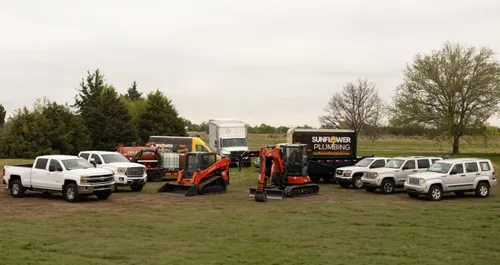
Sunflower Plumbing
3910 W Central Ave, El Dorado, KS 67042
Sunflower Plumbing is a plumbing and septic service provider based in Wichita, KS, serving Butler County and surrounding areas. They offer a range of services including septic tank repair and installation, drain field repair, plumbing repairs, and installations for faucets, drains, water heaters, and gas lines. The company is equipped to handle septic system components such as lagoons and lateral fields. Led by owner Brian Boswell, Sunflower Plumbing emphasizes transparent pricing and professional workmanship. They provide 24/7 availability for plumbing and septic needs.
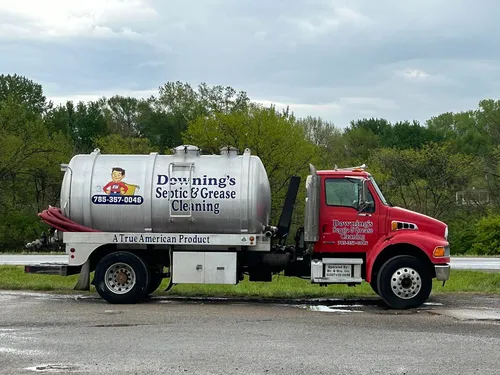
Downing Septic Tank Cleaning
2611 SW 17th St #105, Topeka, KS 66604
Downing Septic Tank Cleaning is a licensed and insured company serving Topeka, KS, and the surrounding northeast Kansas area, including Kansas City and Lawrence. With over 20 years of experience, they provide septic tank installation, pumping, and cleaning services for residential, commercial, and industrial clients. Their expertise includes inspection and repair of lateral fields, grease trap installation and cleaning, and holding tank pumping. The company offers 24/7 service, ensuring support for clients any day of the year.
Understanding Your Kansas Drain Field
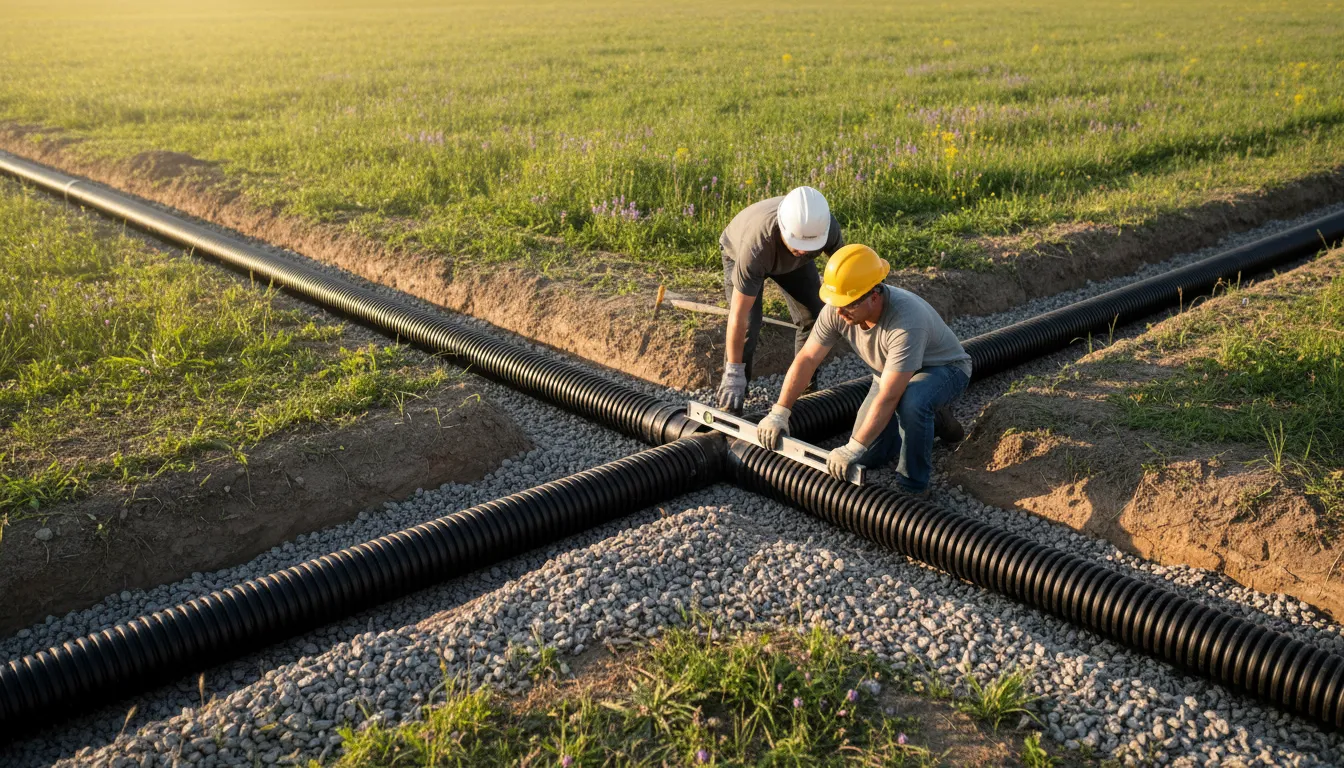
The drain field is the final stage of your onsite wastewater system. After solids settle in the septic tank, liquid effluent flows into a network of perforated pipes buried in gravel-filled trenches. This effluent slowly percolates into the soil, where natural processes provide final treatment. A healthy drain field relies on unsaturated, permeable soil. In Kansas, common causes of failure include soil clogging (often called "souring"), compaction from vehicles or structures, hydraulic overloading from excessive water use, and simple age.
Signs you may need drain field repair or replacement include:
- Sewage odors in the yard or home.
- Soggy ground, standing water, or unusually lush grass over the field area.
- Slow-draining household fixtures or frequent backups.
- Gurgling sounds in plumbing.
If you notice any of these signs, it's crucial to act quickly. A failing system is a public health hazard and can lead to regulatory action from your local county health department.
Kansas Regulations and Permit Requirements
All drain field work in Kansas is governed by state and local codes. The Kansas Department of Health and Environment (KDHE) sets minimum standards that all counties must follow, though local regulations can be more stringent.
Permits are mandatory. Before any repair, alteration, or replacement begins, you or your licensed installer must obtain a permit from your local environmental health department (e.g., Johnson County, Sedgwick County/Wichita). Starting work without a permit can result in fines and orders to remove improperly installed work.
Key Kansas Design and Setback Standards:
- Building Setbacks: Septic tanks must be at least 10 feet from buildings, and drain fields must maintain similar separations.
- Water Source Protection: Systems must be at least 50 feet from water wells, streams, or other water sources.
- Trench Separation: Individual lateral trenches within a drain field must be separated by a minimum of 5 feet of undisturbed soil.
- Inspection Access: Inspection risers over the inlet and outlet tees of the septic tank are typically required to facilitate maintenance and pumping 1.
The Repair vs. Replacement Decision
Not all drain field problems require a full, costly replacement. A professional assessment is necessary to determine the best course of action.
Potential Repairs: Some issues can be resolved with targeted fixes, which may include:
- Jet Cleaning: High-pressure water jetting can clear minor blockages in distribution pipes.
- Baffle/Filter Service: Cleaning or replacing the tank's outlet baffle or filter can prevent solids from clogging the field.
- Adding a Distribution Box: Repairing or leveling a damaged distribution box can restore even flow to all laterals.
- Soil Aeration: In some cases, specialized equipment can fracture and aerate compacted soil around the trenches.
When Replacement is Necessary: A full drain field replacement is often required when the soil absorption area has become permanently clogged with a biomat-a layer of organic material that prevents percolation. This is a "soured" field. Replacement involves designing and constructing a new absorption area in a different location or using advanced technologies like a pressure-dosed system to extend the life of the available soil 2 3.
Find the perfect drain field repair companies for your needs
Get personalized recommendations and expert advice
The Professional Process: From Inspection to Final Approval
Navigating a drain field project requires working with licensed professionals and local officials. Here is the typical workflow:
- System Evaluation & Soil Analysis: A licensed installer or evaluator will perform tests, often including a soil morphology analysis, to determine the cause of failure and design a solution that meets the site's conditions.
- Permit Application & Design Submission: Your installer will prepare engineering plans and submit them with a permit application to your local county health department. The design must comply with all KDHE minimum standards and local amendments 4 5.
- Construction by a Licensed Installer: In most Kansas counties, the physical repair or replacement work must be performed by a county-licensed onsite wastewater installer 6. This ensures the work meets code.
- Mandatory Pre-Cover Inspection: This is a critical step. Before the new or repaired drain field trenches are backfilled, a county sanitarian or inspector must visit the site to verify the installation matches the permitted design and meets all material and construction standards 7 8. You cannot cover the work until it passes this inspection.
- Final Approval & System Care: Once the inspection is passed and the site is restored, the county will issue a final approval. The homeowner then assumes responsibility for proper long-term maintenance.
Costs and Considerations for Kansas Homeowners
The cost for drain field work in Kansas varies significantly based on system size, soil type, technology, and local permitting fees.
- Average Costs: For a completely new system installation, average costs in Kansas are approximately $6,963, but projects can range from $3,150 for simpler repairs or small systems to over $11,000 for complex replacements or difficult sites 9.
- Factors Influencing Price: A gravity-fed system is generally less expensive than a pressure-dosed or mound system, which requires pumps and additional components. Poor soil conditions (heavy clay, high water table) are the primary driver of higher costs, as they require more elaborate engineering 10.
- Property Transfer Inspections: If you are buying or selling a home, be aware that many Kansas counties, including Johnson County, require a septic system inspection and the issuance of a System Use Permit upon transfer of ownership 11. An failing drain field discovered during this inspection must typically be corrected before the sale can be finalized.
Maintaining Your Investment
After a repair or replacement, proper maintenance is key to extending the life of your drain field. As the property owner, you are responsible for this upkeep 12.
- Regular Pumping: Have your septic tank pumped every 3-5 years by a licensed pumper to prevent solids from escaping into the drain field 13.
- Conserve Water: Spread out laundry loads and fix leaks to avoid hydraulically overloading the system.
- Protect the Area: Never drive, park, or build structures (sheds, decks, patios) over the drain field. The soil must remain uncompacted to breathe.
- Mind What You Flush: Only human waste and toilet paper should go down the drain. Avoid chemicals, grease, and non-biodegradable items.
- Landscaping: Only grass should be planted over the field. Tree and shrub roots can infiltrate and damage pipes.
Frequently asked questions
Sources
Footnotes
-
SEPTIC TANKS - KDHE - https://www.kdhe.ks.gov/DocumentCenter/View/8966/Septic-Tanks-PDF ↩
-
How to Get Septic to Pass Inspection - https://www.guardianangelinspections.com/how-to-get-septic-to-pass-inspection ↩
-
Septic Systems and Their Maintenance | NC State Extension Publications - https://content.ces.ncsu.edu/septic-systems-and-their-maintenance ↩
-
Permitting & Inspection of On-Site Wastewater Disposal Systems - https://www.wichita.gov/521/Septic-Systems---Permitting-Inspection-o ↩
-
MF2214 Minimum Standards for Design and Construction of Onsite ... - https://www.kdhe.ks.gov/DocumentCenter/View/8770/Bulletin-4-2-Minimum-Standards-for-Design-and-Construction-of-Onsite-Wastewater-Systems-PDF ↩
-
Failing Systems | Johnson County Kansas - https://www.jocogov.org/department/environment/septic-systems/failing-systems ↩
-
Kansas Septic Tank Requirements | Guide to Installation and ... - https://www.ntotank.com/blog/kansas-septic-tank-requirements ↩
-
KDHE Minimum Standards of Wastewater Systems - https://www.allencounty.org/pdf_doc/2025%20MINIMUM%20STANDARDS%20FOR%20SEPTIC%20SYSTEMS%202025.pdf ↩
-
Cost to Install a Septic System in Kansas City [2026 Data] - Angie's List - https://www.angi.com/articles/what-does-it-cost-install-septic-system/mo/kansas-city ↩
-
Kansas Septic Tank Requirements | Guide to Installation and Compliance - https://www.ntotank.com/blog/kansas-septic-tank-requirements ↩
-
Resales - Johnson County Kansas - https://www.jocogov.org/department/environment/septic-systems/resales ↩
-
Who is Responsible for Maintaining My Drain Field? - https://qualitysepticincorporated.com/who-is-responsible-for-maintaining-my-drain-field/ ↩
-
Wastewater System Standard Field Maintenance - Riley County - https://www.rileycountyks.gov/1761/Wastewater-System-Standard-Field-Mainten ↩