Find the Best Drain Field Repair Companies for Your Business
No obligation • Fast responses • Nationwide coverage

Why you can trust Septic Spot
Septic Spot is a leading United States resource for understanding and comparing septic services. Our editors review providers using consistent criteria and verify key business details. Listings and scores are independent, and companies cannot pay to influence our content.
Search providers near you
Top Drain Field Repair Companies in Wichita, Kansas Ranked
A failing drain field, also known as a leach field or absorption field, is a serious issue for any home with a septic system. This critical component is responsible for safely dispersing and filtering treated wastewater into the soil. When it malfunctions, it can lead to soggy yards, foul odors, and even environmental contamination. Finding a qualified professional for drain field repair or replacement in Wichita is essential for protecting your property, your health, and your investment. This guide provides the local information you need to understand the process, costs, and regulations, helping you connect with experienced specialists in the area.
Understanding Your Wichita Drain Field
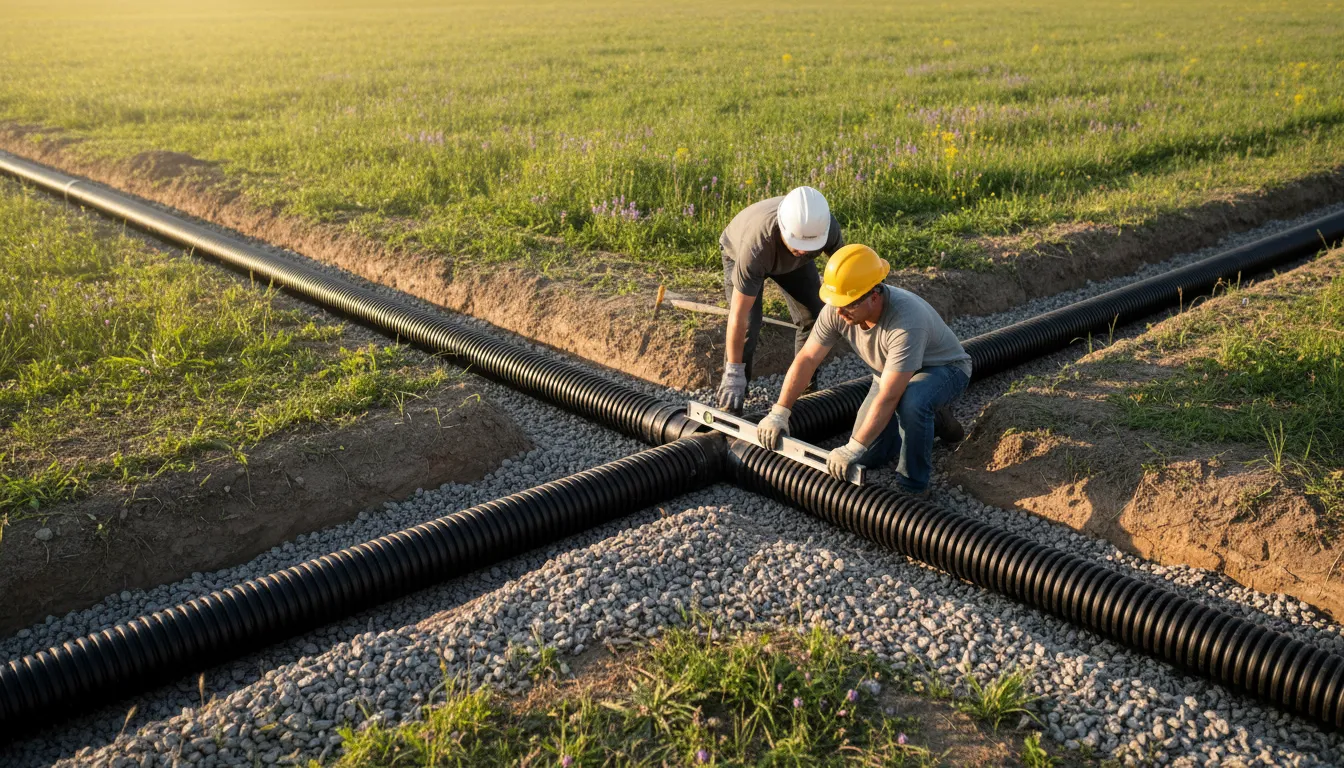
The drain field is the final stage of your onsite wastewater treatment system. After solids settle in the septic tank, the liquid effluent flows through a network of perforated pipes buried in trenches filled with gravel. This effluent slowly seeps into the soil, where natural processes provide the final treatment. In the Wichita area, the performance of your leach field is heavily dependent on local soil conditions and strict county regulations.
Common signs of a failing absorption field include:
- Sewage odors in the yard, especially after rainfall.
- Spongy, soggy, or standing water over the field area.
- Unusually green, lush grass over the drain field while the rest of the lawn is dry.
- Slow drains or sewage backups in the house.
- Surfacing effluent, indicating the soil can no longer absorb liquid.
If you notice any of these issues, it's crucial to act quickly. Continuing to use a failed system is a health hazard and can lead to more extensive and expensive damage.
Wichita and Sedgwick County Regulations You Must Know
All repair, alteration, or replacement of a septic system component in Wichita and Sedgwick County requires a permit and a pre-cover inspection by the Sedgwick County Environmental Resources (part of the Metropolitan Area Building and Construction Department). Ignoring these rules can result in significant fines and complications when selling your property.
Key local regulations include:
- Sewer Availability: A critical Wichita City Ordinance states that if a public sewer main is within 150 feet of your property line, you may be required to connect to the city sewer instead of repairing your septic system 1. Always check this first.
- Setback Requirements: Drain fields must generally be located at least 50 feet from any well or water source and 10 feet from property lines or buildings.
- Floodplains and Slopes: Systems cannot be installed in 100-year floodplains. Steep slopes (over 25%) are generally unsuitable, with slopes under 15% being preferred for proper drainage 2 3.
- Professional Licensing: All design and construction work should be performed by a licensed professional familiar with Kansas Department of Health and Environment (KDHE) and local county codes.
The Role of Soil Testing and Site Evaluation
Before any drain field project can be designed or permitted, a thorough site evaluation is mandatory. The soil in Sedgwick County must be assessed to determine its absorption rate, which dictates the size and type of system needed.
- Percolation Test (Perc Test): This test measures how quickly water drains through the soil. Local regulations typically look for soils with percolation rates between 0 and 60 minutes per inch 4. A professional will dig test holes to perform this analysis.
- Soil Profiles and Boreholes: Contractors or soil scientists will often take soil borings to examine the soil layers (profile) down to the required depth. This identifies limiting layers like clay pans or bedrock.
- Groundwater Assessment: The seasonal high water table must be determined. A minimum separation (usually 3 to 4 feet) is required between the bottom of the drain field trenches and the water table to ensure proper treatment. High groundwater is a common challenge in some areas.
The cost for this essential soil testing and site evaluation in Wichita typically ranges from $600 to $2,000.
The Drain Field Repair and Replacement Process
Whether you need a minor fix or a full leach field replacement, the process follows a structured path.
1. System Assessment: A licensed professional will first inspect the entire septic system. This often involves pumping the tank and using a camera to inspect the distribution box and drain field lines for clogs, breaks, or root intrusion 5.
2. Permit Acquisition: Your contractor will handle the permit application with Sedgwick County Environmental Resources, submitting the required site plans and soil data. Permit fees generally range from $250 to $650.
3. Repair vs. Replacement Decision:
- Repair: Minor issues like a clogged distribution line or a crushed pipe may be repairable. Repair costs can range from $600 to over $3,000.
- Replacement: If the soil is saturated (a condition called "biomat" failure) or the entire field has collapsed, a full replacement is necessary. This involves excavating the old field, disposing of the contaminated soil and gravel, and installing a new system.
4. Installation/Repair Work: For a replacement, new trenches are dug, gravel is laid, new perforated pipes are installed, and the area is covered with soil. In some cases, advanced treatment systems or soil remediation materials are needed to meet code.
5. Final Inspection: Before the new or repaired field is covered with topsoil, a county inspector must visit the site to approve the workmanship and materials 6 7.
Find the perfect drain field repair companies for your needs
Get personalized recommendations and expert advice
Cost Breakdown for Wichita Homeowners
Understanding the potential costs helps in planning for a drain field project. Prices can vary based on system size, soil conditions, and the extent of the problem.
- Septic Inspection: $150 - $450
- Soil (Perc) Testing & Site Evaluation: $600 - $2,000 8
- Permit Fees: $250 - $650
- Drain Field Repair: $600 - $3,000+
- Complete Drain Field Replacement: $5,000 - $12,0009 10
- Septic Tank Pumping (often done during assessment): $250 - $70011
Note: These cost estimates are based on 2025/2026 data and can vary significantly based on your specific site conditions and system requirements.
Choosing a System for Your Property
If a replacement is needed, the soil evaluation will determine the best type of system for your Wichita property.
- Conventional Trenches: The most common type, suitable for soils with good percolation.
- Chamber Systems: Use plastic chambers instead of gravel, which can be easier to install and provide more storage volume in the field.
- Mound Systems: Used when soil depth to bedrock or the water table is too shallow. An elevated mound of sand is constructed to provide adequate treatment depth.
- Advanced Treatment Systems: These systems provide additional treatment before the drain field, allowing for a smaller field size or use on challenging sites. They may be required by the county if soil conditions are poor.
Your licensed contractor will explain the options that meet both the county code and your property's constraints.
Maintaining Your New or Repaired Drain Field
Protect your investment with proper care. Never drive or park vehicles over the drain field, and avoid planting trees or deep-rooted shrubs nearby. Divect roof drains and surface water away from the area. Most importantly, adhere to a regular septic tank pumping schedule (typically every 3-5 years) to prevent solids from overflowing and clogging your new leach field. Proper maintenance is the best way to avoid another costly failure.
Frequently asked questions
Sources
Footnotes
-
SEPTIC TANKS - KDHE - https://www.kdhe.ks.gov/DocumentCenter/View/8966/Septic-Tanks-PDF ↩
-
Kansas Septic Tank Requirements | Guide to Installation and ... - https://www.ntotank.com/blog/kansas-septic-tank-requirements ↩
-
Wastewater - Sedgwick County Only | Sedgwick County, Kansas - https://www.sedgwickcounty.org/mabcd/environmental-section/wastewater/ ↩
-
Soil Management: On-site wastewater treatment systems - https://eupdate.agronomy.ksu.edu/article_new/soil-management-on-site-wastewater-treatment-systems-552-3 ↩
-
Septic Drain Field Replacement Cost - https://dillonseptic.com/septic-drain-field-replacement-cost/ ↩
-
Permitting & Inspection of On-Site Wastewater Disposal Systems - https://www.wichita.gov/521/Septic-Systems---Permitting-Inspection-o ↩
-
What to Expect During a Septic System Replacement - https://www.townesseptic.com/blog/what-to-expect-during-a-septic-system-replacement ↩
-
Cost to Replace Septic Tank and Drain Field [2026 Data] | Angi - https://www.angi.com/articles/how-much-new-drain-fields-foot.htm ↩
-
How much does a leach or drain field replacement cost? - HomeGuide - https://homeguide.com/costs/drain-leach-field-replacement-cost ↩
-
Septic System Installation Cost [2025 Data] - HomeAdvisor - https://www.homeadvisor.com/cost/plumbing/install-a-septic-tank/ ↩
-
Wichita Septic Systems Costs & Prices - ProMatcher Cost Report - https://septic-systems.promatcher.com/cost/wichita-ks-septic-systems-costs-prices.aspx ↩