Find the Best Drain Field Repair Companies for Your Business
No obligation • Fast responses • Nationwide coverage

Why you can trust Septic Spot
Septic Spot is a leading United States resource for understanding and comparing septic services. Our editors review providers using consistent criteria and verify key business details. Listings and scores are independent, and companies cannot pay to influence our content.
Search providers near you
Best Drain Field Repair Companies in Pennsylvania Ranked
A failing drain field is a serious issue for any Pennsylvania homeowner with a septic system. This critical component, also known as a leach field, is responsible for safely filtering and dispersing treated wastewater into the soil. When it malfunctions, it can lead to sewage backups, environmental contamination, and significant property damage. Understanding the state's specific regulations, repair processes, and cost considerations is essential for addressing problems effectively and legally. This guide provides the practical information you need to navigate drain field issues, from identifying early warning signs to understanding the permitting process and connecting with qualified local professionals.

Revelation Plumbing
120 Seville Ave, Pittsburgh, PA 15214
Revelation Plumbing is a family-owned plumbing company serving Pittsburgh, PA, and surrounding areas. They specialize in septic tank inspection, repair, and installation, as well as drain field repair and septic pump services. The company is known for its expertise in trenchless sewer lining, allowing repairs without extensive excavation. Revelation Plumbing holds NASSCO certification and offers emergency plumbing services, including same-day response for urgent issues. Their team is licensed and insured, providing professional solutions tailored to local plumbing needs.

Decker Septic
29 Constitution Dr, Vincentown, NJ 08088
Decker Septic is a septic system service provider based near Philadelphia, PA. They offer a range of services including septic tank pumping, inspections, repairs, installations, and drain field replacement. The company is experienced in handling septic pump repairs and replacements, as well as managing system components like collars and manhole covers to prevent flooding issues. Customers have noted their thorough approach to septic system replacement and maintenance, including assistance with engineering and county approvals. Decker Septic is known for working within tight timelines and maintaining property condition during their work.
Understanding Your Pennsylvania Drain Field
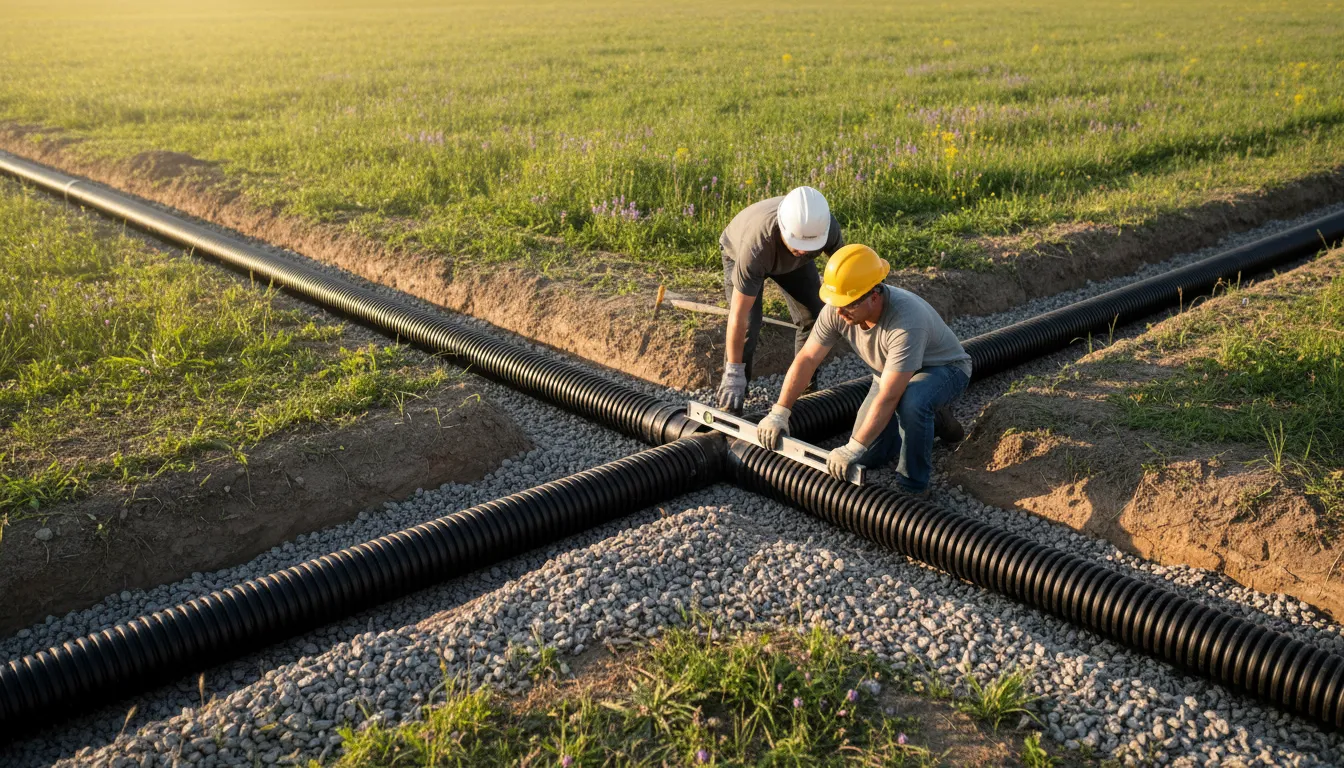
The drain field is the final stage of your on-lot sewage system. After solids settle in the septic tank, the liquid effluent flows into a network of perforated pipes buried in trenches filled with gravel. This effluent slowly seeps into the surrounding soil, where natural processes provide final treatment by removing harmful bacteria, viruses, and nutrients.
In Pennsylvania, these systems are governed by the Pennsylvania Sewage Facilities Act, commonly known as Act 537. This law delegates administration to local municipalities and their appointed Sewage Enforcement Officers (SEOs). Every repair, from a minor pipe fix to a full system replacement, falls under this regulatory framework. The system's performance and the homeowner's responsibility for maintenance are paramount to prevent surface discharge and protect groundwater.
Signs Your Drain Field is Failing
Early detection can mean the difference between a manageable repair and a costly full replacement. Be vigilant for these common warning signs:
- Sewage Odors and Wet Spots: The most direct signs are unpleasant smells or soggy, spongy areas in your yard, especially over the drain field area. Surfacing sewage is a clear malfunction.
- Unusually Lush Vegetation: Grass or plants over the drain field that are greener and grow faster than the rest of the lawn may indicate a nutrient-rich sewage leak.
- Slow Drains and Backups: If sinks, showers, and toilets drain very slowly or back up, especially during wet weather, it could signal that the drain field is saturated and not absorbing water.
- Standing Water: Puddles or persistent dampness in the yard when it hasn't rained is a major red flag.
If you notice any of these issues, a professional inspection is the critical next step before the problem worsens.
The Inspection and Diagnosis Process
A formal inspection is required to determine the exact cause of drain field failure and the appropriate corrective action 1. A qualified professional will typically:
- Locate and Expose Key Components: The homeowner is responsible for locating and providing access to the septic tank and distribution box for inspection 2.
- Assess the Tank: Check baffles, sludge levels, and the tank's structural integrity.
- Evaluate the Drain Field: Probe the field for saturation, check for proper flow from the distribution box, and look for signs of soil clogging (a hardened layer called a biomat) or root intrusion 3.
- Perform Soil and Site Evaluation: Current regulations may require new percolation tests and soil profiling to determine if the original site still meets standards for a conventional system or if an alternative system is now needed.
The inspection will reveal whether the issue is a simple clog, a broken pipe, a failed distribution box, or a complete systemic failure of the soil absorption area.
Pennsylvania's Regulatory and Permitting Requirements
You cannot legally begin any drain field repair or replacement in Pennsylvania without following state and local rules. The permitting process ensures work is done correctly to protect public health and the environment.
- Permit Requirement: A permit from your local SEO is mandatory for any repair, alteration, or new construction of a septic system component, including the drain field 4 5. No part of the system can be backfilled or covered until the SEO has inspected and approved the work.
- Site Standards: Regulations specify minimum requirements, such as 20 inches of suitable soil and typically 4 feet of separation between the bottom of the drain field and the seasonal high-water table or bedrock 6. Your site must meet these standards for a permit to be issued.
- System Type Approval: If the original drain field has failed, you may not be allowed to simply replace it with an identical system. Based on a new site evaluation, the SEO may require a different, often more advanced, system type like a sand mound or pressure-dosed bed to ensure long-term functionality 7 8.
Find the perfect drain field repair companies for your needs
Get personalized recommendations and expert advice
Repair vs. Replacement: Options and Costs
The solution depends entirely on the inspection findings. Costs in Pennsylvania vary by region, with Southeastern PA often seeing prices 15-25% higher than the state average.
Common Repair Scenarios
- Distribution Box Repair/Replacement: If the issue is isolated to a cracked or tilted distribution box causing uneven flow, this is a relatively straightforward fix. Cost: $500 - $2,000.
- Pipe Repair or Root Removal: Clearing root intrusions or repairing a section of crushed or broken perforated pipe can restore function if the soil itself is still viable. Cost: $500 - $1,500.
- Partial Drain Field Repair: Sometimes only one section of the field is clogged or damaged. A partial repair may involve replacing the pipes and gravel in that section. Cost: $3,000 - $8,000.
Full Drain Field Replacement
When the soil absorption area is completely clogged (sealed by a biomat) or the site evaluation dictates a new system design, full replacement is necessary.
- Conventional Field Replacement: Installing a new network of trenches in a suitable area of your property. Cost: $5,000 - $15,000.
- Sand Mound System Replacement: Required when soil depth or permeability is insufficient. This involves constructing an elevated mound of sand and gravel. It is more complex and expensive. Cost: $15,000 - $30,000+9.
Homeowner Responsibilities and Maintenance
Prevention is the most cost-effective strategy. As a Pennsylvania homeowner with a septic system, you are solely responsible for its maintenance and for repairing any malfunction 10 11.
- Regular Pumping: Have the septic tank pumped every 3-5 years by a licensed professional to prevent solids from overflowing into the drain field 12.
- Water Conservation: Spread out water use. Fix leaks and consider water-efficient fixtures to avoid hydraulically overloading the system.
- Protect the Drain Field: Never drive or park vehicles over it. Do not plant trees or deep-rooted shrubs near it. Keep roof drains, sump pumps, and other surface water away from the area.
- Mind What You Flush: Only human waste and toilet paper should go down the drain. Avoid chemicals, grease, diapers, and wipes (even "flushable" ones).
Proper maintenance extends the life of your drain field for decades and is your best defense against premature failure.
Frequently asked questions
Sources
Footnotes
-
Septic Inspections, Testing & Design in Washington County - https://www.wrenvironmental.com/washington-county/residential/septic-inspections-testing-design/ ↩
-
On-lot Sewage Management Programs - https://www.chescoplanning.org/Publications/PDF/PB42-OnLotSewage.pdf ↩
-
Re Use of Existing Septic Systems - Jones Township - https://jonestownship.com/re-use-of-existing-septic-systems/ ↩
-
ACT 537: UNDERSTANDING SEPTIC SYSTEMS - GreenPort - https://greenport.pa.gov/elibrary/PDFProvider.ashx?action=PDFStream&docID=5303&chksum=&revision=3&docName=ACT+537%3A+UNDERSTANDING+SEPTIC+SYSTEMS&nativeExt=pdf&PromptToSave=False&Size=210363&ViewerMode=2&overlay=0 ↩
-
§ 18-204. Sewage Permit Requirements. - American Legal Publishing - https://codelibrary.amlegal.com/codes/dauphinboroughpa/latest/dauphin_pa/0-0-0-2410 ↩
-
Regulatory-Inspections-in-Septic-System-Installation-Joseph ... - https://www.psma.net/wp-content/uploads/2025/02/Regulatory-Inspections-in-Septic-System-Installation-Joseph-Linderman.pdf ↩
-
Septic System Basics - Penn State Extension - https://extension.psu.edu/septic-system-basics ↩
-
The Ins and Outs of Septic Systems in Pennsylvania - https://www.eastvincent.org/vertical/sites/%7B5B8F1E55-6CA8-450E-BB40-12A8385B1313%7D/uploads/septicsystems%281%29.pdf ↩
-
Drain Field Repair Pennsylvania: Cost and Options - https://septicandwell.com/articles/drain-field-repair-pennsylvania ↩
-
Homeowner's Guide to On-Lot Sewage Systems - https://all-county-assoc.com/homeowners-guide-to-on-lot-sewage-systems/ ↩
-
Septic Systems | Department of Environmental Protection | Commonwealth of Pennsylvania - https://www.pa.gov/agencies/dep/residents/my-water/septic-systems ↩
-
25 Pa. Code Subchapter B. Permit Requirements - https://www.pacodeandbulletin.gov/Display/pacode?file=/secure/pacode/data/025/chapter72/subchapBtoc.html&d=reduce ↩