Find the Best Septic Tank Installation & Replacement Contractors for Your Business
No obligation • Fast responses • Nationwide coverage

Why you can trust Septic Spot
Septic Spot is a leading United States resource for understanding and comparing septic services. Our editors review providers using consistent criteria and verify key business details. Listings and scores are independent, and companies cannot pay to influence our content.
Search providers near you
Top Septic Tank Installation & Replacement Contractors in St Peters, Missouri Ranked
Installing or replacing a septic system is a significant home improvement project that ensures the safe and efficient treatment of household wastewater. In St. Peters, this process is governed by specific state and local health regulations designed to protect groundwater and public health. This guide explains the key steps, costs, and regulatory requirements for septic system installation and replacement, helping you understand what to expect and how to connect with qualified local professionals for your project.
Understanding Septic System Basics
A septic system is an on-site wastewater treatment structure, typically used where municipal sewer service is not available. It consists of a septic tank, where solids settle and begin to decompose, and a drainfield (or leach field), where the treated liquid effluent is dispersed into the soil. In St. Peters and throughout St. Charles County, these systems must be carefully designed to match the specific conditions of your property. Proper installation is critical for long-term functionality, preventing system failures that can lead to costly repairs, environmental contamination, and health hazards.
The Regulatory Landscape in Missouri
All new septic system installations and major replacements in Missouri are regulated under state rule 19 CSR 20-3.060, administered by the Missouri Department of Health and Senior Services (DHSS) 1. However, the permitting and inspection process is typically handled at the county level. For St. Peters residents, this means working with the St. Charles County Department of Public Health.
The cornerstone of regulation is the Disposal Works Construction Permit, which is required before any construction begins. Some exemptions exist for single-family residential lots over three acres, but these are not automatic and must be verified with the local health department 2. The regulations establish minimum construction standards for tanks, piping, and drainfields to ensure system integrity and environmental protection.
Step-by-Step: The Installation Process
Navigating a septic system project involves a series of defined steps, from initial evaluation to final approval.
1. Site and Soil Evaluation (The "Perc" Test)
The first technical step is a soil percolation test, often called a "perc" test. This evaluation determines how quickly water drains through the soil on your property, which directly dictates the size and design of the necessary drainfield 3. A licensed soil evaluator or engineer performs the test by digging test pits and measuring absorption rates. The results are used to create the engineering plans required for your permit application. The cost for this test can range from $150 to over $1,200, depending on your lot size and soil complexity 4.
2. Permit Application and Design
With the soil evaluation complete, a licensed installer or engineer will prepare detailed system plans. These plans, along with the completed Disposal Works Construction Permit application, are submitted to the St. Charles County health department for review 5. The permit fees themselves typically range from $150 to $500. This stage ensures your proposed system complies with all setback requirements (often 50 to 300 feet from wells and water bodies) and construction standards 6.
3. Installation and Inspections
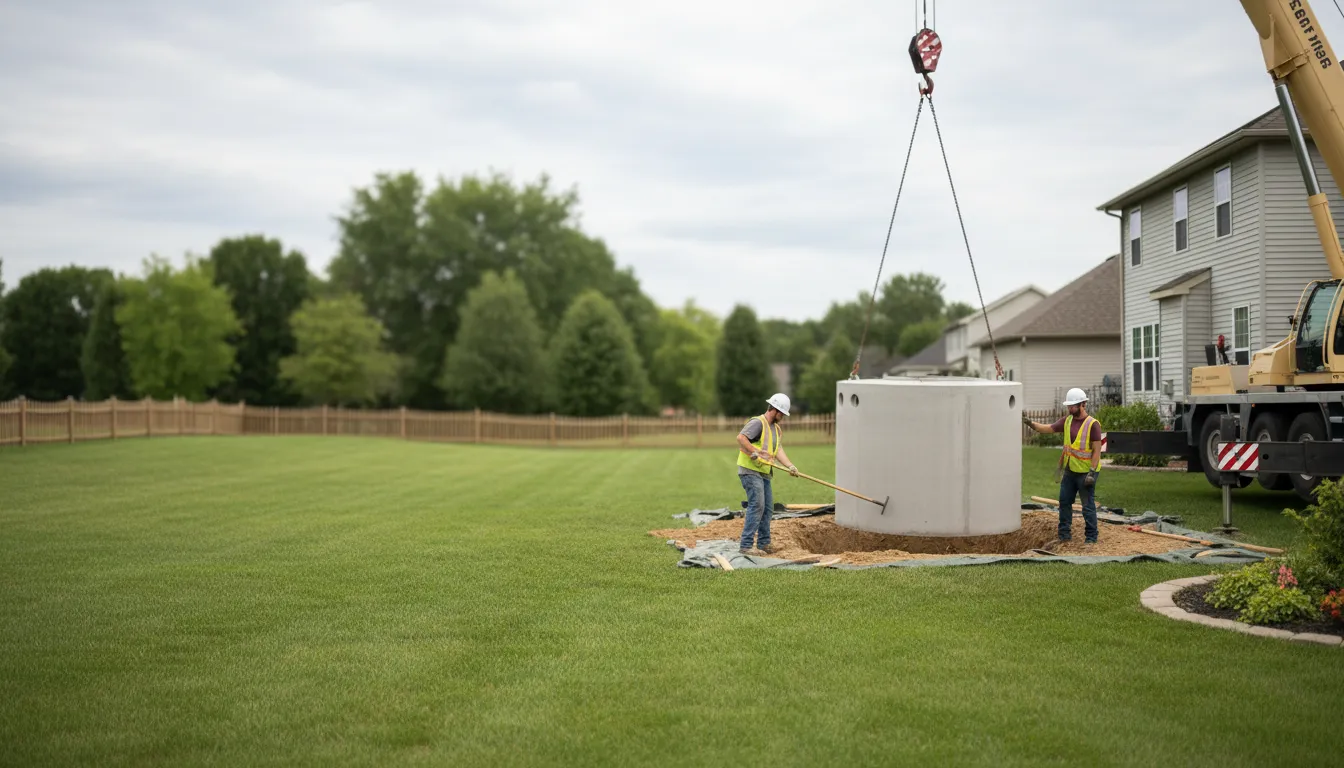
Once the permit is issued, installation can begin. The process involves excavating for the septic tank and drainfield, placing the tank (often concrete, plastic, or fiberglass), and constructing the network of perforated pipes in the drainfield trenches. Crucially, the county requires mandatory inspections during construction 7. An inspector must approve the excavated layout, tank placement, and pipe installation before the system is backfilled. A final inspection is usually required after completion to grant approval for use.
Find the perfect septic tank installation & replacement contractors for your needs
Get personalized recommendations and expert advice
Cost Breakdown for St. Peters
The total cost for a new septic system or a full system replacement in the St. Peters area varies widely based on soil conditions, system size, and tank material. Here is a general breakdown based on available data:
- Permit Fees: $150 - $500
- Soil Percolation Test: $150 - $3,000 8
- Septic Tank Only (1,000 gallon): $900 - $2,100
- Complete System Installation: $3,000 - $20,000, with an average range of $5,000 to $15,000 for a standard conventional system 9 10.
More complex systems required for challenging soils, such as mound systems or aerobic treatment units, can push costs toward the higher end of this range or beyond.
When is Replacement Necessary?
Understanding when to replace an existing septic system can prevent emergencies. Common signs include:
- Sewage Backups in household drains.
- Damp, Spongy, or Foul-Smelling Areas in the yard above the drainfield.
- Slow Drains throughout the house that aren't resolved by cleaning.
- Lush, Green Grass over the drainfield, especially during dry weather, indicating effluent surfacing.
- Failed Inspection during a property sale or as part of a routine check.
Replacement follows the same permit and installation process as a new installation. The old tank must be properly pumped and either removed or collapsed in place and backfilled according to code.
Choosing a Licensed Installer
Selecting the right contractor is paramount. Always choose a licensed septic system installer registered in Missouri. A reputable professional will:
- Handle the permit application process and coordinate with the health department.
- Conduct or arrange for the required soil evaluation.
- Provide a detailed, written estimate outlining all costs, including permits, tank, labor, and materials.
- Obtain all necessary inspections before backfilling.
- Offer guidance on proper long-term maintenance to extend your system's lifespan.
Be wary of quotes that seem unusually low, as they may not include necessary steps or may use substandard materials. Check references and verify the installer's license with the state.
Maintaining Your New System
A properly installed system is a long-term investment that requires routine care. Essential maintenance includes:
- Regular Pumping: Have the septic tank pumped every 3 to 5 years by a licensed pumper to remove accumulated solids.
- Water Conservation: Reducing excessive water use prevents hydraulic overload of the drainfield.
- Mindful Flushing: Only human waste and toilet paper should go down the drain. Avoid chemicals, grease, diapers, and wipes.
- Protecting the Drainfield: Never drive or park vehicles over it, and avoid planting trees with deep roots nearby.
Proper maintenance is the best way to avoid premature system failure and protect your property value.
Frequently asked questions
Sources
Footnotes
-
Frequently Asked Questions | Onsite Wastewater Treatment - https://health.mo.gov/living/environment/onsite/faqs.php ↩
-
On-site Septic Systems and Subdivisions | Missouri Department of ... - https://dnr.mo.gov/water/business-industry-other-entities/technical-assistance-guidance/onsite-wastewater-septic-systems ↩
-
Onsite Wastewater Process and Guidance - Site and Soil Evaluation - https://emery.utah.gov/wp-content/uploads/2023/02/Onsite-Wastewater-Packet.pdf ↩
-
Demystifying the Process: Getting a New Septic System Designed by an Engineer in Massachusetts - PMP Consulting Inc. - https://pmpconsultinginc.com/demystifying-the-process-getting-a-new-septic-system-designed-by-an-engineer-in-massachusetts/ ↩
-
OWTS Construction Permit Application Process - https://health.mo.gov/living/environment/onsite/permitprocess.html ↩
-
An Onsite Wastewater Treatment System Owner's Manual - https://health.mo.gov/living/environment/onsite/pdf/SystemOwnersManual.pdf ↩
-
UNDERSTANDING THE WORKFLOW FOR INSTALLATION ... - https://www.mashpeema.gov/DocumentCenter/View/1459/System-Installation-Process-0 ↩
-
How Much Does a Septic Soil Test Cost in 2026? - https://landperc.com/septic-soil-test-cost/ ↩
-
Understanding Septic Tank Permits and Regulations - https://westcoastsanitationinc.com/understanding-septic-tank-permits-and-regulations/ ↩
-
How Much Does It Cost To Install a Septic System in St. Louis, MO? | Angi - https://www.angi.com/articles/what-does-it-cost-install-septic-system/mo/st-louis ↩