Find the Best Septic Tank Installation & Replacement Contractors for Your Business
No obligation • Fast responses • Nationwide coverage

Why you can trust Septic Spot
Septic Spot is a leading United States resource for understanding and comparing septic services. Our editors review providers using consistent criteria and verify key business details. Listings and scores are independent, and companies cannot pay to influence our content.
Search providers near you
Top Septic Tank Installation & Replacement Contractors in Hickory, North Carolina Ranked
Installing or replacing a septic system is a significant investment and a critical component of your property's infrastructure. In Hickory and Catawba County, this process is governed by specific state and local regulations designed to protect public health and the environment. This guide explains the key steps, costs, and considerations for septic system installation and septic tank replacement in the Hickory area, helping you navigate the permitting process and find qualified local professionals to handle your onsite wastewater needs.

Lentz Wastewater Management - Mooresville
Charlotte, NC
Lentz Wastewater Management - Mooresville offers septic system repair, installation, and maintenance services in Charlotte, NC. They handle septic tank replacements, drain field repairs, and septic pump services, including installation of risers and sanitary tees to extend system life. The company also provides Terralift technology to address saturated drain fields without excavation. With over twenty years of experience, Lentz Wastewater Management installs various septic systems, including conventional and alternative types, and offers warranties on parts and workmanship.
Benfield Outdoor Services & Solutions LLC
127 Promenade Dr C2, Mooresville, NC 28117
Benfield Outdoor Services & Solutions LLC is a septic tank inspection and installation company based near Charlotte, NC. Established in 2017 by Michael Benfield, the company serves the Lake Norman and coastal North Carolina areas, providing services to realtors and homeowners. Their team includes soil scientists, licensed inspectors, sub-surface operators, and installers with over 50 years of combined experience. They offer professional inspections, consulting, and septic system installations with a focus on maintaining high standards of professionalism and integrity.
Foothills Septic & Grading LLC
2819 Sigmon Dairy Rd, Newton, NC 28658
Foothills Septic & Grading LLC is a family-owned company providing septic tank inspection, repair, and installation services in Charlotte, NC. They are Level 4 Installers and Inspectors, offering Point of Sale septic system inspections. The company also handles lot clearing and large field bush hogging. Serving multiple areas including Alexander, Caldwell, Catawba, Burke, Lincoln, Gastonia, Iredell, and the Mountains, they handle a variety of septic and grading needs.
Wastewater Solutions & Design
4919 E Maiden Rd, Maiden, NC 28650
Wastewater Solutions & Design is a septic tank inspection and installation company based in Charlotte, NC. They provide certified septic system installation and inspection services, holding credentials such as Septic System Installer & Inspector and NC Water Pollution Control System Operator certifications. Their expertise ensures compliance with local regulations and proper system functionality.
Understanding the Septic System Permit Process in Catawba County
All new installations and most replacements in Hickory require a permit from the Catawba County Environmental Health department. The process is designed to ensure the system is suitable for your specific property's conditions. It's not a single permit but a series of approvals that must be obtained in sequence. Attempting to install a system without following this process can result in fines, system failure, and complications when selling your property 1.
The modern permitting process in North Carolina has moved beyond simple "perc tests." Today, it involves a comprehensive soil and site evaluation conducted by a licensed soil scientist or the county Environmental Health Specialist (EHS). This evaluation assesses soil type, depth to bedrock, slope, and seasonal water table levels to determine the most appropriate and environmentally safe system design for your lot.
Key Permit Stages
The journey to an operational septic system involves four main permit stages:
- Improvement Permit (IP): This is the first official step. It validates that the site is suitable for a septic system based on the proposed house size (number of bedrooms). You cannot get a building permit for a new home without first obtaining an Improvement Permit for the wastewater system 2.
- Construction Authorization (CA): After the soil evaluation is complete and a system has been designed by a licensed installer or engineer, detailed plans are submitted for a Construction Authorization. This permit gives the green light for the physical installation to begin. It specifies the exact type, size, and location of the system 3.
- Installation Inspections: The county EHS must inspect critical stages of the installation before they are covered. This typically includes inspecting the tank placement, distribution lines, and drain field excavation to verify they match the approved plans and meet all setback requirements.
- Operation Permit (OP): After a final inspection confirms the installation is complete and correct, the county issues an Operation Permit. This is the final approval that allows you to use the system 4.
Site Evaluation & System Design: The Foundation of Success
The feasibility and cost of your septic system hinge on the site evaluation. In Hickory's varied terrain, soil conditions can change dramatically over a short distance. The evaluation involves digging several deep test pits to examine the soil profile 5.
Factors determined during this phase include:
- Soil Drainage (Percolation): How quickly water moves through the soil layers.
- Soil Texture and Structure: The composition of sand, silt, and clay.
- Depth to Limiting Conditions: This includes the distance to bedrock, a seasonal high water table, or dense clay pans.
- Topography and Slope: The lay of the land affects system placement and type.
Based on these findings, a system is designed. There are two primary categories:
- Conventional Gravity Systems: These are typically the most affordable option, costing between $4,000 and $8,000 for installation. They rely on gravity to move effluent from the tank to a traditional stone-and-pipe drain field and require soils with good drainage.
- Engineered or Alternative Systems: For lots with poor drainage, high water tables, or small size, an engineered system is necessary. These might include chamber systems, low-pressure pipe (LPP) systems, or aerobic treatment units (ATUs). They are more complex and therefore more expensive, often ranging from $5,000 to $12,000 or more 6.
Find the perfect septic tank installation & replacement contractors for your needs
Get personalized recommendations and expert advice
The Installation & Inspection Timeline
Once you have your Construction Authorization in hand, your licensed installer can begin work. The installation process itself usually follows these steps:
- Excavation: The area for the septic tank and drain field is excavated according to the approved plan.
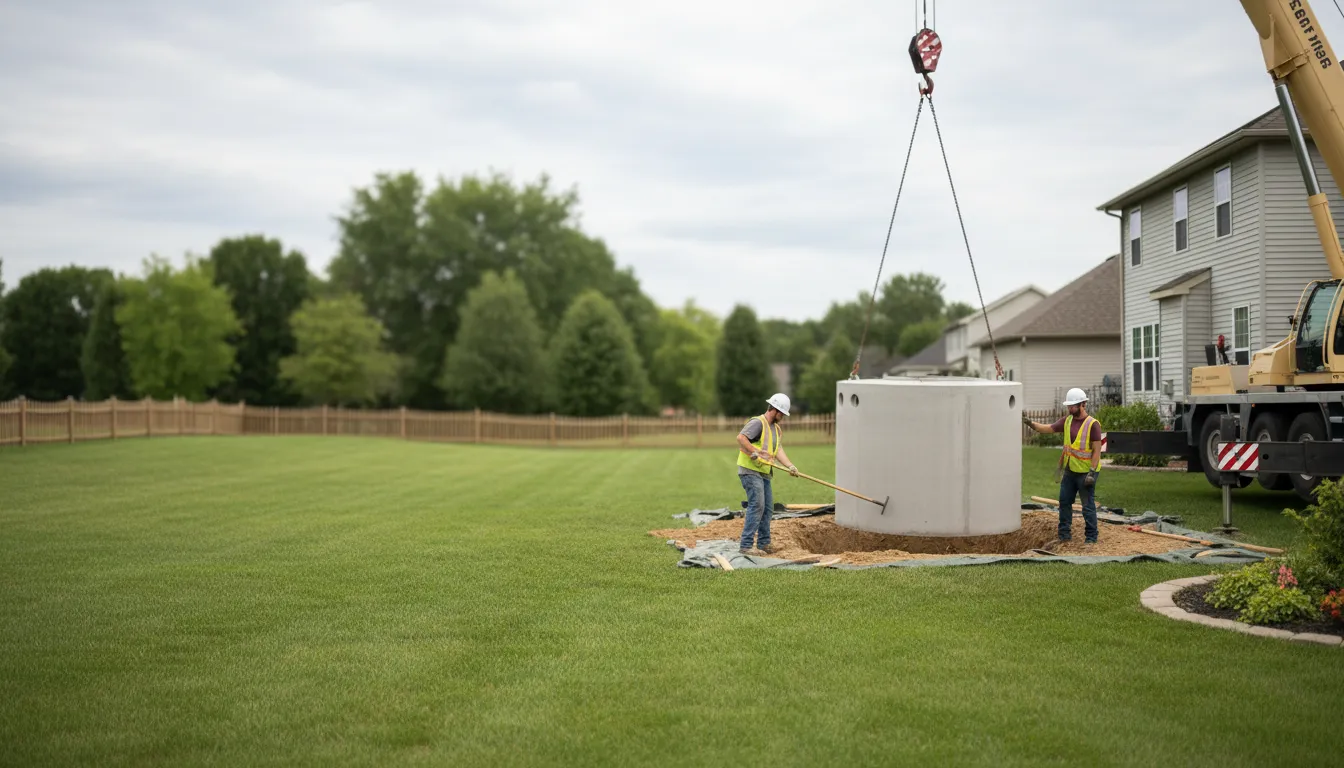
- Tank Placement: The concrete or plastic septic tank is set in place, and inlet/outlet pipes are connected. All tanks must be watertight.
- Drain Field Construction: For a conventional system, a bed of gravel is laid, and perforated distribution pipes are placed. For alternative systems, chambers or other proprietary components are installed.
- Critical Inspections: This is crucial. The installer must notify the county EHS to inspect the tank, pipes, and drain field before any components are covered with soil 7. Failing to call for this inspection can lead to failed final approval.
- Backfilling and Final Grade: After passing inspection, the system is carefully backfilled and the land is graded to direct surface water away from the drain field area.
- Final Inspection and Operation Permit: Once everything is complete, a final inspection is requested. Upon passing, the county issues the Operation Permit, making your system legal for use.
Special Considerations for System Replacement
Replacing a failed septic system in Hickory is often more challenging and expensive than a new installation. If a drain field has failed due to age, damage, or hydraulic overload, the county will require a repair. A key rule is that a repair area must be identified and set aside on your property during the replacement permitting process. This area must be suitable for a future drain field.
Furthermore, you are generally required to upgrade to a system that meets current code. This often means that if your old conventional system failed, you may need to install a modern engineered system to replace it, which increases the cost significantly. The process still requires a new site evaluation and full permitting sequence.
Navigating Local Hickory and Catawba County Requirements
- Online Applications: Catawba County encourages the use of online applications for permits, which can streamline the process 8.
- Setback Distances: State and local rules mandate minimum distances between septic system components and other features. These include distances from wells (typically 50-100 feet), property lines, buildings, and streams 9 10. Your system design must adhere to these.
- Working with Professionals: Given the complexity, working with a licensed septic system installer who is familiar with Catawba County's inspectors and procedures is highly recommended. They can help navigate the paperwork, design a compliant system, and schedule the required inspections.
Costs and Long-Term Planning
As noted, total costs for a new septic system installation in the Hickory area can vary widely. A simple conventional system may start around $4,000, while complex alternative systems for difficult sites can exceed $12,000 11 12. Replacement costs often fall on the higher end of this scale. When budgeting, remember to include:
- County permit fees
- Soil scientist/evaluation fees
- System design/engineering fees
- Excavation and installation labor
- Materials (tank, pipe, gravel, etc.)
- Landscaping restoration after installation
Proper maintenance, including regular pumping every 3-5 years, is essential to protect this long-term investment and avoid premature, costly replacement 13.
Frequently asked questions
Sources
Footnotes
-
Point of Sale Inspection Requirements - MARLIN - https://mseptic.com/septic-inspection-requirements-north-carolina ↩
-
What Realtors and Landbuyers Should Understand About the NC ... - https://agriwaste.com/what-realtors-and-landbuyers-should-understand-about-the-nc-septic-system-permitting-process/ ↩
-
Navigating the Septic System Permit and Installation Process ... - https://carolinaearthwerx.com/blogs/news/navigating-the-septic-system-permit-and-installation-process-in-north-carolina ↩
-
NC Septic Permit Process: Step-by-Step Guide for Homeowners - https://septicandwell.com/articles/nc-septic-permit-process ↩
-
North Carolina Soil Evaluations: The New Standard for Septic ... - https://www.creechsplumbing.com/blog/2024/february/perc-tests-are-no-longer-used-uncovering-north-c/ ↩
-
Septic Installations Hickory NC - https://www.looseendssepticcleaning.com/septic-installations/ ↩
-
Septic Installation Sacramento County | Step-by-Step Guide | Blog - https://www.blueribbonseptic.com/blog/septic-installation-sacramento-county ↩
-
Septic Systems - Catawba County, North Carolina - https://catawbacountync.gov/county-services/environmental-health/septic-wells/septic-systems/ ↩
-
North Carolina Onsite Wastewater Rules - Environmental Health - https://ehs.dph.ncdhhs.gov/oswp/docs/rules/1900-Rules-08-2017.pdf ↩
-
Permit Center | City of Hickory - https://www.hickorync.gov/permit-center ↩
-
Perc Tests and Septic Systems: What Land Buyers Must Know ... - https://aspyrerealtygroup.com/nc-perc-tests-and-septic-guide-2025/ ↩
-
Permitting, Installing, and Maintaining Your Septic System in Boulder County & Jefferson County - High Performance Earthworks - https://www.highperformanceearthworks.com/boulder-septic-installation/2018/6/20/permitting-installing-and-maintaining-your-septic-system-in-boulder-county-jefferson-county-9z73z ↩
-
Investigate Before You Invest | NC State Extension Publications - https://content.ces.ncsu.edu/investigate-before-you-invest ↩