Find the Best Drain Field Repair Companies for Your Business
No obligation • Fast responses • Nationwide coverage

Why you can trust Septic Spot
Septic Spot is a leading United States resource for understanding and comparing septic services. Our editors review providers using consistent criteria and verify key business details. Listings and scores are independent, and companies cannot pay to influence our content.
Search providers near you
Top Drain Field Repair Companies in Longmont, Colorado Ranked
A failing septic drain field is a serious issue that can lead to sewage backups, environmental contamination, and costly property damage. Drain field repair and replacement involves addressing the underground network of pipes and soil that treats and disperses wastewater from your home. In Longmont, this process is highly regulated due to local soil conditions and environmental protections. This guide helps you understand the local requirements, costs, and steps involved in restoring your onsite wastewater treatment system, connecting you with qualified local professionals for your project.
Understanding Your Septic System's Leach Field
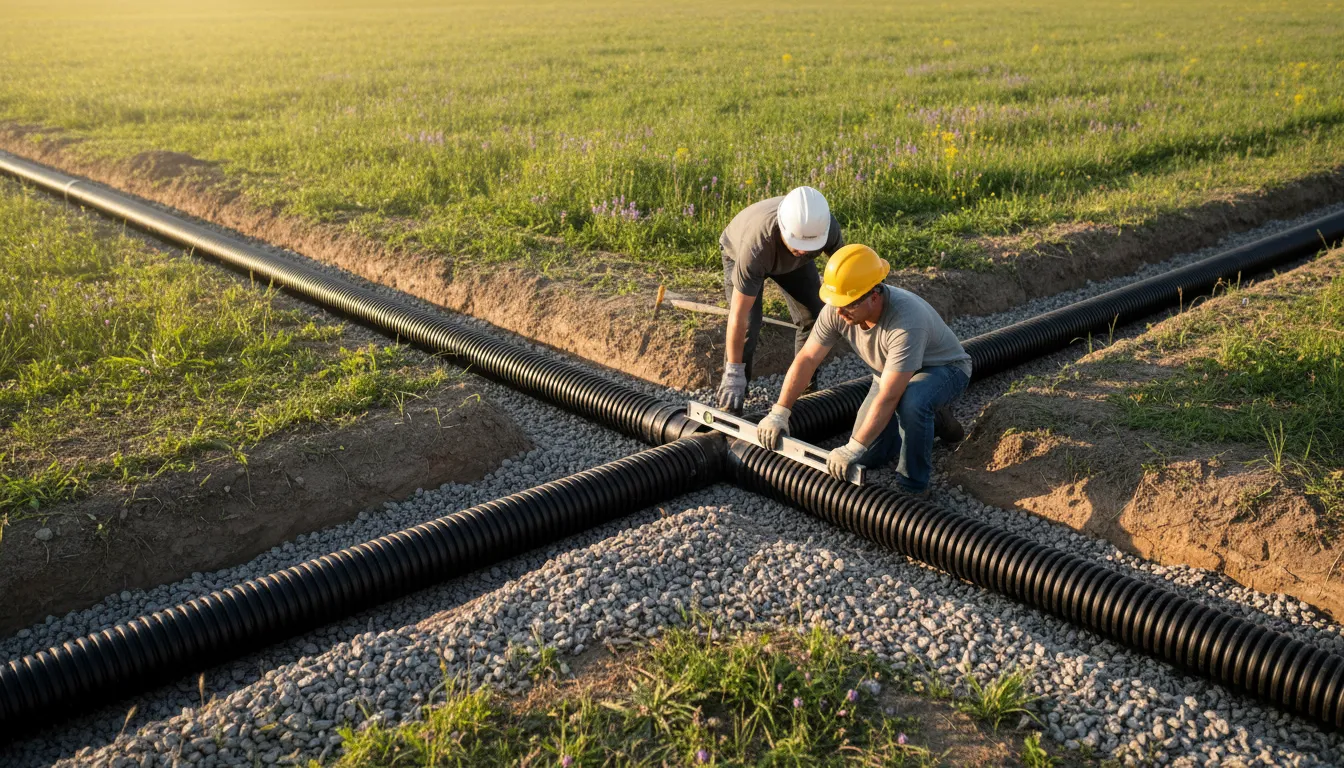
The drain field, also commonly called a leach field or absorption field, is the final and most critical stage of a septic system. After solids settle in the tank, liquid effluent flows into a network of perforated pipes buried in trenches filled with gravel or proprietary chambers. This effluent then slowly percolates into the soil, where natural processes provide final treatment. When this area fails, wastewater can no longer be absorbed, leading to system-wide problems. Recognizing the signs of a failing leach field is the first step toward a solution 1.
Common failure signs include:
- Persistent foul odors around the tank or drain field area.
- Sewage backing up into household drains or toilets.
- Unusually lush, green, wet, or spongy grass directly over the field lines.
- Consistently slow-draining sinks, showers, and tubs.
Why Longmont Presents Unique Challenges
Septic system performance is deeply tied to local geology, and the Longmont area presents specific challenges that directly impact drain field work. The region's soils often have a high clay content, which naturally inhibits the percolation rate-the speed at which water moves through the soil. A slow percolation rate means a standard gravity-fed system may not work, requiring a larger drain field area or a more complex, engineered alternative.
Other critical site constraints that professionals must evaluate include:
- Water Table Depth: A high water table can saturate a drain field, preventing proper treatment and dispersal.
- Lot Slope: Steep slopes can cause hydraulic overloading and require specialized design.
- Proximity to Water: Setback distances from wells, streams, and property lines are strictly enforced by Boulder County to protect water quality 2.
The Regulatory Landscape: Permits and Professionals
Any significant repair or full replacement of a septic system in Longmont requires navigating Boulder County's On-site Wastewater Treatment System (OWTS) regulations. You cannot simply hire an excavator; the process is designed to ensure public and environmental health.
Permitting is Mandatory: A permit from Boulder County Public Health is required for any repair, alteration, or replacement of a septic system. Your licensed installer will typically handle this, but the property owner is ultimately responsible. The permit process ensures the proposed system design is appropriate for your soil and site.
Professional Licensing: All installations and major repairs must be performed by a Boulder County-licensed septic system installer. Furthermore, a qualified professional, such as someone certified by the National Association of Wastewater Technicians (NAWT), must create the official soils report and system design 3. This design is the blueprint submitted for the permit.
Required Inspections: The county mandates specific inspections at critical stages. Most importantly, a final inspection by a county representative is required before the new drain field is backfilled with soil 4. This ensures the installation matches the approved design.
The Step-by-Step Process for Repair or Replacement
When you suspect a problem, a systematic approach is essential. Here's what to expect from initial diagnosis through project completion.
- Professional Evaluation & Testing: A licensed inspector will check the tank's integrity, baffles, and scum/sludge levels. To diagnose the drain field, they will often perform a soil evaluation. This may involve digging a deep soil profile hole (or "pit") or conducting a percolation test to measure the soil's absorption rate 5 6. This data is crucial for the new design.
- System Design & Permitting: If replacement is needed, a licensed designer uses the soil data to create a new system plan. This plan is submitted to Boulder County for permit approval. The design will specify whether a conventional gravity system or an engineered system (like a mound or pressure-dosed system) is necessary for your property's conditions 7.
- Excavation & Installation: Once permitted, the old drain field may be abandoned in place. The new area is excavated according to the design specifications. New perforated pipes are laid in gravel-filled trenches or within specialized chambers, connected to the distribution box from the septic tank.
- Final Inspection & Restoration: Before any backfilling occurs, the county inspector visits to approve the installation of the lateral pipes, gravel, and other components 8. After passing inspection, the trenches are carefully backfilled, and the area is graded and seeded to restore your landscape.
Find the perfect drain field repair companies for your needs
Get personalized recommendations and expert advice
Cost Considerations for Drain Field Work
Costs for septic drain field repair and replacement in Longmont are significant and vary widely based on system size, site accessibility, and soil conditions. The need for an engineered system due to clay-heavy soils or other constraints is a major cost driver. The following estimates are based on regional data for a typical 3-5 bedroom home but should be used as a guideline only; obtaining multiple local quotes is essential.
- Complete System Replacement: Replacing both the septic tank and the entire drain field is the most extensive project. In the Longmont area, costs for this typically range from $28,000 to over $35,000 9.
- Drain Field-Only Replacement: If the septic tank is still functional, replacing just the leach field can cost approximately $7,000 to $10,000+, depending on size 10.
- Septic Tank-Only Replacement: Should only the tank need replacement, expect costs in the range of $9,500 to $11,500 11 12.
- Additional Costs: Remember to factor in county permit fees, which vary by project complexity, and the cost of the required professional soil report and system design. These are typically included in a contractor's total quote.
Maintaining Your New or Repaired System
Protecting your investment in a new absorption field is critical. After a repair or replacement, proper maintenance is non-negotiable. Boulder County requires that all septic systems be inspected by a licensed professional at least every four years, as well as at the time of property sale. Regular pumping of the septic tank (typically every 3-5 years) is the single most important thing you can do to prevent solids from clogging and destroying your new drain field. Additionally, practice water conservation, avoid pouring grease or chemicals down drains, and never drive or build over the drain field area.
Frequently asked questions
Sources
Footnotes
-
The Ultimate Guide to Replacing a Septic Drain Field - https://www.rciseptic.com/the-ultimate-guide-to-replacing-a-septic-drain-field ↩
-
Septic Field Lines: Homeowner's Guide & Maintenance Tips - https://www.vdwws.com/blog/septic-system-field-lines ↩
-
Onsite Wastewater Treatment System - Northeast Colorado Health Department - https://nchd.org/onsite-wastewater-treatment-system/ ↩
-
Colorado Septic Tank Requirements | On-site Wastewater ... - https://www.ntotank.com/blog/colorado-septic-tank-requirements ↩
-
Realtors Guide to Septic Inspections in Southern Colorado - https://saveurseptic.com/wp-content/uploads/2025/02/Realtors-Guide-to-Septic-Inspections-Final.pdf ↩
-
Septic Tank Installation Requirements - Angie's List - https://www.angi.com/articles/complete-septic-installation-checklist.htm ↩
-
Longmont Residentail Excess Runoff - https://longmontcolorado.gov/wp-content/uploads/2024/07/ResidentailExcessRunoff_Brochure_062922.pdf ↩
-
Septic Systems - Adams County Health Department - https://adamscountyhealthdepartment.org/licensing-inspections/septic-systems/ ↩
-
SepticSmart: Maintenance - Boulder County - https://bouldercounty.gov/environment/water/septicsmart/maintenance/ ↩
-
Cost to Replace Septic Tank and Drain Field [2026 Data] | Angi - https://www.angi.com/articles/how-much-new-drain-fields-foot.htm ↩
-
Septic System Replacement Costs, Repair & Pumping in Northern CO - https://boonstraexcavation.com/septic-systems/ ↩
-
How Much Does A Septic System Cost? - https://uniquedrainseptic.com/blogs/resources/how-much-does-a-septic-system-cost ↩