
Find the Best Septic Tank Installation & Replacement Contractors for Your Business
No obligation • Fast responses • Nationwide coverage

Why you can trust Septic Spot
Septic Spot is a leading United States resource for understanding and comparing septic services. Our editors review providers using consistent criteria and verify key business details. Listings and scores are independent, and companies cannot pay to influence our content.
Search providers near you
Top Septic Tank Installation & Replacement Contractors in Omaha, Nebraska Ranked
Installing or replacing a septic system is a significant home improvement project that requires careful planning, professional expertise, and strict adherence to local regulations. For Omaha homeowners, this means navigating the requirements set by the Douglas County Health Department and Nebraska's Title 124 standards. This guide explains the key steps, costs, and regulations for septic system work in Omaha, helping you understand the process and connect with certified local professionals who can ensure your project is completed safely and legally.
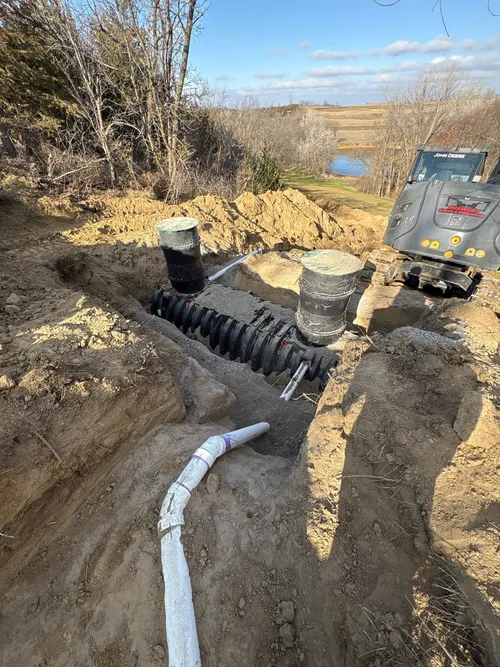
Midwest Septic & Excavating LLC
22377 Sumac Rd, Neola, IA 51559
Midwest Septic & Excavating LLC is a septic system repair and installation company serving Omaha, NE, and the surrounding Council Bluffs, IA area. Established in 2021, the company offers septic system installation, including EcoFlo systems, septic repairs, and excavation services such as trenching and site preparation. Their certified experts handle both new and existing home septic projects with a focus on quality workmanship.

Norm's Pumping Service Inc
20418 Husker Ln, Council Bluffs, IA 51503
Norm's Pumping Service Inc provides septic system services including pumping, inspections, repairs, and installations in Omaha, NE. With over 70 years of experience since 1954, they serve both residential and commercial clients. Their capabilities include septic pump repairs and certified septic tank inspections, as well as grease trap maintenance to prevent sewer line clogs. Norm's offers emergency and routine septic pumping to help maintain system performance.
Understanding Omaha's Septic System Regulations
All new septic system installations and major replacements in Omaha and Douglas County fall under the jurisdiction of the Douglas County Health Department (DCHD) Environmental Health Section. The state's legal framework, Nebraska Title 124, sets the technical standards for design, construction, and operation. A core requirement is that only state-certified professionals can design, install, or repair these systems. This certification ensures the installer understands critical rules, such as mandatory setbacks from water wells, property lines, foundations, and surface water. A fundamental design rule is maintaining a minimum 4-foot separation between the bottom of the drainfield and the seasonal high groundwater table.
The Permit Process: A Step-by-Step Guide
Before any digging begins, you must secure the proper permits. The process typically starts with a site evaluation by a certified professional.
- Initial Site Review & Soil Evaluation: A certified installer will assess your property. The most critical part of this evaluation is a percolation (perc) test, which is mandatory for new systems or drainfield replacements. This test determines the soil's ability to absorb liquid effluent. In Nebraska, a minimum of 3 holes must be dug to the planned drainfield depth and spaced across the proposed site. The holes are pre-saturated with water for at least 4 hours (often overnight) to simulate wet conditions, and then the rate at which the water level drops is timed.
- Permit Application: Your certified professional will submit a system design and permit application to the DCHD. This application includes the soil evaluation results and a detailed plan showing tank placement, drainfield layout, and all required setbacks. The DCHD's initial review often takes 3 to 5 working days 1.
- Permit Fees: Be prepared for associated costs. The Nebraska Department of Environment and Energy (NDEE) construction/operating permit application fee is approximately $450 2. Additional local permit fees from the county can range from $150 to $500.
- Approval and Scheduling: Once the permit is approved, your installer can schedule the construction. They must notify the DCHD at least 48 hours before the installation inspection is needed.
Key Factors in System Design and Installation
The design of your onsite wastewater treatment system depends heavily on the results of the soil evaluation and your property's characteristics.
- Tank Selection and Placement: Tanks are typically concrete, fiberglass, or polyethylene. A standard 1,000-gallon concrete tank may cost between $500 and $900, with an additional $50-$150 per extra 100 gallons of capacity. During installation, the tank must be set perfectly level and bedded on at least 6 inches of sand or fine gravel to prevent shifting 3.
- Drainfield Considerations: The drainfield size is dictated by the perc test results and home size. The soil must be carefully prepared, and the distribution pipes laid according to the approved design. Soil backfill must be compacted in layers to prevent future settling that could damage pipes.
- Site Constraints: While Nebraska does not mandate a minimum lot size, properties smaller than 0.5 acres can struggle to meet all the required separation distances from wells, property lines, and structures 4. This makes the pre-application site review crucial.
Find the perfect septic tank installation & replacement contractors for your needs
Get personalized recommendations and expert advice
Inspection Requirements for Septic System Installation
Inspections are mandatory checkpoints to ensure the work matches the permitted plans. The primary inspection occurs after the tank and drainfield are installed but before they are backfilled with soil 5. A DCHD inspector will visit the site to verify:
- The tank is level and properly bedded.
- All pipe materials and connections are correct.
- The drainfield layout, including pipe spacing and placement, conforms to the design.
- All required setbacks are maintained.
Only after the inspector approves the work can the system be covered. Skipping this inspection can result in fines and orders to excavate the system for inspection.
Cost Breakdown for Septic System Projects in Omaha
The total cost for a complete septic system installation in Omaha varies widely based on soil conditions, tank size, and system type. For a standard anaerobic (conventional) system, homeowners can expect total costs generally ranging from $5,000 to $15,000 or more 6. This includes the tank, drainfield, labor, and permitting. If your soil fails a standard perc test, you may need an alternative system, such as an aerobic treatment unit (ATU). These advanced systems introduce oxygen to treat wastewater more thoroughly and can cost significantly more, typically between $10,000 and $18,000 6.
Planning for a System Replacement
Replacing a failing septic system follows largely the same process as a new installation. If your drainfield is failing, a new perc test will be required for the replacement area 7. Sometimes, a system can be repaired instead of fully replaced-for example, if only the tank lid is damaged or a distribution box is clogged. However, any repair involving the drainfield or a change in system capacity will require a permit and likely a new soil evaluation. Working with a certified professional is essential to correctly diagnose the problem and determine if repair or full replacement is the necessary and most cost-effective solution.
Frequently asked questions
Sources
Footnotes
-
WATER & WASTE WATER - Douglas County Health Department - https://www.douglascountyhealth.com/environmental/water-wastewater ↩
-
Onsite Wastewater Fees, Certifications, & Permits | DWEE NE - https://dee.nebraska.gov/water-quality/wastewater/onsite-wastewater-program/professional-certification/onsite-wastewater-fees-certifications-permits ↩
-
Septic and Holding Tanks Fact Sheet A septic tank or holding ... - https://dee.nebraska.gov/sites/default/files/publications/12-036%20Septic%20and%20Holding%20Tank%20Fact%20Sheet.pdf ↩
-
Septic Systems on Small Lots Title 124 - Onsite Wastewater ... - https://dee.nebraska.gov/sites/default/files/publications/12-038_Septic_Systems_on_Small_Lots_Fact_Sheet.pdf ↩
-
Applying For A Septic Permit - https://cms5.revize.com/revize/knox/Document_Center/EH/Septic%20Systems/Applying%20for%20a%20Septic%20Permit.pdf ↩
-
Understanding Septic Tank Permits and Regulations - https://westcoastsanitationinc.com/understanding-septic-tank-permits-and-regulations/ ↩ ↩2
-
June 2016 - Nebraska.gov - https://dee.nebraska.gov/sites/default/files/publications/2016June.pdf ↩