Find the Best Drain Field Repair Companies for Your Business
No obligation • Fast responses • Nationwide coverage

Why you can trust Septic Spot
Septic Spot is a leading United States resource for understanding and comparing septic services. Our editors review providers using consistent criteria and verify key business details. Listings and scores are independent, and companies cannot pay to influence our content.
Search providers near you
Top Drain Field Repair Companies in Jeffersonville, Indiana Ranked
A failing drain field, also known as a leach field or absorption field, is a serious issue for any Jeffersonville homeowner with a septic system. When this critical component stops properly dispersing treated wastewater, it can lead to soggy yards, foul odors, and even sewage backups into your home. Understanding the local regulations, repair process, and costs is essential for protecting your property and public health. This guide provides the information you need to navigate drain field issues, connect with qualified local professionals, and ensure your system is restored to proper function in compliance with Clark County and Indiana state codes.
Hartman Septic
24 Old 7 Mile Pike, Shelbyville, KY 40065
Hartman Septic provides full-service septic solutions in Louisville, KY, and surrounding areas including Shelby County and Pewee Valley. The company offers residential and commercial septic tank pumping, inspection, repair, installation, and drain field repair or replacement. Hartman Septic is led by Kentucky's first Master Septic Installer, bringing expert knowledge to each project. They are experienced in managing complex septic system issues and work closely with local health authorities to ensure compliance and approved repairs. The company is known for handling excavation and septic challenges efficiently and professionally.
K. Franck Enterprises Inc.
1805 Button Ct, La Grange, KY 40031
K. Franck Enterprises Inc. is a septic system specialist serving Louisville, KY. They provide a full range of services including septic tank pumping, inspections, repairs, and system installations. Their expertise covers conventional septic systems, surface discharge setups, and advanced Norweco brand systems. With nearly 30 years of experience, they understand local soil and environmental conditions and tailor solutions accordingly. They also offer erosion control and drainage services to protect properties and support septic system health. The company manages projects directly with trained professionals and backs their work with a two-year material and workmanship warranty.
Understanding Your Drain Field and Signs of Failure
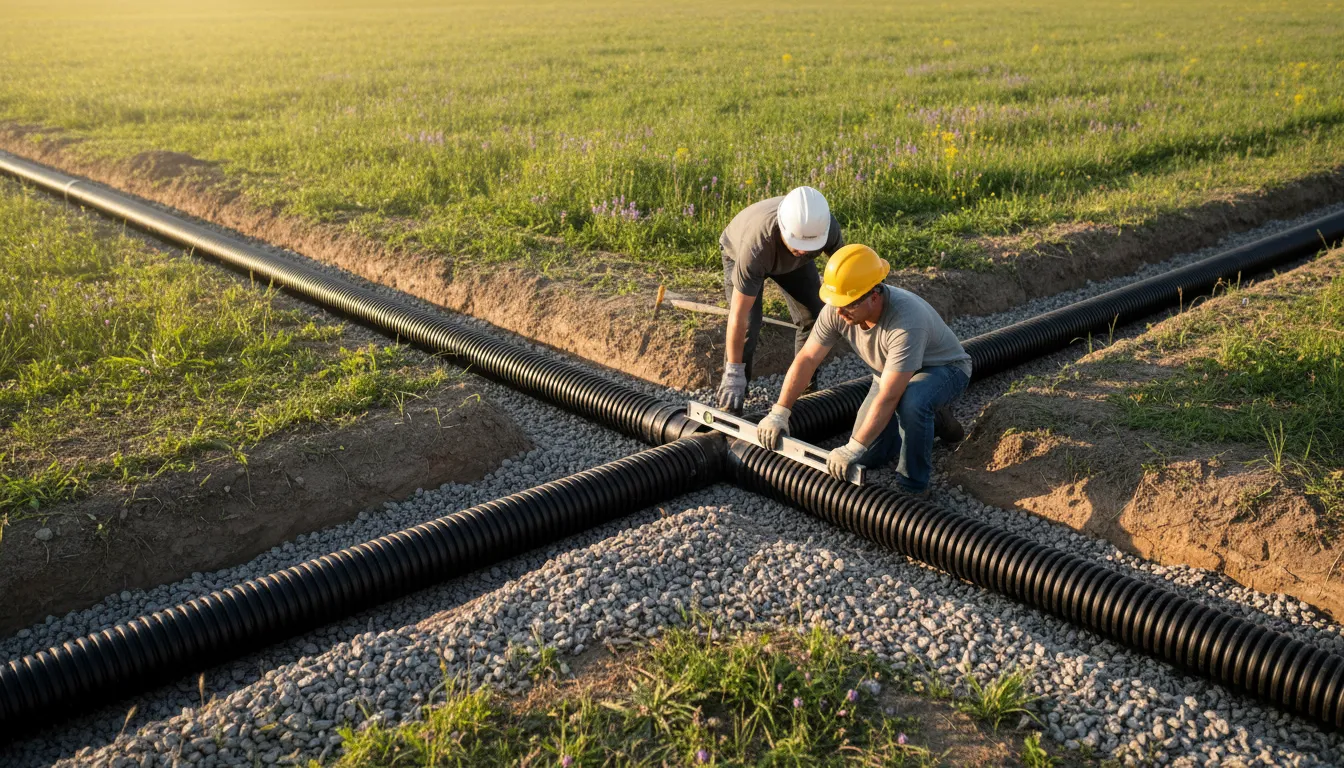
The drain field is the final stage of your onsite sewage system. After solids settle in the septic tank, liquid effluent flows into a network of perforated pipes buried in trenches filled with gravel. This effluent slowly percolates into the soil, where natural processes provide final treatment. In Jeffersonville and surrounding Clark County, soil conditions-particularly areas with dense, expansive clay-can challenge this process over time.
Recognizing early warning signs can prevent a complete system failure and more costly repairs. Be alert for:
- Soggy Ground or Surfacing Sewage: Wet, spongy areas or standing effluent over the drain field, especially when it hasn't rained.
- Foul Odors: Persistent sewage smells in your yard or near the drain field area.
- Slow Drains & Backups: Gurgling pipes, slow-draining sinks and toilets, or sewage backing up into household drains.
- Unusually Green Grass: Patches of grass over the drain field that are much lusher and grow faster than the rest of the lawn.
- Nitrate Contamination: High levels of nitrates in well water, which can indicate a failing system is contaminating groundwater.
If you notice any of these signs, it's crucial to act promptly. A failing system is a health hazard and violates Indiana State Department of Health (ISDH) regulations.
The Regulatory Landscape: Clark County and Indiana Requirements
All septic system work in Jeffersonville is regulated by the Clark County Health Department under Indiana State Department of Health Rule 410 IAC 6-8.3. You cannot begin any repair or replacement without following their specific procedures. The first and most critical step for any suspected drain field failure is to contact the Health Department at 812-282-7521.
Permit is Mandatory: A septic system permit must be obtained from the Clark County Health Department before any excavation or repair work begins. This is non-negotiable. The application process requires details about your property and the proposed repair 1.
Professional Installation Required: All repairs and replacements must be completed by a registered septic installer certified in Indiana. Clark County may require installers to pass a local exam 2. Homeowners are generally not permitted to perform this work themselves.
The "Failed System" Protocol: If a health department environmentalist inspects and declares your system non-functional (due to surfacing sewage, backups, etc.), you must submit a formal repair or replacement application. You will also need to file an "Existing Septic System Verification" form 3.
The Step-by-Step Process for Repair or Replacement
Navigating a drain field project involves a series of defined steps, often starting with a professional inspection.
-
Initial Inspection & Health Department Notification: A licensed installer or inspector will locate and uncover your septic tank and drain field for evaluation. The Clark County Health Department requires that septic tank lids or risers be exposed and easily removable for their inspection 4. They will check for visual evidence of failure and assess components like baffles and the distribution box 5 6.
-
Soil Evaluation & Site Assessment: This is a pivotal step, especially in areas with clay soils. A certified soil scientist must perform a soil profile analysis, typically involving a minimum of three soil borings. They evaluate soil structure, percolation rate, and depth to bedrock or seasonal water table. In expansive clay soils, loading rates are strictly regulated, and no reductions in drain field size are allowed, often necessitating a larger absorption area.
-
System Design & Permit Application: Based on the soil evaluation, a new system must be designed. If soil conditions are poor (shallow bedrock, high water table, heavy clay), a conventional trench system may not be possible. Alternatives like mound systems or systems with subsurface drainage may be required 7. The design plans, along with the permit application and fee, are submitted to the health department for approval.
-
Installation & Final Inspection: Once the permit is issued, your registered installer will execute the repair or replacement. This may involve repairing a section of the leach field or installing a completely new absorption field in a suitable location on your property, adhering to strict setback distances from wells, property lines, and waterways. After installation but before the system is covered, a final inspection by the health department is required for approval 8.
Find the perfect drain field repair companies for your needs
Get personalized recommendations and expert advice
Key Considerations for Jeffersonville Properties
Several local factors heavily influence drain field projects in Clark County.
- Clay Soils: Expansive clay is common in the region. These soils have a slow percolation rate, meaning they don't absorb water quickly. Health department regulations mandate specific, often larger, drain field sizing for these conditions to prevent premature failure 9.
- Site Constraints: Your new drain field must be sited with proper easements and cannot be placed on property you do not own. It must also meet all setback requirements (e.g., 50 feet from a water well) 10. A lack of suitable space on your lot can complicate repairs.
- High Water Table: If the soil evaluation reveals a seasonally high water table, the site may only be deemed suitable if subsurface drainage (tile drains) are installed to lower the water level around the absorption field 11.
- Record Research: Part of the process involves reviewing any existing records at the health department to determine the layout of your current system, which guides the investigation and design.
Understanding the Costs Involved
Costs for drain field work vary widely based on system type, soil conditions, and property accessibility. The figures below are estimates to help you budget; always get detailed quotes from local, registered installers.
- Permit Fees (Clark County): A non-refundable fee is required with your application. Check with the county for the current amount, but it is typically under $200 for repair permits 12 13.
- Soil Evaluation: Hiring a certified soil scientist for the required profile analysis typically costs between $400 and $800 or more.
- System Design: If engineered plans are required (common for mound systems or difficult sites), design fees can range from $500 to $1,500.
- Drain Field Repair/Replacement: The core construction cost. For a simple gravity-fed trench system repair or replacement, expect costs in the range of $3,000 to $10,000+ 14 15.
- Mound System Replacement: In cases where native soil is unsuitable, a raised sand mound system is often the solution. These are significantly more complex and expensive, typically ranging from $15,000 to $30,000 or more 16 17.
Maintaining Your New or Repaired System
Protect your investment by practicing good septic system care:
- Pump Regularly: Have your septic tank pumped every 3-5 years by a licensed professional to prevent solids from clogging the drain field.
- Conserve Water: Spread out laundry loads and fix leaks to avoid hydraulically overloading the system.
- Mind What You Flush: Only human waste and toilet paper should go down the drain. Avoid chemicals, grease, wipes, and feminine hygiene products.
- Protect the Area: Never drive or park vehicles over the drain field, and avoid planting trees with deep roots nearby.
Frequently asked questions
Sources
Footnotes
-
Indiana Septic Tank Requirements | On-Site Sewage Systems - https://www.ntotank.com/blog/indiana-septic-tank-requirements ↩
-
Environmental Health: Installing Your Own Septic System? - IN.gov - https://www.in.gov/localhealth/harrisoncounty/environmental-health/septic-systems/installing-your-own-septic-system/ ↩
-
Clark County Indiana Septic System Installers - https://clarkhealth.net/index.php/environmental-health/septic-systems ↩
-
Indiana Onsite Sewage System Inspection Form - IOWPA - https://iowpa.org/wp-content/uploads/2019/09/Inspection_Form21.pdf ↩
-
Septic - Huntington County - IN.gov - https://www.in.gov/localhealth/huntingtoncounty/environmental-sanitarian/septic/ ↩
-
Septic System Booklet (PDF) - Adams County, IN - https://www.co.adams.in.us/DocumentCenter/View/1769/Septic-System-Booklet-PDF ↩
-
Onsite Sewage Systems Program - IN.gov - https://www.in.gov/health/eph/onsite-sewage-systems-program/ ↩
-
Rule 410 IAC 6-8 Residential Sewage Disposal Systems - IN.gov - https://www.in.gov/health/eph/onsite-sewage-systems-program/historic-bulletins-and-rules/410-IAC-6-8-Residential-Sewage-Disposal-Systems,-1978-05-26.pdf ↩
-
Indiana Septic Tank Requirements | On-Site Sewage Systems - https://www.ntotank.com/blog/indiana-septic-tank-requirements ↩
-
County On-site Sewage Systems Ordinance This ... - IN.gov - https://www.in.gov/health/eph/files/Recommended-Ordinance-Sections-DRAFT-2024-04-29.pdf ↩
-
410 12-156 | IARP - Indiana Administrative Code - https://iar.iga.in.gov/register/20121114-IR-410120156FRA ↩
-
Clark County Indiana Septic System Installers - https://clarkhealth.net/index.php/environmental-health/septic-systems ↩
-
APPLYING FOR A SEPTIC SYSTEM PERMIT - https://clarkhealth.net/images/pdf/online_septic_permit_application_packet.pdf ↩
-
Can Leach Fields Be Repaired? | GoodFlow Solutions - https://www.goodflow.com/can-leach-fields-be-repaired/ ↩
-
NEW HOME CONSTRUCTION OR SYSTEM REPLACEMENT - IN.gov - https://www.in.gov/localhealth/marshallcounty/files/guidance-residential-onsite-sewage-procedures.pdf ↩
-
Indiana Septic System Installation and Permit Procedure Guide - https://www.septicdesign.com/homeowners/the-septic-system-installation-processs-for-indiana/ ↩
-
CHAPTER 51. - SEWAGE AND SEPTIC SYSTEMS REGULATIONS | ... - https://library.municode.com/in/st._joseph_county/codes/code_of_ordinances?nodeId=TITVPUWO_CH51SESESYRE ↩