Find the Best Drain Field Repair Companies for Your Business
No obligation • Fast responses • Nationwide coverage

Why you can trust Septic Spot
Septic Spot is a leading United States resource for understanding and comparing septic services. Our editors review providers using consistent criteria and verify key business details. Listings and scores are independent, and companies cannot pay to influence our content.
Search providers near you
Top Drain Field Repair Companies in Noblesville, Indiana Ranked
A failing drain field, also known as a leach field or soil absorption system, is a serious issue for any home with a septic system. When this critical component stops properly filtering and dispersing wastewater, it can lead to sewage backups, soggy yards, and environmental contamination. In Noblesville, this repair work is a regulated process involving specific permits, soil science, and approved professionals. This guide explains the local requirements, steps, and costs to help you navigate restoring your property's wastewater treatment system.
Understanding Your Drain Field and Signs of Failure
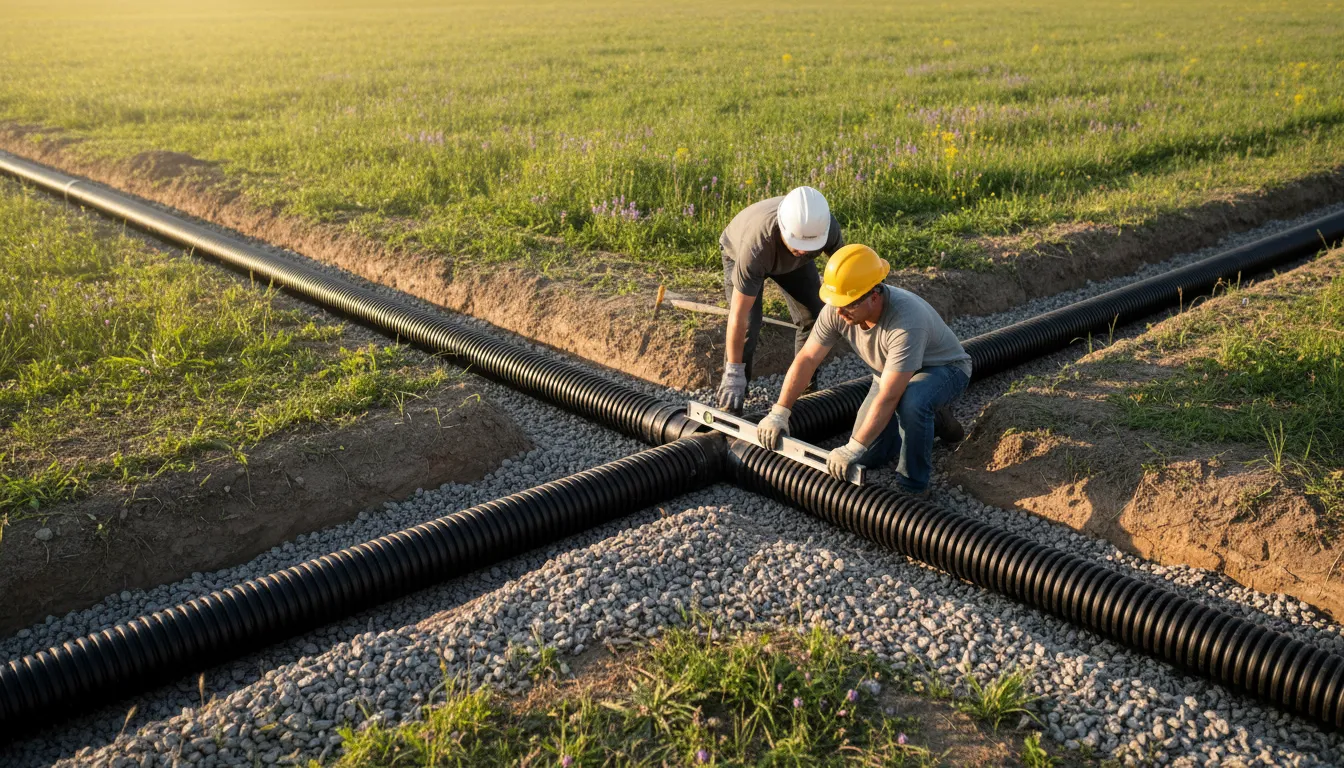
Your septic system is a two-part setup: a watertight tank that holds solids and a drain field that treats the liquid effluent. The drain field consists of a series of perforated pipes buried in trenches filled with gravel. This network allows pre-treated wastewater to slowly seep into the soil, where natural processes remove harmful bacteria, viruses, and nutrients 1. When this area becomes clogged with biomat (a layer of sludge) or fails due to hydraulic overload, compaction, or root intrusion, it can no longer absorb water.
Common warning signs include:
- Sewage odors in the yard or home.
- Wet, spongy, or soggy soil over the drain field area, even during dry weather.
- Surfacing sewage or effluent, often appearing as grayish liquid.
- Unusually lush, green grass growing over the field.
- Slow-draining household fixtures like toilets, sinks, and showers.
- Gurgling sounds in your plumbing.
If you notice any of these issues, it's crucial to act quickly. A failed system is a public health concern and must be addressed to comply with local and state regulations.
Noblesville and Hamilton County Regulations: The First Step
All work on a septic system's leach field in Noblesville is governed by the Hamilton County Health Department (HCHD), which enforces the Indiana State Department of Health (ISDH) Rule 410 IAC 6-8.3. You cannot simply hire a contractor to start digging. The process is designed to ensure repairs protect groundwater and public health.
The cornerstone of this process is the permit. A septic permit from the HCHD is mandatory before any repair, replacement, or alteration begins 2. The application requires a detailed site plan and, for any replacement, a formal soil evaluation report (discussed below). The non-refundable permit fee is currently $200 2.
A critical local rule involves public sewer availability. If a public sanitary sewer line is within 1,000 feet of your property line, the city may require you to connect to it instead of repairing your private septic system 3. This can be a significant project with its own connection fees, so checking with the city is an essential first inquiry.
Furthermore, only contractors who are approved by the Hamilton County Health Department can perform the installation or repair work. Homeowners may install their own system only if they meet specific criteria, including attending a preconstruction meeting with the HCHD. You must also notify the assigned Environmental Health Worker (EHW) 48 hours before starting any work and schedule a final inspection before the new system is covered with soil.
Find the perfect drain field repair companies for your needs
Get personalized recommendations and expert advice
The Mandatory Soil Evaluation: Science Before Shovels
For any drain field replacement-not just a minor repair-a professional soil evaluation is required by law. This isn't a simple look at the dirt; it's a scientific assessment conducted by a registered soil scientist. The goal is to determine the soil's permeability, texture, and depth to limiting layers (like bedrock or a high water table) to calculate the soil-loading rate.
This evaluation dictates the design and size of your new absorption system. The scientist must conduct a minimum of three soil profile evaluations (using borings or test pits) within the proposed repair area 4. They will analyze the soil horizons and classify the site according to state standards. The resulting report is a key document for your permit application and ensures the new system is sized correctly for your home's needs (based on 150 gallons per day per bedroom) and the land's ability to absorb effluent 5.
You pay the soil scientist directly for this service, with fees typically ranging from $400 to $800 or more, depending on the property's complexity.
The Step-by-Step Process for Repair or Replacement
Navigating a drain field project involves a clear sequence of steps:
- Professional System Evaluation: When failure is suspected, contact an HCHD-approved septic professional or the Health Department itself to diagnose the problem. They will determine if the issue is a clogged pipe, a failing tank, or a complete drain field failure 6.
- Soil Scientist Consultation: If replacement is needed, hire a registered soil scientist to perform the mandatory evaluation and produce the required report 7.
- Permit Application: Submit your completed permit application, site plan, and soil scientist's report to the Hamilton County Health Department. The site plan must show the proposed location with all required setback distances from property lines, wells, buildings, and streams 8.
- Site Inspection & Permit Issuance: An HCHD representative will likely inspect the site, especially if soil conditions are challenging. Once approved, your permit is issued.
- 48-Hour Notice & Construction: Hire an HCHD-approved installer and provide the required 48-hour notice before work begins. The installer will excavate and construct the new trenches, pipe, and stone bed according to the approved design.
- Final Construction Inspection: This is mandatory. Before the new drain field is backfilled, the HCHD inspector must visit to verify it was built to code. Do not cover the system before this inspection 9.
- Drainage Permit (If Applicable): If the construction work impacts a regulated drain or utility easement, you may also need a separate permit from the Hamilton County Surveyor's Office 10.
Understanding Costs and System Options
The total cost for a drain field replacement in Noblesville is substantial and varies widely. A standard gravity-fed trench system can start upwards of $5,000 to $10,000 11. Factors that increase cost include:
- Soil Conditions: Poorly draining soil may require a more complex (and expensive) system like a pressurized drip distribution or sand mound system.
- System Size: Larger homes require larger drain fields.
- Site Accessibility: Difficult terrain or limited access for machinery can raise labor costs.
- System Technology: Alternative systems with pumps, alarms, and additional treatment components cost more than conventional gravity systems.
The HCHD operates on a "best judgment" policy. If a standard replacement cannot meet current code on your existing property, the department will work to approve the best possible alternative that complies as closely as possible with state rules. This may involve innovative/alternative (I/A) system designs.
Maintaining Your New Drain Field
Protect your investment with proper care:
- Divert Water: Ensure roof gutters, sump pumps, and surface runoff are directed away from the drain field area.
- Drive and Park: Never drive or park vehicles or heavy equipment over the drain field.
- Plant Wisely: Only plant grass over the field. Tree and shrub roots can clog and damage pipes.
- Conserve Water: Spread out laundry loads and fix leaks to avoid hydraulically overloading the system.
- Mind What You Flush: Only human waste and toilet paper should go down the drain. Avoid chemicals, grease, and non-biodegradable items.
Frequently asked questions
Sources
Footnotes
-
Frequent Questions on Septic Systems | US EPA - https://www.epa.gov/septic/frequent-questions-septic-systems ↩
-
Septic System Policy - Hamilton County Public Health - https://www.hamiltoncountypublichealth.com/wp-content/uploads/2020/02/Septic-Systems-Policy-Revised-2-2020.pdf ↩ ↩2
-
§ 159.080 SEWERAGE FACILITIES. - https://codelibrary.amlegal.com/codes/noblesville/latest/noblesville_in/0-0-0-9267 ↩
-
County On-site Sewage Systems Ordinance This ... - IN.gov - https://www.in.gov/health/eph/files/Recommended-Ordinance-Sections-2024-05-28.pdf ↩
-
Indiana Septic Tank Requirements | On-Site Sewage Systems - https://www.ntotank.com/blog/indiana-septic-tank-requirements ↩
-
Indiana Soils:Evaluation and Conservation Online Manual - https://www.agry.purdue.edu/soils_judging/new_manual/ch4-homesite-onsite.html ↩
-
Permits - Hamilton County, IN - https://www.hamiltoncounty.in.gov/300/Permits ↩
-
Septic Systems | Indiana State Department of Health - IN.gov - https://www.in.gov/localhealth/miamicounty/files/In-Your-Own-Backyard-Septic-Systems-ADunn.pdf ↩
-
Residential On-Site Sewage System Permit Procedure - https://www.hamiltoncounty.in.gov/DocumentCenter/View/432/Residential-On-Site-Sewage-System-Permit-Procedure-PDF ↩
-
Drainage Permits - Hamilton County, IN - https://www.hamiltoncounty.in.gov/615/Drainage-Permits ↩
-
Drain Field Replacement Services near Hamilton County ... - https://finalgradex.com/drain-field-replacement-near-indiana-hamilton-county ↩