Find the Best Drain Field Repair Companies for Your Business
No obligation • Fast responses • Nationwide coverage

Why you can trust Septic Spot
Septic Spot is a leading United States resource for understanding and comparing septic services. Our editors review providers using consistent criteria and verify key business details. Listings and scores are independent, and companies cannot pay to influence our content.
Search providers near you
Top Drain Field Repair Companies in Cleveland Heights, Ohio Ranked
A failing drain field is a serious issue for any home with a septic system, leading to unpleasant odors, soggy yards, and potential health hazards. Drain field repair and replacement involves diagnosing and fixing the underground network of pipes and soil that treats and disperses wastewater from your home. In Cleveland Heights, this work is strictly regulated to protect public health and the environment. This guide explains the local process, regulations, and key considerations to help you understand your options and connect with qualified local professionals for your leach field or soil absorption system needs.
Double Flush Septic Services
2481 Remsen Rd, Medina, OH 44256
Double Flush Septic Services is a family-owned company based in Medina, OH, providing septic system installation, pumping, inspection, and repair services throughout Akron and the surrounding Northeast Ohio counties. They serve a broad area including Medina, Summit, Stark, Wayne, and Cuyahoga counties, offering expertise in maintaining and repairing septic tanks, drain fields, and aeration systems such as Norweco, Hydro-Action, and Marlow-Hunter. The company also provides emergency septic services and commercial grease trap cleaning, with capabilities like hydro jetting and drain snaking to address severe blockages. Double Flush Septic Services emphasizes local knowledge of Ohio's climate and soil conditions to support system longevity and functionality.
Wolcott Septic
13781 G.A.R. Hwy., Chardon, OH 44024
Wolcott Septic is a septic service provider located near Cleveland, OH. The company offers septic tank pumping, inspection, and repair services to help maintain and restore septic systems. Their expertise includes handling various types of drain fields such as drip, mound, gravity, and pressure systems, as well as advanced pre-treatment systems. Wolcott Septic focuses on preventing septic failures and maintaining system cleanliness through professional pumping and repair services.
Understanding Your Drain Field's Role
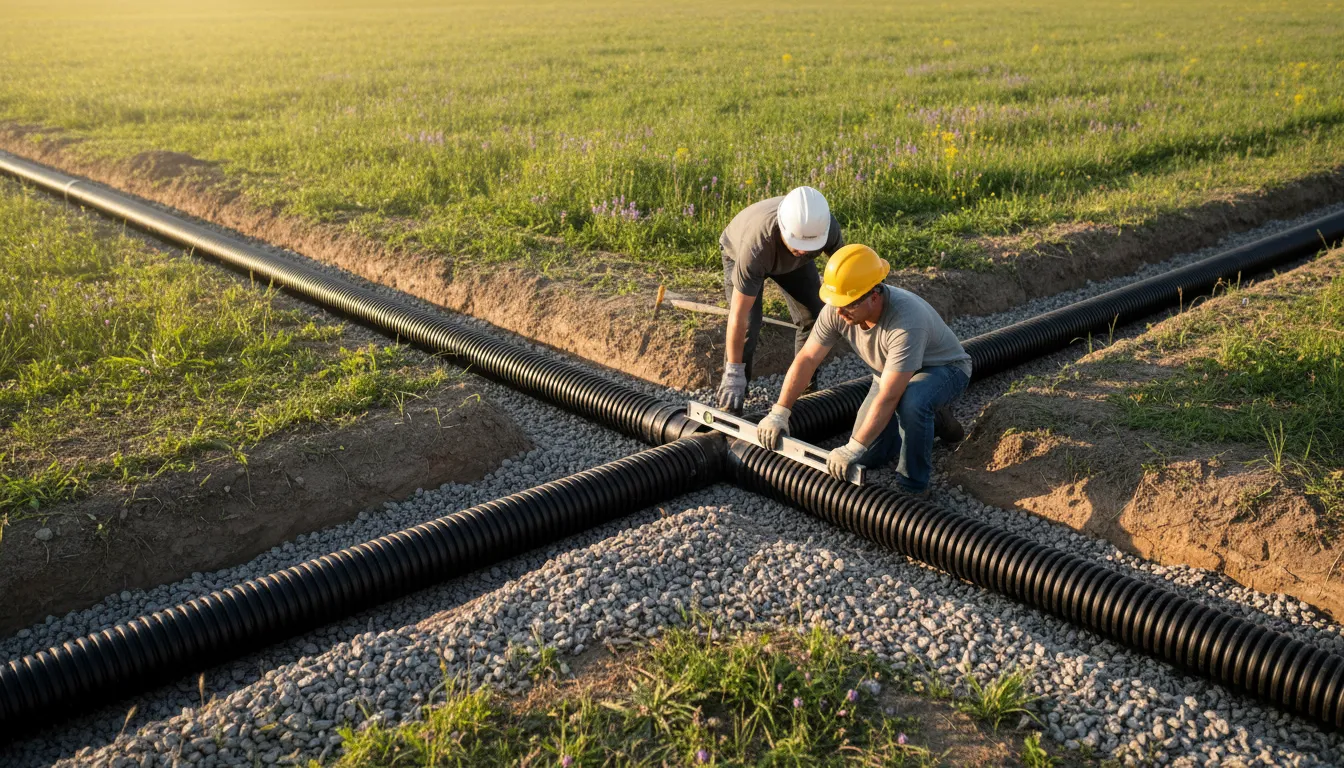
Often called a leach field or soil absorption system, the drain field is the final and most critical stage of a septic system. After solids settle in the septic tank, the liquid effluent flows into a series of perforated pipes buried in gravel-filled trenches. This effluent slowly percolates through the soil, where natural processes remove harmful bacteria, viruses, and nutrients before the water rejoins the groundwater. A properly functioning drain field is essential for preventing contamination of nearby wells, streams, and property.
Signs of a Failing Drain Field in Cleveland Heights
Recognizing early warning signs can prevent a minor issue from becoming a major environmental and financial problem. According to Ohio regulations, a system is considered failing if it exhibits any of the following:
- Surfacing Effluent: Sewage or gray water pooling on your lawn, especially over the drain field area.
- Sewage Backups: Wastewater backing up into household drains, tubs, or toilets.
- Foul Odors: Persistent sewage smells in the yard or near the system.
- Unusually Lush Grass: Patches of grass over the drain field that are much greener and faster-growing than the rest of the yard.
- Slow Drains: Throughout the house, not isolated to one fixture.
If you observe any of these signs, it's crucial to contact a registered professional immediately for an evaluation.
The Regulatory Landscape: Cuyahoga County Board of Health
All septic system work in Cleveland Heights falls under the jurisdiction of the Cuyahoga County Board of Health (CCBH), which enforces the Ohio Administrative Code (OAC) Chapter 3701-29 1. You cannot simply hire any contractor to dig up and replace your leach field. The process is designed to ensure the new system is safe, effective, and properly sited.
Key Regulatory Points:
- Registered Contractors: All installation, alteration, and replacement work must be performed by an Ohio Department of Health (ODH) registered Sewage Treatment System (STS) contractor 2.
- Permits are Mandatory: If a failing system cannot be repaired, a full replacement or alteration permit from the CCBH is required before any work begins.
- System Inspections: Standard systems require a compliance inspection every 3 years, while systems with electrical or mechanical components need annual inspection 3.
The Step-by-Step Process for Repair or Replacement
Navigating a drain field project involves a series of defined steps to comply with local health codes.
1. Professional System Evaluation & Dye Test
The first step is a thorough assessment by a registered STS contractor. They will perform a diagnostic inspection, which may include a dye test, to confirm the drain field is the source of failure and determine if a simple repair is possible or if a full replacement is necessary 4 5.
2. Permit Application
Your contractor (or you, as the homeowner) must apply to the CCBH for a repair or alteration permit. The application will detail the proposed solution. Permit fees apply; for example, the state charges $75 for a new tank permit and $35 for an alteration, with additional local fees 6 7.
3. Critical Site & Soil Evaluation
This is a cornerstone of the process. If a new absorption field is needed, a qualified soil scientist or system designer must evaluate your property. They conduct a percolation ("perc") test and soil analysis to determine:
- Soil Type and Depth: The soil must have adequate permeability to infiltrate wastewater but not so fast that it fails to treat it.
- Setback Distances: Ohio law mandates strict minimum distances from septic components to wells, property lines, buildings, and water sources. For example, drain fields must typically be at least 10-20 feet from a house, with greater distances required for water wells 8.
- Usable Area: The evaluation identifies a suitable, protected area for the new leach field that meets all setbacks and has the correct soil conditions 9.
4. Design and Installation/Replacement
Using the soil evaluation data, a new system is designed. A typical drain field consists of three to five trenches, 18 to 24 inches deep, containing perforated pipe laid in gravel and covered with at least 12 inches of soil 10. The registered contractor then excavates and installs the new system, taking care to avoid compacting the soil in the new absorption area with heavy machinery, as compaction destroys its ability to absorb water 11 12.
5. Final Inspection and Operation Permit
Before the new trenches are backfilled, a CCBH inspector must perform a final inspection to ensure the installation matches the permitted design and meets all health codes 13 14. Once approved, the system is covered, and a new Operation Permit is issued. This permit must be maintained for the life of the system.
Find the perfect drain field repair companies for your needs
Get personalized recommendations and expert advice
Costs and Financial Considerations
Costs for drain field work vary widely based on the extent of the problem, soil conditions, and the size of the system needed.
- Routine Maintenance: Proactive care, including pumping your septic tank every 3-5 years, costs between $100 and $200 per year on average and is the best way to avoid premature drain field failure 15.
- Septic Tank Replacement: If the tank also needs replacing, a 1,000-gallon concrete tank can cost between $500 and $900 for the tank itself, plus significant installation labor 16.
- Point of Sale Inspection: In Cleveland Heights, a system inspection is required during property transfer, with an average cost around $350 17.
- Financial Assistance: Ohio homeowners may qualify for low-interest loans or grants through the Water Pollution Control Loan Fund (WPCLF) to help finance necessary repairs or replacements to correct public health hazards.
Protecting Your New Drain Field
Once installed, the designated drain field area must be protected. Never drive or park vehicles on it, build structures like sheds or decks over it, or plant trees with deep roots nearby. The area should only have a grass cover to prevent soil erosion and promote evaporation 18.
Abandonment Requirements
If the City of Cleveland Heights extends a sanitary sewer line to your property and you connect to it, you are legally required to properly abandon your septic system in accordance with OAC rule 3701-29-21 19. This involves pumping out the tank and having it either removed or filled with an inert material like sand or concrete to prevent future collapse.
Frequently asked questions
Sources
Footnotes
-
Sewage Treatment Systems - Ohio Department of Health - https://odh.ohio.gov/know-our-programs/sewage-treatment-systems ↩
-
Information for Contractors - Ohio Department of Health - https://odh.ohio.gov/know-our-programs/sewage-treatment-systems/INFORMATION-FOR-CONTRACTORS ↩
-
Information for Homeowners - https://odh.ohio.gov/know-our-programs/sewage-treatment-systems/INFORMATION-FOR-HOMEOWNERS ↩
-
Sewage Treatment Systems Forms & Bond Lists - https://odh.ohio.gov/know-our-programs/sewage-treatment-systems/forms ↩
-
Household Sewage Treatment Systems (HSTS)- NPDES - Ohio EPA - https://epa.ohio.gov/divisions-and-offices/surface-water/permitting/discharging-household-sewage-treatment-systems-general-permits ↩
-
Septic Tanks Get New Rules in Ohio - Clear Drain Cleaning - https://cleardraincleaning.com/septic-tanks-get-new-rules-ohio/ ↩
-
Home Sewage Treatment Systems (HSTS) - Ohio EPA - https://epa.ohio.gov/wps/portal/gov/epa/divisions-and-offices/environmental-financial-assistance/financial-assistance/home-sewage-treatment-systems-hsts ↩
-
How Far Should You Put A Septic System From Your House? - https://www.townesseptic.com/blog/how-far-should-you-put-a-septic-system-from-your-house ↩
-
New or Replacement Sewage Treatment Systems - https://www.scph.org/water-quality/new-or-replacement-sewage-treatment-systems ↩
-
Septic Drain Field Design and Maintenance - SERA-17 - https://sera17.wordpress.ncsu.edu/septic-drain-field-design-and-maintenance/ ↩
-
Rule 3701-29-15 - Ohio Administrative Code - https://codes.ohio.gov/ohio-administrative-code/rule-3701-29-15 ↩
-
Septic System Leach Fields: Soil Health Impact Guide - https://smartsepticpros.com/blog/septic-system-leach-fields/ ↩
-
Information for Homeowners - https://odh.ohio.gov/know-our-programs/sewage-treatment-systems/INFORMATION-FOR-HOMEOWNERS ↩
-
Chapter 3718 - Ohio Revised Code - https://codes.ohio.gov/ohio-revised-code/chapter-3718 ↩
-
STS Components, Systems and Maintenance - https://odh.ohio.gov/know-our-programs/sewage-treatment-systems/information-for-homeowners/sts-components-systems-and-maintenance ↩
-
Residential Septic Tank Pricing | Homeowner's Guide to Costs - https://www.ntotank.com/blog/residential-septic-tank-pricing ↩
-
SEWAGE TREATMENT SYSTEM POINT OF SALE ... - CCBH.net - https://www.ccbh.net/wp-content/uploads/2019/01/SEWAGE-TREATMENT-SYSTEM-POINT-OF-SALE-EVALUATION-APPLICATION-12-26-2018.pdf ↩
-
Septic System Maintenance | Ohioline - https://ohioline.osu.edu/factsheet/aex-740 ↩
-
Rule 3701-29-06 - Ohio Administrative Code - https://codes.ohio.gov/ohio-administrative-code/rule-3701-29-06 ↩