Find the Best Drain Field Repair Companies for Your Business
No obligation • Fast responses • Nationwide coverage

Why you can trust Septic Spot
Septic Spot is a leading United States resource for understanding and comparing septic services. Our editors review providers using consistent criteria and verify key business details. Listings and scores are independent, and companies cannot pay to influence our content.
Search providers near you
Top Drain Field Repair Companies in Franklin, Tennessee Ranked
A failing septic system drain field is a serious issue that can lead to property damage and environmental contamination. In Franklin, Tennessee, repairing or replacing this critical component is a regulated process that requires specific permits and licensed professionals. This guide explains the local requirements, common procedures, and costs associated with septic leach field work, helping you understand the steps to restore your system's function and protect your property.
Understanding Drain Fields and Local Soil Challenges
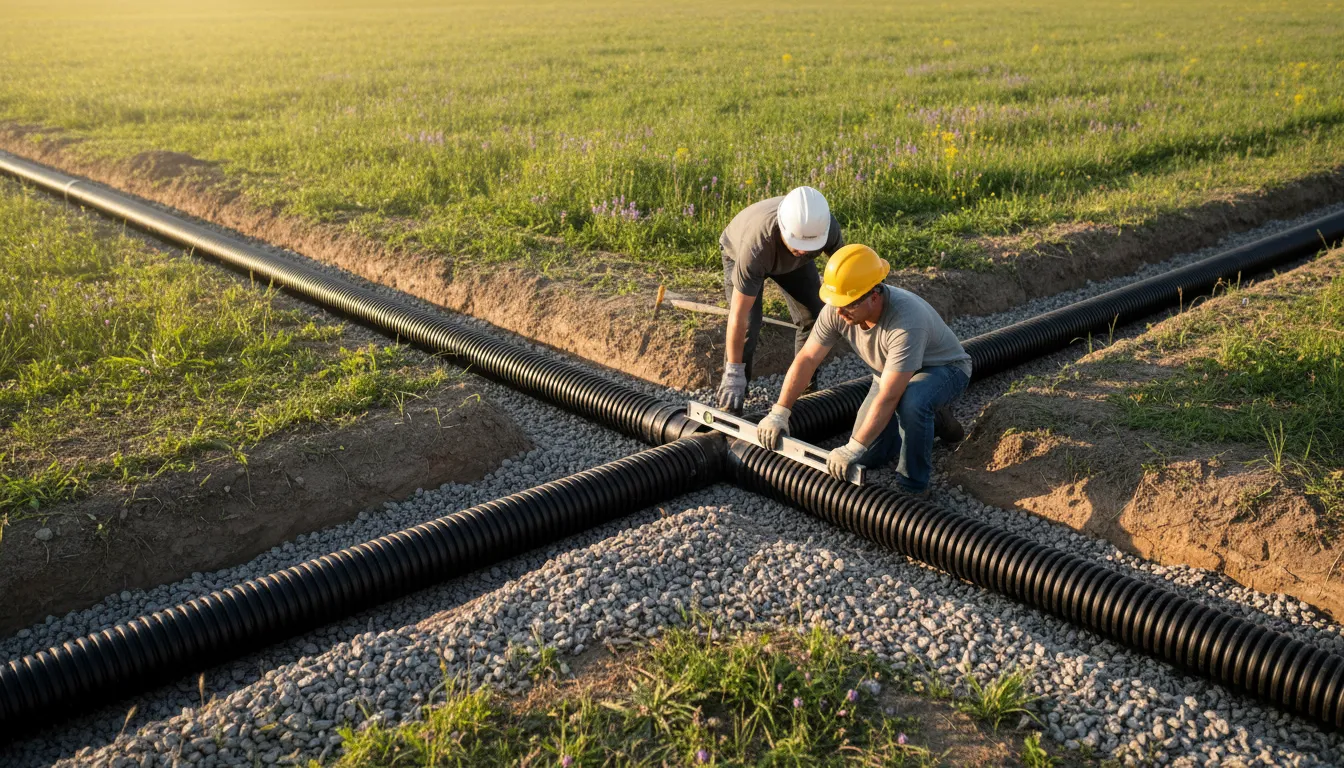
The drain field, also known as a leach field or absorption field, is the final stage of a septic system where treated wastewater is dispersed into the soil. In Franklin and the surrounding Williamson County, this process is heavily influenced by local geology. The area is characterized by karst topography and soils with high clay content, which can slow water absorption and complicate system design 1. Site approval for any system is based on percolation rates, measured in minutes per inch (MPI). Suitable soils for conventional gravity systems typically have MPI ratings between 30 and 105. Many sites in the county are unsuitable for standard systems, often necessitating more complex alternative systems like low-pressure pipe (LPP) or mound systems.
Regulatory Oversight: Permits and Inspections
All major septic system repairs and replacements in Franklin are governed by the Williamson County Sewage Disposal Management (WCDSDM), which acts as a contract agent for the Tennessee Department of Environment and Conservation (TDEC) 2. Before any significant work begins, a Septic System Repair Permit must be obtained. This is a non-negotiable requirement for any alteration to the system, including drain field work.
The permitting process is designed to ensure repairs meet health and environmental standards. It can be rigorous, with county regulations allowing for up to 11 inspections throughout a project, which can add considerable time to the completion schedule 3. The final inspection for a repair permit carries a fee of $100, with re-inspection fees costing $50 per visit if the work is not ready or fails inspection 4. It's crucial to engage a county-licensed installer from the start, as only they can legally perform the work and navigate the permit and inspection process 5.
Signs You Need Drain Field Attention
Recognizing early warning signs can prevent a complete system failure and more expensive repairs. Key indicators of a failing leach field include:
- Sewage Backups: Wastewater backing up into household drains, tubs, or toilets is a primary red flag.
- Surface Effluent: The most serious sign is sewage or gray water surfacing in your yard, particularly around the drain field area. This constitutes an emergency.
- Odors and Lush Grass: Strong, persistent odors near the tank or drain field, coupled with spongy soil or patches of grass that are unusually bright green and growing faster than the rest of the lawn, indicate that nutrients are not being properly filtered 6 7.
If you notice sewage surfacing, you may take emergency relief measures like pumping the tank, but you must notify the WCDSDM on the first business day following the incident 8.
The Repair or Replacement Process: A Step-by-Step Guide
Navigating a drain field project involves a clear sequence of steps coordinated between you, your licensed professional, and the county.
- Contact a Licensed Professional: Your first action should be to hire a county-licensed septic installer or pumper. They will diagnose the cause of the failure, which is essential for determining the correct solution.
- Submit a Repair Request: Your installer will typically help you apply for the necessary Repair Permit through the WCDSDM or the TN.gov online portal 9 10.
- Site Evaluation and Plan Approval: A county inspector will visit your property to evaluate the site conditions and approve the proposed repair plan. This evaluation will determine if a simple repair is possible or if a full drain field replacement is necessary 11.
- System Installation or Repair: The licensed installer performs the approved work. For replacements, Williamson County requires that a "duplicate" area (a reserve field) be designated and protected for future use if a conventional system is installed 12.
- Final Construction Inspection: Before the new or repaired drain field is covered with soil, the county inspector must review the construction. Only after this inspection passes can the work be completed.
Find the perfect drain field repair companies for your needs
Get personalized recommendations and expert advice
Understanding Costs: From Minor Repairs to Full Replacements
The cost to address drain field issues in Franklin varies widely based on the solution. While the repair permit itself may not have a direct fee from the state, the associated inspection and construction costs are significant.
- Minor Repairs: Sometimes, the issue is a clogged distribution box or line, which can be cleared or repaired. More commonly, the first step is pumping the septic tank (typically $250-$500) to see if it alleviates the problem, though this is often a temporary fix for a failing field 13.
- Conventional Drain Field Replacement: If a full, conventional gravity system replacement is possible on your property, costs typically range from $3,000 to $7,000 or more 14.
- Alternative System Installation: Due to soil constraints in Williamson County, many properties require alternative systems like mounds or LPP systems. These are engineering-intensive and can cost significantly more than conventional replacements. Local regulatory complexity can increase these costs by up to 10% or more compared to less restrictive areas 15 16.
Special Considerations for Franklin Properties
Franklin homeowners must be aware of several unique local requirements:
- Setbacks: Systems require a 2-foot vertical separation and a 50-foot horizontal setback from high-water levels, such as lakes or streams 17.
- TVA Easements: If your property is within a Tennessee Valley Authority (TVA) flowage easement, you will need special approval from the TVA for any septic system work 18.
- Abandoning Old Systems: If a drain field replacement involves decommissioning an old septic tank, it must be properly abandoned. This involves pumping it out, having it crushed or filled with inert material, and inspected by the county 19.
Working with a professional who is deeply familiar with these Williamson County and Franklin-specific rules is the best way to ensure a compliant and successful project.
Frequently asked questions
Sources
Footnotes
-
Septic Systems - Tennessee Valley Authority - https://tva.com/environment/shoreline-construction-permits/section-26a-guidance/septic-systems ↩
-
SECTION 15 - Williamson County Government - https://www.williamsoncounty-tn.gov/DocumentCenter/View/25657/SECTION-15-revision-3---DRAFT---01-23-25 ↩
-
Inspections | Williamson County, TN - Official Site - https://www.williamsoncounty-tn.gov/396/Inspections ↩
-
state of - TDEC Dataviewers - TN.gov - https://dataviewers.tdec.tn.gov/dataviewers/BGWPC.GET_WPC_DOCUMENTS?p_file=572496293533403377 ↩
-
Licensed Septic System Installers & Septic Tank Pumpers - TN.gov - https://www.tn.gov/environment/permit-permits/water-permits1/septic-systems-permits/ssp/wr-sds-active-installers-pumpers.html ↩
-
SECTION 13 - Williamson County Government - https://www.williamsoncounty-tn.gov/DocumentCenter/View/25656/SECTION-13---revision-2---DRAFT---01-23-25 ↩
-
The Ultimate Guide to Septic Drain Field Maintenance - https://mathisandsonsseptic.com/mathis-sons-septic-blog-orlando-fl/the-ultimate-guide-to-septic-drain-field-maintenance/ ↩
-
EMERGENCY RELIEF MEASURES - Williamson County Government - https://www.williamsoncounty-tn.gov/DocumentView.asp?DID=132 ↩
-
Online Application for Septic Related Services - TN.gov - https://www.tn.gov/environment/permit-permits/water-permits1/septic-systems-permits/ssp/wr-sds-online-application-for-ground-water-protection-services.html ↩
-
SSDS FAQs - TN.gov - https://www.tn.gov/environment/permit-permits/water-permits1/septic-systems-permits/ssp/ssds-faqs.html ↩
-
Franklin County - https://www.franklincountyva.gov/DocumentCenter/View/596/Maintaining-Your-Septic-System-Brochure-PDF ↩
-
SECTION 15 - Williamson County Government - https://www.williamsoncounty-tn.gov/DocumentCenter/View/25657/SECTION-15-revision-3---DRAFT---01-23-25 ↩
-
New Homebuyer's Guide to Septic Systems - EPA - https://www.epa.gov/sites/default/files/2017-08/documents/170803-homebuyerssepticguide_508c.pdf ↩
-
How To Replace A Septic Drain Field Without Costly Mistakes - https://millersepticfl.com/how-to-replace-a-septic-drain-field-without-costly-mistakes/ ↩
-
Regulation reset: Bring back common sense to county rules - https://www.williamsonherald.com/opinion/columns/regulation-reset-bring-back-common-sense-to-county-rules/article_2ca5454a-970d-43f9-a7db-9717b981479b.html ↩
-
Septic System Construction Permit - TN.gov - https://www.tn.gov/environment/permit-permits/water-permits1/septic-systems-permits/ssp/permit-water-septic-system-construction-permit.html ↩
-
Georgia's Septic Drain Field Requirements: Homeowner's Guide - https://smartsepticpros.com/blog/georgias-septic-drain-field-requirements/ ↩
-
Septic Systems - Tennessee Valley Authority - https://tva.com/environment/shoreline-construction-permits/section-26a-guidance/septic-systems ↩
-
Process for Existing Septic Tank Abandonment - Williamson County - http://www.williamsoncounty-tn.gov/DocumentCenter/View/1651 ↩