Find the Best Drain Field Repair Companies for Your Business
No obligation • Fast responses • Nationwide coverage

Why you can trust Septic Spot
Septic Spot is a leading United States resource for understanding and comparing septic services. Our editors review providers using consistent criteria and verify key business details. Listings and scores are independent, and companies cannot pay to influence our content.
Search providers near you
Top Drain Field Repair Companies in Buffalo, New York Ranked
A failing drain field, also known as a leach field or absorption area, is a serious issue for any home with a septic system. It's the final and most critical stage where treated wastewater is dispersed into the soil. When it fails, untreated sewage can back up into your home or surface in your yard, creating health hazards and environmental concerns. In Buffalo and Erie County, all work on septic system drain fields is strictly regulated. This guide explains the local process, regulations, and financial assistance available to help you navigate the necessary steps for repairing or replacing your septic system's drainage area.
Understanding Drain Field Failure
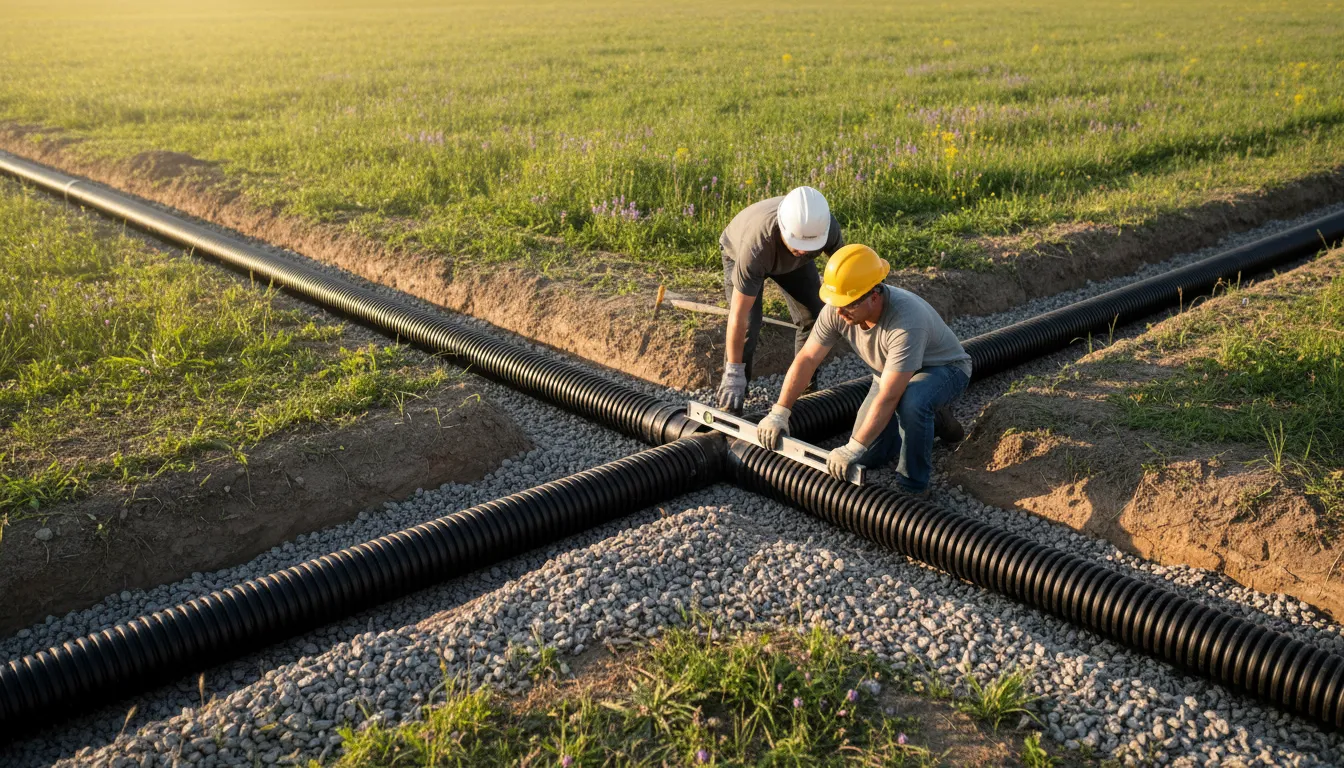
Your septic system is a multi-part wastewater treatment plant for your property. After solids settle in the tank, the liquid effluent flows to the drain field. Here, perforated pipes distribute it into trenches filled with gravel, allowing it to percolate through the soil for final natural treatment. Failure occurs when the soil can no longer absorb the water.
Common signs of a failing leach field include:
- Slow-draining toilets and sinks throughout the house.
- Sewage odors near the tank, drain field, or inside the home.
- Standing water or soggy, spongy ground over the absorption area, even in dry weather.
- Unusually lush, green grass growing over the drain field.
In the Buffalo area, a primary cause of failure is the buildup of a "biomat"-a layer of organic material that clogs the soil pores. Other causes include compacted soil from driving or building over the field, damage from tree roots, or simply old age; most conventional drain fields have a functional lifespan of 30 to 40 years 1.
Erie County's Regulatory Process: Permits Are Mandatory
The Erie County Department of Health (ECDOH) has jurisdiction over all onsite wastewater treatment systems. It is unlawful to begin any repair or replacement of a septic system component without first obtaining a construction permit from the ECDOH.
The formal process begins when you or a licensed contractor submits an Application for Construction Permit for an Onsite Wastewater Treatment System for Existing Residential Lots. This application triggers a mandatory site evaluation by a county sanitarian.
The County Inspection and Dye Test
To confirm system failure, an ECDOH inspector will typically perform a dye test. A non-staining dye is flushed into the system, and the inspector looks for its emergence in the drain field area, which visually confirms a failure of the absorption system. The inspection also includes:
- Locating and assessing the condition of the septic tank and distribution box.
- Checking for visible surfacing sewage or soggy ground.
- Measuring the water level inside the septic tank to check for a high groundwater table.
- If your home has a private well, verifying it meets the required separation distance (typically 100 feet) from the septic system 2.
Property Transfer Inspections
A common scenario that uncovers a failing system is a home sale. Erie County requires an inspection if the property transfer affidavit indicates the home is served by a septic system 3. If this inspection finds the system has failed, the law requires that it be replaced before the sale can be finalized3. This makes understanding the replacement process crucial for both buyers and sellers.
Site and Soil Requirements: New York's Appendix 75-A
All septic system design in New York, including in Buffalo, must comply with Appendix 75-A of the State Sanitary Code. These regulations ensure wastewater is adequately treated by the soil before reaching groundwater. Key site requirements for a new or replacement absorption area include:
- Usable Soil Depth: A minimum of four feet of suitable soil must exist above bedrock or the high groundwater table 4.
- Vertical Separation: There must be at least two feet of soil between the bottom of the leach trench and the seasonal high groundwater table or bedrock.
- Soil Testing: A licensed designer or engineer must conduct deep test pits (at least 6 feet deep) and percolation tests to determine the soil's absorption rate and suitability.
- Location Restrictions: Drain fields cannot be placed under driveways, buildings, patios, or swimming pools. The area must remain undisturbed.
- Reserve Area: Property owners are strongly advised to designate and preserve a "reserve area" on their lot for a future replacement drain field. This is a prudent long-term planning step, as the original area will be spent once used 5.
Find the perfect drain field repair companies for your needs
Get personalized recommendations and expert advice
The Cost of Drain Field Replacement in Buffalo
Replacing an entire septic system, including the drain field, is a significant investment. For 2024, total replacement costs in the Buffalo region typically range from $10,000 to over $25,000. The final price depends heavily on:
- Tank Size: Larger homes require larger tanks.
- System Type: A standard gravity-fed trench system is less expensive than an advanced "enhanced" treatment system or a system requiring pumps or mounds due to poor soil.
- Site Conditions: Difficult access, rocky soil, high groundwater, or the need for extensive excavation can dramatically increase costs.
- Permit and Design Fees: The Erie County construction permit fee is $300, and hiring a licensed professional to design the system is an additional cost 6.
Financial Assistance: The Septic System Replacement Fund
Recognizing the high cost, New York State and Erie County administer a Septic System Replacement Fund (SSRF) program to provide financial relief, particularly for systems impacting water quality.
Eligibility: The primary criterion is that the property must be located within 250 feet of a designated "priority waterbody" in Erie County. You can submit a simple application via email to sewage@erie.gov to determine if your property is in a priority area.
Reimbursement Tiers: If eligible and your system is confirmed failed, the program offers reimbursement after the new system is installed and permitted:
- Up to 50% reimbursement (maximum $10,000) for the installation of a standard, compliant system.
- Up to 75% reimbursement (maximum $25,000) for installing an "Enhanced" treatment system. These systems go beyond standard treatment to significantly reduce nitrogen and phosphorus, which helps protect local waterways like Lake Erie and its tributaries 7 8.
This program provides a powerful incentive to consider higher-level treatment technology if you are eligible.
The Path to a New Drain Field: A Step-by-Step Summary
- Recognize the Problem: Note the signs of failure (slow drains, odors, wet spots).
- Contact the County: Initiate the process by contacting the ECDOH or a licensed septic contractor who can guide you on permit applications.
- Inspection & Permit: The ECDOH will inspect and dye-test to confirm failure. Submit your construction permit application with the $300 fee 9.
- System Design: Hire a licensed contractor or professional engineer to design a new system that meets all Appendix 75-A site requirements for your property 10 11.
- Check for Funding: Email
sewage@erie.govto check SSRF eligibility. If eligible, follow the specific program steps for inspection and reimbursement 12. - Installation: A licensed installer constructs the new septic tank and drain field according to the approved design and permit.
- Final Inspection & Reimbursement: The ECDOH performs a final inspection. Once approved, if you are in the SSRF program, submit your paperwork for reimbursement.
Maintaining Your New System and Avoiding Future Problems
A new drain field is a major investment worth protecting. Key maintenance rules include:
- Regular Pumping: Pump the septic tank every 3-5 years to prevent solids from washing out into the new field.
- Water Conservation: Spread out laundry loads and fix leaks to avoid hydraulically overloading the system.
- Mind What You Flush: Only human waste and toilet paper. No wipes, grease, chemicals, or medications.
- Protect the Area: Never drive, park, or build over any part of the septic system. Keep roof drains, sump pumps, and surface water far away from the drain field 13.
- Landscaping: Only plant grass over the field. Tree and shrub roots can infiltrate and damage pipes.
Frequently asked questions
Sources
Footnotes
-
Top 3 Ways To know a drainfield failed - YouTube - https://www.youtube.com/watch?v=GaUxUynlATU ↩
-
Septic Inspection Explained: What Homeowners Can Expect - https://www.townesseptic.com/blog/what-happens-during-a-septic-inspection ↩
-
Property Transfers | Environmental Health - | Erie County - https://www3.erie.gov/envhealth/property-transfers ↩ ↩2
-
N.Y. Comp. Codes R. & Regs. Tit. 10, app 75-A § 75-A.4 - Soil and ... - https://www.law.cornell.edu/regulations/new-york/10-NYCRR-app-75-A-SS-75-A-4 ↩
-
Do-It-Yourself Septic System Inspection Field Guide - https://doh.wa.gov/sites/default/files/legacy/Documents/Pubs//337-122.pdf ↩
-
erie county department of health onsite wastewater treatment ... - https://www3.erie.gov/envhealth/sites/www3.erie.gov.envhealth/files/2023-03/phedpinstructions.pdf ↩
-
Septic System Replacement Fund Program Outline - https://efc.ny.gov/septic-system-replacement-fund-program-outline-2025-pdf ↩
-
Septic System Replacement Fund Program Outline - https://efc.ny.gov/septic-system-replacement-fund-program-outline-2025-pdf ↩
-
Septic and Onsite Wastewater Systems | Environmental Health - https://www3.erie.gov/envhealth/septic-and-onsite-wastewater-systems ↩
-
APPENDIX 75-A - New York State Department of Health - https://www.health.ny.gov/environmental/water/drinking/docs/appendix_75a.pdf ↩
-
Residential Onsite Wastewater Treatment Systems Design Handbook - https://www.health.ny.gov/environmental/water/drinking/wastewater_treatment_systems/docs/design_handbook.pdf ↩
-
Septic System Replacement Fund Program | Environmental Health - https://www3.erie.gov/envhealth/septic-system-replacement-fund-program ↩
-
Appendix I On-site Wastewater Model Ordinance - | Erie County - https://www3.erie.gov/environment/sites/www3.erie.gov.environment/files/2022-05/appendix_i_onsite_wastewater_model.pdf ↩