Find the Best Drain Field Repair Companies for Your Business
No obligation • Fast responses • Nationwide coverage

Why you can trust Septic Spot
Septic Spot is a leading United States resource for understanding and comparing septic services. Our editors review providers using consistent criteria and verify key business details. Listings and scores are independent, and companies cannot pay to influence our content.
Search providers near you
Top Drain Field Repair Companies in New York, New York Ranked
A failing drain field, also known as a leach field or absorption area, is a serious issue for any New York City property with a septic system. This critical component is responsible for safely filtering and dispersing treated wastewater into the soil. When it malfunctions, it can lead to sewage backups, foul odors, and environmental contamination. Understanding the complex local regulations and finding qualified professionals for septic system repair or a full septic drain field replacement is essential for protecting your property, health, and the surrounding watershed.
This guide provides clear information on the process, costs, and regulatory landscape for drain field work in New York, helping you navigate your options and connect with experienced local specialists.

All Pro Rooter Inc.
New York, NY
All Pro Rooter Inc. is a septic system repair and installation company serving New York, NY, with over 36 years of experience. They provide a range of services including septic tank installation, septic system repair, drain field repair and replacement, land clearing, real estate septic inspections, and general excavation. The company is known for its expertise in septic tank placement and maintenance, and it maintains strong relationships with local health and environmental departments in Westchester County. Their services cover septic tank and drain field maintenance to help ensure proper system function.
Michael Smith Excavating & Septic Systems LLC
205 Bordentown Turnpike, Monroe Township, NJ 08831
Michael Smith Excavating & Septic Systems LLC is a locally owned company based in Monroe Township, NJ, serving New York, NY, and surrounding areas. Established in 1970, the company specializes in septic system installation, repair, inspection, and excavation services for both residential and commercial properties. Their expertise includes comprehensive septic system repairs, drain field replacement, and land excavation tailored to client needs. With over 55 years of experience, they hold certification as septic professionals and are members of the New Jersey Septic Management Association.
Understanding Your Septic System's Drain Field
The drain field is the final stage of a conventional septic system. After solids settle in the tank, liquid effluent flows through pipes into a network of perforated tubes buried in trenches filled with gravel or other aggregate. This effluent slowly percolates through the soil, where natural processes remove harmful bacteria, viruses, and nutrients before the water rejoins the groundwater.
A system fails when this absorption area can no longer accept liquid. Common signs include:
- Sewage backing up into household drains.
- Damp, soggy ground or standing water over the drain field area.
- Unpleasant odors around the tank or field.
- Unusually lush, green grass growing over the field.
- Slow-draining toilets and sinks.
If you notice any of these red flags, the first step is to have your entire system-both tank and leach field-inspected by a licensed professional 1.
New York's Regulatory Landscape for Septic Work
All residential septic system work in New York State, including drain field repair and replacement, is governed by state health code 10 NYCRR Appendix 75-A. This code sets the baseline standards, but local health departments often enforce stricter rules. In New York City and its watershed areas, regulations are particularly stringent to protect water quality.
Key State & Local Requirements:
- Permits Are Mandatory: It is unlawful to replace or substantially alter a septic system without a permit from the local health department or its authorized agent 2. You cannot simply hire a contractor to dig up and replace a field without official approval.
- Local Design Approval: Repair or replacement plans must be approved by the County Health Department or relevant NYC agency 3. In Suffolk County, for example, all new or replacement systems must be designed to reduce nitrogen by at least 30 percent 3.
- NYC Watershed Rules: For properties west of the Hudson River in the Catskill/Delaware Watershed, the Catskill Watershed Corporation (CWC) administers specific programs. Rehabilitation or replacement work here requires CWC-approved plans and often must meet enhanced performance standards 4.
- Soil and Site Evaluations: State law requires a minimum of 4 feet of usable soil above both bedrock and the seasonal high groundwater table for a new absorption area. A professional site evaluation and percolation test are required to determine the design capacity and feasibility of a repair on your property.
The Professional Assessment and Repair Process
When you contact a specialist for a suspected drain field failure, they will follow a systematic process to diagnose the problem and recommend a solution.
- Locating and Uncovering: The technician will locate all system components, including the tank and distribution box, and uncover access manholes.
- Tank Inspection: The tank will be pumped (if needed) and inspected for sludge/scum levels, baffle condition, and structural integrity 5 6.
- Hydraulic Load Test: This is the critical test for the leach field. A large amount of water is run into the system to see if the drain field can absorb it properly. Failure to drain indicates a clogged or saturated field 7.
- Diagnosis & Proposal: Based on the findings, the professional will determine if the issue is a simple repair (e.g., clogged pipe, damaged distribution box) or a complete drain field failure requiring replacement. They will outline the necessary steps, which will involve designing a system that meets local code and submitting for permits.
Find the perfect drain field repair companies for your needs
Get personalized recommendations and expert advice
Drain Field Replacement: What to Expect
If the absorption area has failed irreparably, a full replacement is necessary. This is a significant project with several phases.
Design and Permitting: An engineer or licensed designer creates a plan for a new drain field that complies with all current setbacks from wells, property lines, and watercourses, and meets soil depth requirements 8 9. This plan is submitted to the health department for a permit.
Site Preparation: The old field may be abandoned in place. A new area is prepared, which can involve extensive excavation, soil grading, and ensuring the proper slope for drainage 10.
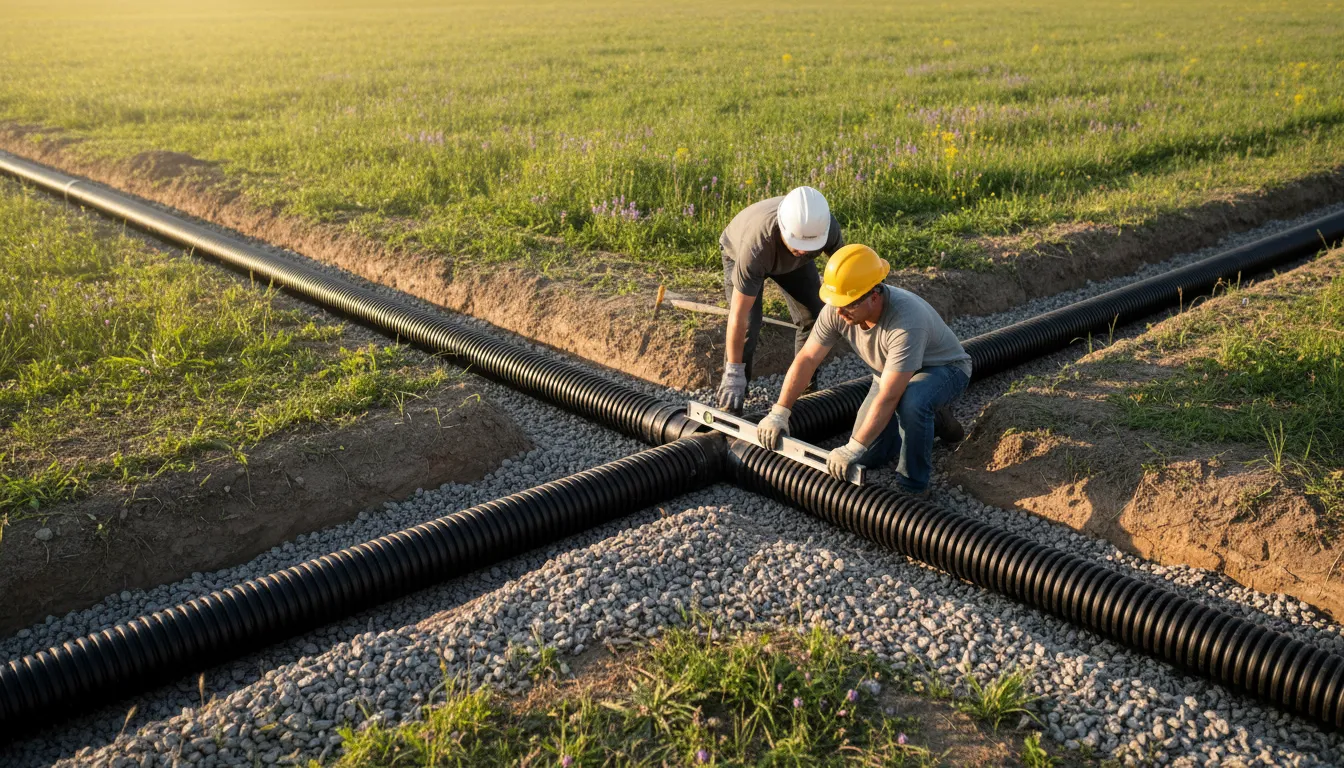
Installation: New perforated pipes are laid in gravel-filled trenches according to the approved design. A new distribution box is installed to evenly disperse effluent from the septic tank to the new field lines.
Costs and Financial Assistance: A complete septic system replacement in New York can range from $10,000 to $30,000 or more, depending on system type, soil conditions, and local requirements 11 12. Rejuvenation techniques (like fracturing or cleaning) may cost $3,000-$7,000 but are not always a permanent fix 11.
- Reimbursement Programs: Financial help may be available. The Catskill Watershed Corporation offers reimbursement for eligible property owners-up to 100% of costs for primary residents under certain programs 13 14.
- NYS Septic System Replacement Fund: New York State also has a program that may provide reimbursement, particularly for properties in priority water quality areas 15 16.
- Permit Fees: Local health department permit fees vary; for example, Putnam County charges around $150 for a repair permit 17.
Maintaining Your New Drain Field
Protecting your investment is crucial. Proper maintenance extends the life of your new leach field for decades.
- Conserve Water: Spread out laundry and dishwasher use to avoid overwhelming the system.
- Mind What You Flush: Only human waste and toilet paper should go down the drain. Avoid chemicals, grease, wipes, and medications.
- Protect the Area: Never drive or park over the drain field. Keep roof drains, sump pumps, and other surface water away from the area.
- Regular Pumping: Have the septic tank pumped regularly (typically every 3-5 years) by a licensed pumper to prevent solids from escaping into and clogging the new field 18.
Frequently asked questions
Sources
Footnotes
-
Septic System - New York State Department of Health - https://www.health.ny.gov/publications/3208.pdf ↩
-
1 RCNY §8001-01 - NYC.gov - https://www.nyc.gov/assets/buildings/rules/1_RCNY_8001-01.pdf ↩
-
Residential Standards 2022.04.19.pdf - Suffolk County Government - https://www.suffolkcountyny.gov/Portals/0/FormsDocs/health/WWM/Residential%20Standards%202022.04.19.pdf ↩ ↩2
-
septic system rehabilitation and replacement program rules (article 2 ... - https://cwconline.org/wp-content/uploads/2019/02/Article-2A-Program-Rules-Rev.-02-05-19.pdf ↩
-
Preparing for Septic Tank Inspection: 7 Key Steps - https://septic911.com/preparing-for-septic-tank-inspection/ ↩
-
EPA - NYC.gov - https://www.nyc.gov/assets/dep/downloads/pdf/watershed-protection/east-of-hudson-ms4/epa_guide_to_septic_systems_b.pdf ↩
-
Septic Inspections - http://countrysidesepticservice.com/septic-inspections.html ↩
-
APPENDIX 75-A - New York State Department of Health - https://www.health.ny.gov/environmental/water/drinking/docs/appendix_75a.pdf ↩
-
Resolving Septic System Malfunctions | US EPA - https://www.epa.gov/septic/resolving-septic-system-malfunctions ↩
-
How to properly prepare a site for evaluation of a septic system - https://www.youtube.com/watch?v=1rXH1uYUjsY&t=1 ↩
-
Septic Repair vs. Replacement: A Guide to Costs & Red Flags - https://prosepticri.com/septic-repair-vs-replacement-guide/ ↩ ↩2
-
The Ultimate Guide to Replacing a Septic Drain Field - https://www.rciseptic.com/the-ultimate-guide-to-replacing-a-septic-drain-field ↩
-
septic system rehabilitation and replacement program rules (article 2 ... - https://cwconline.org/wp-content/uploads/2020/09/Article-2A-Program-Rules-Rev.-01-07-20.pdf ↩
-
Septic Repair and Replacement - Catskill Watershed Corporation - https://cwconline.org/programs/septic-repair-and-replacement/ ↩
-
Septic System Replacement Fund Program Outline - https://efc.ny.gov/septic-system-replacement-fund-program-outline-2025-pdf ↩
-
New Directions for Local Septic System Management in New ... - https://efc.syr.edu/wp-content/uploads/2025/02/Public-Problem_Private-Property_PDF_2024_FINAL.pdf ↩
-
procedures & policies sewage system repair permits - https://www.putnamcountyny.gov/images/Departments/Department_of_Health/Documents-Forms/Engineering/RP-1_SSTS_Repair_Procedures.pdf ↩
-
Protecting the Environment is Everyone's Job: Prevent Septic ... - https://putnamcountyny.gov/component/zoo/item/protecting-the-environment-is-everyones-job-prevent-septic-failures?Itemid=101 ↩