Find the Best Drain Field Repair Companies for Your Business
No obligation • Fast responses • Nationwide coverage

Why you can trust Septic Spot
Septic Spot is a leading United States resource for understanding and comparing septic services. Our editors review providers using consistent criteria and verify key business details. Listings and scores are independent, and companies cannot pay to influence our content.
Search providers near you
Top Drain Field Repair Companies in New Rochelle, New York Ranked
A failing drain field, also known as a leach field or absorption area, is a serious issue for any home with a septic system. It's the final and most critical stage for treating wastewater, and when it fails, it can lead to sewage backups, soggy yards, and environmental contamination. In New Rochelle, all repair and replacement work is strictly regulated by Westchester County and New York State. This guide explains the local process, costs, and regulations to help you understand your options and connect with qualified, licensed professionals for your project.

Understanding Your Drain Field and Local Regulations
Your septic system is a mini wastewater treatment plant for your property. After solids settle in the tank, the liquid effluent flows to the drain field. Here, it percolates through layers of soil, where natural processes remove harmful bacteria and nutrients before the water rejoins the groundwater. When this area becomes clogged, saturated, or physically damaged, it can no longer absorb effluent, leading to system failure.
In New Rochelle and all of Westchester County, any work on an Onsite Wastewater Treatment System (OWTS), including drain field repair, must be performed by a contractor licensed by the Westchester County Department of Health (WCDOH) 1. You cannot legally hire an unlicensed provider for this specialized work. Furthermore, written approval from the WCDOH is required before any repair or replacement begins. For emergency situations, verbal approval may be granted, but it must be followed up with the proper documentation.
The Step-by-Step Process for Repair or Replacement
Addressing a failing leach field is not a simple fix; it's a multi-step process governed by health codes.
1. Professional Inspection and Diagnosis
The first step is a comprehensive inspection by a licensed professional to confirm the failure and its cause. A thorough evaluation typically includes2 3 4:
- Historical Review: Examining the system's as-built design and past maintenance records.
- Full Access: Locating and exposing the septic tank and distribution box.
- Tank Inspection: Pumping the tank to check for structural damage, baffle integrity, and root intrusion.
- Hydraulic Load Test (Dye Test): Introducing 200-300 gallons of water into the drain field to see if it surfaces, indicating a loss of absorption capacity. Dye is often used to trace the path of failure 5.
- Pipe Inspection: Using a camera to examine the effluent lines and distribution box for blockages or breaks.
- Final Report: A detailed report is provided to you and may be required by the health department to proceed.
2. Soil Evaluation and Percolation Testing
If the drain field is confirmed to have failed, a new system design is usually necessary. This starts with a percolation (perc) test. A licensed engineer or designer conducts this test to determine the soil's absorption rate (how fast water soaks in). The results directly dictate the size and type of leaching area required. Westchester County mandates a minimum of four feet of usable soil above both bedrock and the seasonal high groundwater table. There must also be a minimum two-foot vertical separation between the bottom of any trench and the groundwater6.
3. System Design and Permit Acquisition
Using the perc test results, a licensed design professional creates a new system plan that complies with NY State Appendix 75-A standards7. This plan is submitted to the WCDOH for approval. Once approved, a permit must be obtained. Permit fees in Westchester County for drain field replacement typically range from $450 to $2,000, depending on the project's complexity 8.
4. Installation by a Licensed Contractor
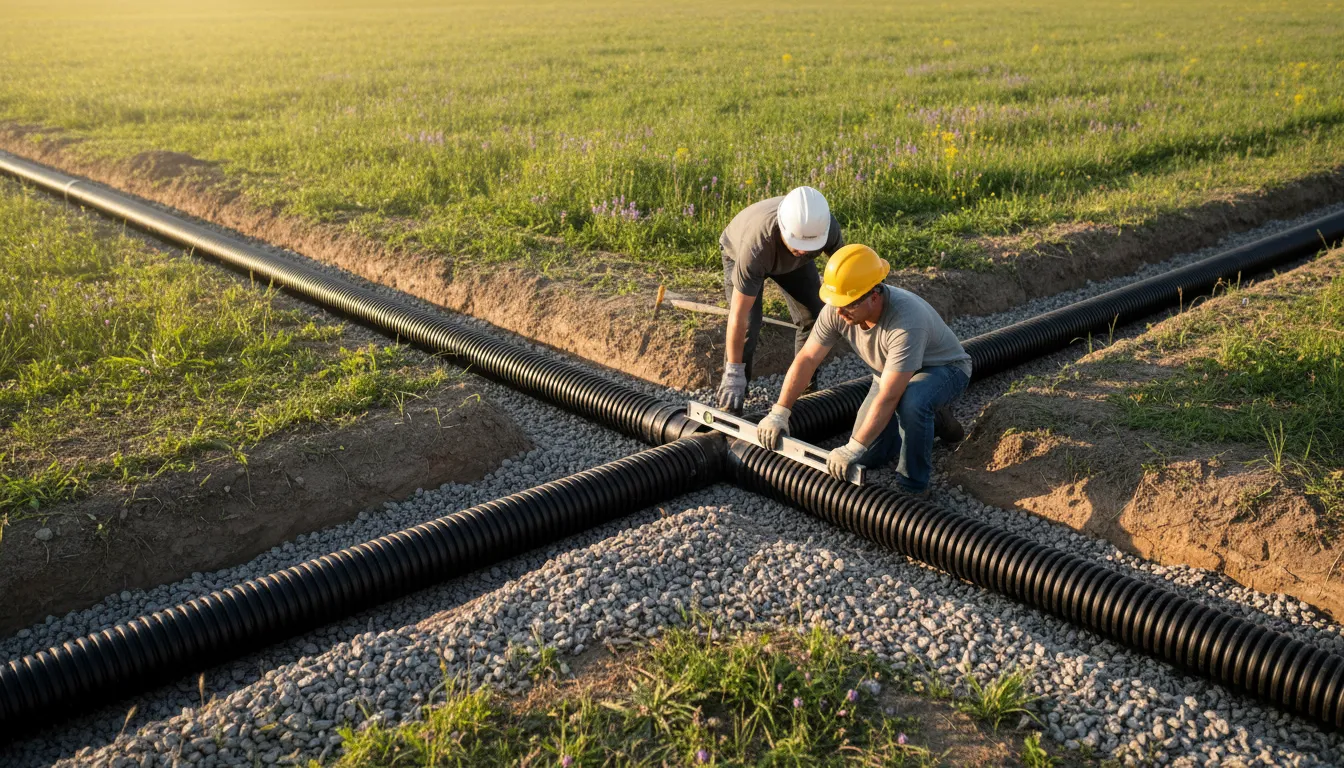
Only after permits are secured can installation begin. The licensed contractor will execute the approved plan. Key installation standards include 9:
- Fill Material: If additional soil is needed, it must be sandy loam or gravel with minimal clay/silt content, placed under professional supervision.
- Setbacks: The new leaching bed cannot be placed under driveways, structures, or pools.
- Slope: Properties with slopes greater than 15% are generally unsuitable for traditional trench systems and may require an alternative technology.
Find the perfect drain field repair companies for your needs
Get personalized recommendations and expert advice
Cost Factors for Drain Field Projects in New Rochelle
The cost to address a failing absorption area is significant and varies based on site conditions. Here's a breakdown of what to expect:
- Percolation Testing: The essential first design step averages around $1,300.
- Drain Field Replacement: The core cost for installing a new leach field typically starts around $7,000 and can increase substantially based on size, soil conditions, and accessibility10 11.
- Full System Replacement: If the septic tank also needs replacement, total costs for a complete new system in New York often range from $10,000 to over $24,000, depending on the home's size12.
- Labor Intensive: Labor is the primary driver, often constituting about 60% of the total project cost.
Financial Assistance: The NY State Septic System Replacement Program
Eligible homeowners in targeted areas may qualify for a state grant that can cover up to 50% of project costs, with a maximum grant of $10,00013 14. This program is designed to help replace failing systems with new, environmentally sound technology. Checking your eligibility is a crucial early step in the planning process.
Maintaining Your New Drain Field
Protecting your investment is key. After a repair or replacement, follow these guidelines to maximize the lifespan of your leaching system15:
- Pump Regularly: Westchester County requires septic tanks to be pumped and inspected at least once every five years16 17. More frequent pumping may be needed for larger households or if you use a garbage disposal.
- Avoid Additives: Commercial septic additives are not recommended by experts, as they can disrupt the bacterial balance and potentially damage components.
- Reduce Solids: Avoid using a garbage disposal, as it significantly increases the solid waste load, leading to more frequent pumping and potential drain field clogging.
- Protect the Area: Never drive, park, or build over your drain field. Compacting the soil destroys its ability to absorb and treat wastewater.
Signs You May Need Drain Field Service
Be proactive. Watch for these warning signs of a potential leach field problem:
- Sewage odors in the yard or home.
- Persistently soggy, spongy, or standing water over the drain field area.
- Unusually green, lush grass over the leach field.
- Slow-draining toilets, sinks, and showers, or frequent backups.
- Gurgling sounds in plumbing fixtures.
If you notice any of these signs, contact a licensed Westchester County septic professional immediately for an inspection. Early intervention can sometimes allow for repairs instead of a full, costly replacement.
Frequently asked questions
Sources
Footnotes
-
Septic System Contractors Require a License - https://health.westchestergov.com/images/stories/realty/septic/Septic_licensing2019.pdf ↩
-
Septic Inspection Service in New York - https://sherwoodinspection.com/septic-inspection-new-york/ ↩
-
What to Expect from a Septic Tank Inspection - https://www.mecindustries.com/morse-engineering-and-construction-industries/what-to-expect-from-a-septic-tank-inspection ↩
-
A Complete Homeowner's Guide to the Process - Septic Masters - https://septic-masters.com/septic-tank-inspection-homeowner-guide/ ↩
-
Septic Tank Home Inspection - what to expect? : r/nova - Reddit - https://www.reddit.com/r/nova/comments/71fv3h/septic_tank_home_inspection_what_to_expect/ ↩
-
View Document - Unofficial New York Codes, Rules and Regulations - https://govt.westlaw.com/nycrr/Document/I4fff5ba8cd1711dda432a117e6e0f345?viewType=FullText&originationContext=documenttoc&transitionType=CategoryPageItem&contextData=%28sc.Default%29 ↩
-
APPENDIX 75-A - New York State Department of Health - https://www.health.ny.gov/environmental/water/drinking/docs/appendix_75a.pdf ↩
-
Septic Systems | Lewisboro, NY - https://www.lewisborony.gov/community/page/septic-systems ↩
-
Rules and Regulations for Design construct residential owtswells 2022 - https://health.westchestercountyny.gov/images/stories/realty/Forms/rulesregsdesignconstructresidentialowtswells22.pdf ↩
-
Cost to Replace Septic Tank and Drain Field [2026 Data] | Angi - https://www.angi.com/articles/how-much-new-drain-fields-foot.htm ↩
-
Drain Field Installation | Hudson Valley & Albany, NY - https://www.proseptichv.com/drain-field-installation ↩
-
How Much Does a Septic System Cost in 2025? What to Expect - https://sewertechli.com/how-much-does-a-septic-system-cost/ ↩
-
Septic System Replacement Fund Program Outline - https://efc.ny.gov/septic-system-replacement-fund-program-outline-2025-pdf ↩
-
NY State Septic Repair and Replacement Program Outline | - https://truesdalelake.com/2021/04/ny-state-septic-repair-and-replacement-program-outline/ ↩
-
Septic System Operation and Maintenance - https://www.health.ny.gov/publications/3208/ ↩
-
Homeowners Septic System-rev_Septic Systems-2-up.qxd - https://health.westchestergov.com/images/stories/realty/septic/homeownersguide-septicsystem.pdf ↩
-
ARTICLE VIII. - SEWERAGE, SEWAGE AND REFUSE | Code of ... - https://library.municode.com/ny/westchester_county/codes/code_of_ordinances?nodeId=PTXISACO_CH873SACO_ARTVIIISESERE_S873.723STAPLISESYCOLISECOOWSEREVE ↩