Find the Best Drain Field Repair Companies for Your Business
No obligation • Fast responses • Nationwide coverage

Why you can trust Septic Spot
Septic Spot is a leading United States resource for understanding and comparing septic services. Our editors review providers using consistent criteria and verify key business details. Listings and scores are independent, and companies cannot pay to influence our content.
Search providers near you
Top Drain Field Repair Companies in White Plains, New York Ranked
A failing septic system drain field, also known as a leach field or absorption field, is a serious issue for any White Plains homeowner. This critical component is responsible for safely dispersing and filtering treated wastewater into the soil. When it malfunctions, it can lead to soggy yards, foul odors, and environmental contamination. Navigating drain field repair or replacement involves strict local health regulations, specialized contractors, and significant investment. This guide explains the process, costs, and key regulations specific to Westchester County to help you understand your options and find qualified local professionals for your septic system needs.

Understanding Your Drain Field and Local Regulations
In White Plains and throughout Westchester County, all work on residential septic system drain fields is regulated by the Westchester County Department of Health (WCDH) and must adhere to New York State Department of Health Appendix 75-A standards. These rules are designed to protect public health and local groundwater, especially given the area's proximity to vital water sources.
A key mandate in many Westchester municipalities is the requirement for septic tanks to be inspected and pumped at least once every five years 1. This preventative maintenance is crucial because allowing solids to carry over from the tank into the drain lines is a primary cause of clogging and system failure. By law, a system is considered failed if there is a discharge of sewage onto the ground surface, into a storm sewer, or into any water body, necessitating immediate repair2.
The Role of Professional Licensing and Permits
You cannot hire just any contractor for this work. All repairs and replacements must be conducted by a contractor licensed by the Westchester County Department of Health. Before any shovel hits the ground, a proper permit must be secured. This typically involves submitting a WCDH "Application for Construction Approval" or "Certificate of Construction Compliance," which will be reviewed against county and state codes3.
Common Causes of Drain Field Failure
Understanding why leach fields fail can help in diagnosing problems and preventing future issues. Common causes around White Plains include:
- Soil Saturation: The most frequent culprit. Over time, the biomat (a layer of bacteria and organic matter) in the trenches can become too thick, or the soil itself can become compacted and unable to absorb effluent.
- Physical Damage: Driving or parking heavy vehicles over the drain field, building structures on it, or planting trees with invasive roots too close by can crush pipes or clog the system.
- System Overload: Consistently exceeding the system's design capacity with excessive water use (long showers, frequent laundry, leaky fixtures) floods the field.
- Poor Soil Conditions: The original system may have been installed in soil with poor percolation rates, or the local water table may have risen, leaving insufficient dry soil for treatment.
- Tank Neglect: Failing to pump the septic tank regularly allows solids to escape and clog the distribution box and drain field pipes.
The Diagnostic and Repair Process
When you suspect a problem, a licensed professional will follow a systematic process to diagnose and address the issue.
1. Locate & Access: The first step is to locate the septic tank and the boundaries of the drain field. All access ports must be cleared for inspection.
2. Pump and Inspect: The tank is pumped out so the inlet and outlet baffles can be examined for damage or blockage. The tank is also checked for structural cracks, leaks, and root intrusion4 5.
3. Soil Evaluation (Percolation Testing): If the drain field needs to be moved or expanded, a percolation (perc) test is mandatory. This test measures how quickly water drains through the soil to determine its suitability for a new absorption field. The NYS code requires a minimum of four feet of usable soil above both bedrock and the seasonal high groundwater table.
4. Distribution Box and Pipe Inspection: The distribution box (D-box), which evenly disperses effluent to each drain line, is checked for levelness and cracks. Drain field pipes are inspected for breaks, collapses, or root blockages6.
5. Repair or Replacement Options:
- Minor Repairs: This may involve replacing a section of crushed pipe, cleaning root intrusions, or installing an effluent filter in the tank outlet to prevent future clogs.
- Drain Field Rehabilitation: In some cases, techniques like jetting high-pressure water through the pipes or adding specialized additives to break down the biomat can restore function, though these are often temporary solutions.
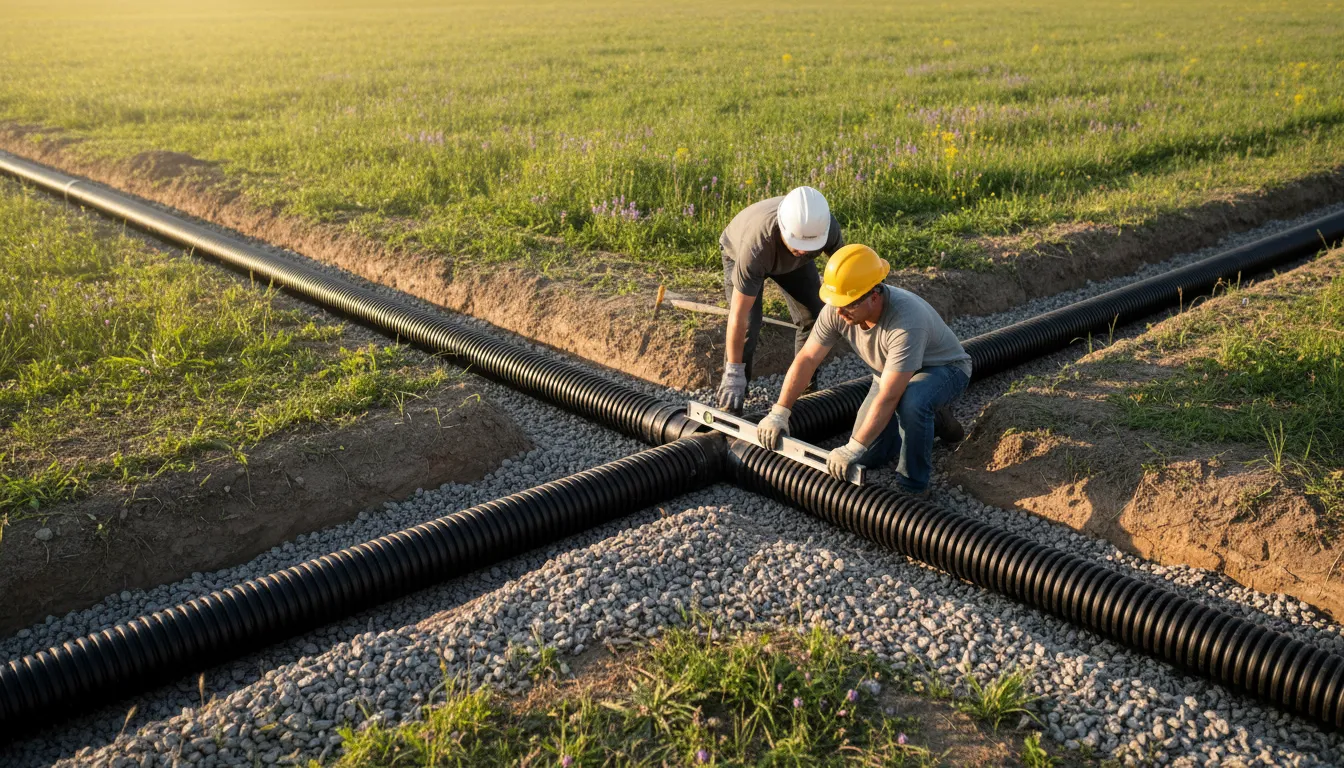
- Partial or Full Replacement: If the soil is permanently saturated or the pipes are extensively damaged, a new drain field must be constructed. This could be in a new area of your property or, if space allows, a replacement "alternating field" system7.
Find the perfect drain field repair companies for your needs
Get personalized recommendations and expert advice
Cost Factors for Drain Field Work in White Plains
The cost of addressing drain field issues can vary widely based on the scope of work, soil conditions, and permit requirements. Here's a breakdown of potential costs:
- Permit Fees: Depending on the project's scope and local town requirements, permit fees can range from $450 to $2,000.
- Percolation Testing: The average cost for professional soil evaluation and perc testing in the region is approximately $1,300.
- Drain Field Repair/Replacement: This is the most significant expense. A full drain field replacement in White Plains typically ranges from $7,000 to $10,000 or more. The final price depends on the size of the field needed, soil conditions (expensive fill material may be required), accessibility, and local labor rates8.
Financial Assistance Programs
Westchester County offers a maintenance reimbursement program for septic tank pump-outs and inspections for properties located within county sewer tax districts9. Furthermore, homeowners in northern parts of Westchester that fall within the New York City Watershed may be eligible for substantial reimbursement-60% to 100% of eligible costs-through the Catskill Watershed Corporation's Septic Repair and Replacement Program10 11. It's crucial to check your specific eligibility for these programs.
Key Installation and Setback Requirements
New York State and Westchester County codes have strict requirements for where a new leach field can be placed:
- Soil Quality: The soil must be permeable. If native soil is unsuitable, it must be replaced with approved run-of-bank sand and gravel that has a percolation rate of ten minutes per inch or less12.
- Setbacks: Absorption fields cannot be placed under driveways, buildings, patios, or swimming pools. They must also maintain specific separation distances from property lines, wells, streams, and other water sources13 14.
- Limiting Factors: Properties with heavy clay soils, high groundwater tables, or steep slopes present significant challenges and may require engineered alternative systems, which can be more costly to install and maintain15.
Maintaining a New or Repaired Drain Field
Protecting your investment after a repair or replacement is essential. Practice water conservation, redirect roof and surface drains away from the field, avoid planting trees or shrubs nearby, and never drive or build over the area. Most importantly, adhere to the mandatory five-year pumping and inspection schedule to prevent solids from damaging your new drain field16 17.
Frequently asked questions
Sources
Footnotes
-
Septic Systems | North Castle, NY - https://www.northcastleny.com/662/Septic-Systems ↩
-
ARTICLE VIII. - SEWERAGE, SEWAGE AND REFUSE | Code of ... - https://library.municode.com/ny/westchester_county/codes/code_of_ordinances?nodeId=PTXISACO_CH873SACO_ARTVIIISESERE_S873.723STAPLISESYCOLISECOOWSEREVE ↩
-
on-site wastewater treatment system checklist - https://health.westchestergov.com/images/stories/Environmental%20Forms/Realty/contructionapprovalchecklist25.pdf ↩
-
Septic Inspection Service in New York - https://sherwoodinspection.com/septic-inspection-new-york/ ↩
-
Preparing for Septic Tank Inspection: 7 Key Steps - https://septic911.com/preparing-for-septic-tank-inspection/ ↩
-
Septic Inspections - http://countrysidesepticservice.com/septic-inspections.html ↩
-
The Importance of Your Septic System Drainfield Leach Field ... - https://biomicrobics.com/articles/importance-septic-system-drainfield-leach-field-repair/ ↩
-
Cost to Replace Septic Tank and Drain Field [2026 Data] | Angi - https://www.angi.com/articles/how-much-new-drain-fields-foot.htm ↩
-
Septic Systems - Westchester County Planning - https://planning.westchestercountyny.gov/septic-systems ↩
-
Septic Repair and Replacement - Catskill Watershed Corporation - https://cwconline.org/programs/septic-repair-and-replacement/ ↩
-
septic system rehabilitation and replacement program rules (article 2 ... - https://cwconline.org/wp-content/uploads/2020/09/Article-2A-Program-Rules-Rev.-01-07-20.pdf ↩
-
Rules and Regulations for Design construct residential owtswells 2022 - https://health.westchestercountyny.gov/images/stories/realty/Forms/rulesregsdesignconstructresidentialowtswells22.pdf ↩
-
APPENDIX 75-A - New York State Department of Health - https://www.health.ny.gov/environmental/water/drinking/docs/appendix_75a.pdf ↩
-
Township of Bedminster, NJ: The Individual Sewage Disposal Systems of Bedminster Township - https://ecode360.com/35873617 ↩
-
Resolving Septic System Malfunctions | US EPA - https://www.epa.gov/septic/resolving-septic-system-malfunctions ↩
-
Homeowners Septic System-rev_Septic Systems-2-up.qxd - https://health.westchestergov.com/images/stories/realty/septic/homeownersguide-septicsystem.pdf ↩
-
Septic Systems | Lewisboro, NY - https://www.lewisborony.gov/community/page/septic-systems ↩