Find the Best Drain Field Repair Companies for Your Business
No obligation • Fast responses • Nationwide coverage

Why you can trust Septic Spot
Septic Spot is a leading United States resource for understanding and comparing septic services. Our editors review providers using consistent criteria and verify key business details. Listings and scores are independent, and companies cannot pay to influence our content.
Search providers near you
Top Drain Field Repair Companies in Bedford, Texas Ranked
A failing drain field is a serious issue for any home with a septic system, leading to unpleasant odors, soggy yards, and potential environmental contamination. Drain field repair and replacement involves diagnosing and fixing the soil absorption area, a critical component that treats and disperses wastewater. For Bedford homeowners, navigating this process means understanding strict Texas regulations, obtaining proper permits, and working with licensed professionals to restore your property's wastewater system safely and effectively. This guide will help you understand the local requirements, common procedures, and what to expect when addressing drain field issues.
Understanding Your Drain Field and Common Failures
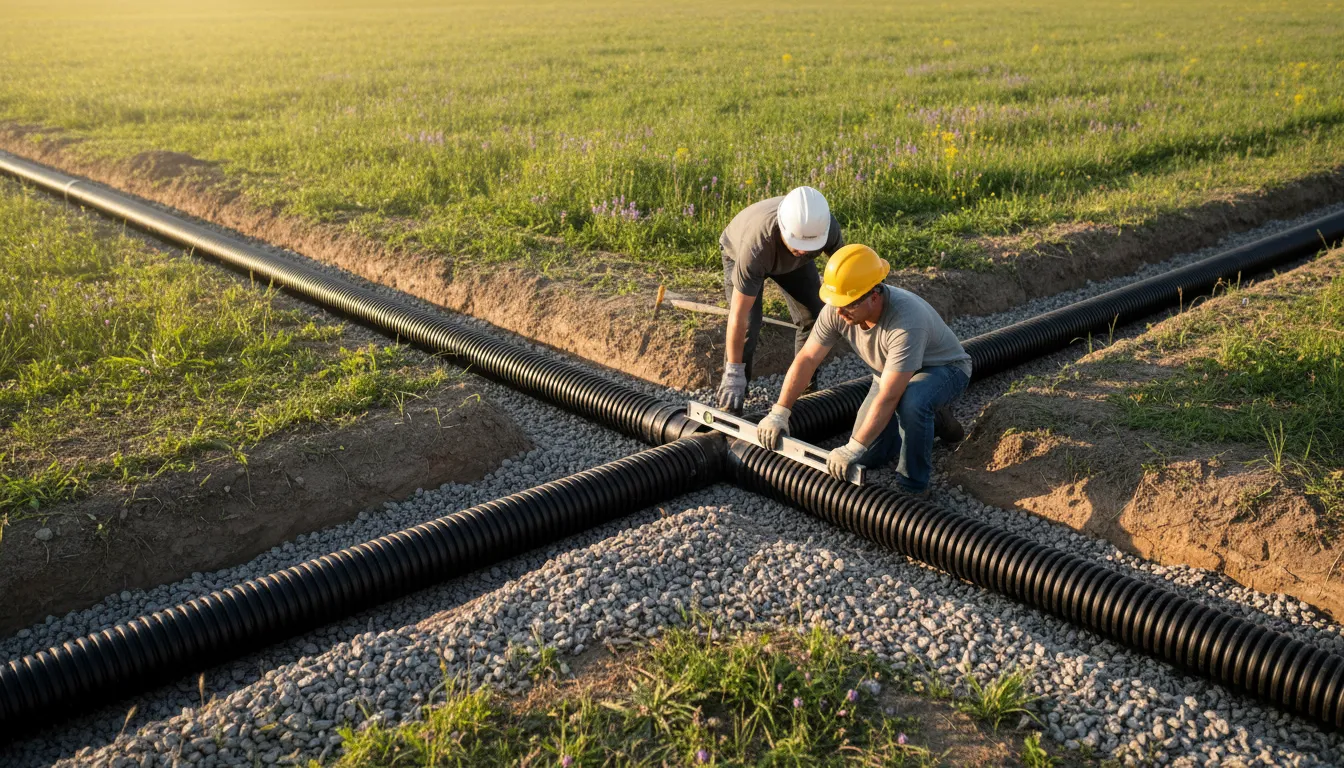
The drain field, also known as a leach field or soil absorption field, is the final stage of your onsite sewage facility (OSSF). After solids settle in the septic tank, liquid effluent flows into a network of perforated pipes buried in trenches. This effluent slowly percolates through the soil, where natural processes filter and treat it before it rejoins the groundwater.
Failures in this absorption area are often signaled by:
- Sewage surfacing in your yard, creating soggy patches or standing water.
- Persistent foul odors near the drain field or septic tank area.
- Unusually lush, green grass growing over the drain field lines.
- Slow-draining toilets and fixtures inside the home.
- Backups of sewage into the home (in severe cases).
In Bedford and across Texas, common causes of failure include soil compaction, root intrusion, hydraulic overloading from excessive water use, and a buildup of biomat-a layer that can eventually clog the soil. The clay-heavy soils prevalent in our region are particularly prone to slow percolation and saturation, accelerating system failure.
Texas and Bedford Regulations You Must Follow
All drain field work in Texas is governed by the Texas Commission on Environmental Quality (TCEQ) under the On-Site Sewage Facility (OSSF) rules. Compliance isn't optional; it's the law.
Key regulatory steps include:
- Permit Requirement: Nearly all repairs and full replacements of a drain field require an OSSF permit from the local authorized agent (often the county environmental health department) 1.
- Licensed Professionals: The actual repair or installation work must be performed by a TCEQ-licensed installer. It is illegal for an unlicensed person to install or repair an OSSF.
- Soil Evaluation: Before any new drain field is designed, a licensed site evaluator must conduct a thorough soil analysis. This evaluation determines the soil's absorption rate, depth to groundwater, and slope, which directly dictates the system's design and size.
- Setback Distances: State law mandates minimum distances. For example, drain fields must be at least 100 feet from water wells and 50 feet from home foundations. These setbacks protect water sources and structures.
- Final Inspection: Once work is complete, the permitting authority will conduct a final inspection to ensure the repair or replacement meets all state and local codes before the system can be put into use.
The Diagnostic and Repair Process
When you suspect a problem, a systematic approach is essential.
1. Professional Site Assessment & Inspection A qualified professional will start with a visual inspection of your property, looking for the telltale signs of failure mentioned above. They will then likely:
- Check System Components: Inspect the septic tank, distribution box, and accessible pipes for blockages or damage that might be overloading the drain field 2.
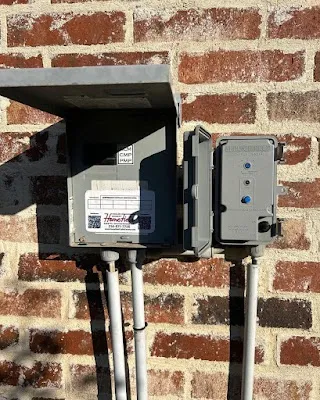
- Perform Diagnostic Tests: This may include a "push test" to check soil absorption or, for aerobic systems, checking the air pump and spray head functionality 3 4.
- Review History: Understanding the system's age, last pumping date, and your household's water usage patterns is crucial for diagnosis.
2. Determining the Solution: Repair vs. Replacement The inspection findings will determine the path forward.
- Minor Repairs: Issues like a clogged distribution box, broken pipe segment, or minor biomat buildup may be addressed with targeted repairs such as jetting pipes or replacing a damaged component.
- Drain Field Replacement: If the soil is completely saturated, clogged, or the existing field has failed structurally, a full replacement is necessary. This involves designing a new absorption area based on the current soil evaluation and installing a completely new set of trenches and piping 5.
Find the perfect drain field repair companies for your needs
Get personalized recommendations and expert advice
Design Standards and Soil Considerations in Bedford
Texas design rules are specific. For conventional trench systems, pipes are typically buried in trenches 18 inches to 3 feet deep, with precise spacing requirements between each trench 6. The total size (number of trenches and linear feet) is calculated based on the soil's percolation rate and the home's daily wastewater flow.
Bedford's soil presents a unique challenge. The high clay content common in North Texas has very slow permeability. In many cases, standard gravity-fed trench systems are not suitable for clay soils. When a soil evaluation reveals poor percolation, the licensed designer may recommend an aerobic treatment system (ATS). These systems use an oxygen-rich environment to treat effluent to a higher standard, allowing it to be dispersed via spray irrigation across the surface, which is often a viable solution for difficult clay sites 7 8.
Understanding the Costs Involved
The cost for drain field work varies widely based on the scope, soil conditions, and system type. It's important to budget for both the professional services and the required permits.
- Permit Fees: Permit fees for repair or replacement in Texas typically range from $400 to $800.
- Soil Test & Site Evaluation: This is an additional upfront cost performed by a licensed site evaluator.
- Minor Repairs: Fixing a specific component like a distribution box or a section of pipe can cost between $1,000 and $5,000.
- Full Drain Field Replacement: This is a major excavation and installation project. For a conventional system, costs often range from $5,000 to $20,000 9 10.
- Aerobic System Replacement: If clay soil necessitates an aerobic treatment system, the total replacement cost can be higher, sometimes exceeding $20,000 for complex installations, due to the added mechanical components and spray field 11.
Always get detailed, written estimates from multiple TCEQ-licensed installers. The estimate should break down costs for design, permitting, excavation, materials, installation, and the final inspection.
Maintaining Your New or Repaired Drain Field
Protecting your investment is key. Once your drain field is functioning again, proper maintenance is non-negotiable:
- Pump the Septic Tank Regularly: Every 3-5 years, or as recommended based on usage. A full tank sends solids into the drain field, causing rapid failure.
- Conserve Water: Spread out laundry loads, fix leaks, and use water-efficient fixtures to avoid hydraulically overloading the system.
- Divert Water: Ensure roof gutters, sump pumps, and yard drainage do not flow over the drain field area.
- Protect the Area: Never drive or park heavy vehicles on the drain field, and avoid planting trees or deep-rooted shrubs nearby.
Frequently asked questions
Sources
Footnotes
-
SEPTIC SYSTEM LAWS IN TEXAS - https://www.terseptic.com/posts/septic-systems-its-the-law ↩
-
Texas Septic Systems & OSSF Requirements | 2026 Guide - https://texaslandbrokerage.com/resources/texas-septic-systems-ossf-requirements-guide/ ↩
-
Texas OSSF Inspection Requirements: Complete Guide for 2025 - https://www.fieldbaseos.com/blog/texas-ossf-inspection-requirements.html ↩
-
Septic systems explained - Texas Water Resources Institute - https://twri.tamu.edu/blog/septic-systems-explained/ ↩
-
Are There Regulations or Guidelines for Septic Tank Drain ... - https://weebeewasteservices.com/are-there-regulations-or-guidelines-for-septic-tank-drain-field-maintenance-in-texas/ ↩
-
Septic Tank Laws in Texas - https://dillonseptic.com/septic-tank-laws-in-texas/ ↩
-
Texas Septic Tank Rules - https://dillonseptic.com/texas-septic-tank-rules/ ↩
-
Pearland Clay Soil vs Septic Systems | 40% Failure Rate - https://accurateplumbingtx.com/pearland-clay-soil-septic-system-failure/ ↩
-
Septic System Repair Costs in Texas | 1 Source - https://tx1source.com/blog/septic-system-repair-costs-texas/ ↩
-
Cost to Replace Septic Tank and Drain Field [2026 Data] | Angi - https://www.angi.com/articles/how-much-new-drain-fields-foot.htm ↩
-
Aerobic Septic System Cost in Texas (Updated 2026) - https://dillonseptic.com/aerobic-septic-system-cost-in-texas/ ↩