Find the Best Drain Field Repair Companies for Your Business
No obligation • Fast responses • Nationwide coverage

Why you can trust Septic Spot
Septic Spot is a leading United States resource for understanding and comparing septic services. Our editors review providers using consistent criteria and verify key business details. Listings and scores are independent, and companies cannot pay to influence our content.
Search providers near you
Top Drain Field Repair Companies in Dallas, Texas Ranked
A failing drain field, also known as a leach field or absorption area, is a serious issue for any property with a septic system. When this critical component stops absorbing and filtering wastewater, it can lead to soggy yards, foul odors, and even sewage backups into your home. In Dallas, addressing these problems requires navigating specific local regulations and soil conditions. This guide helps you understand the process, costs, and key considerations for repairing or replacing your septic system's drain field, connecting you with the licensed professionals required to get the job done right.

Understanding Your Septic System's Drain Field
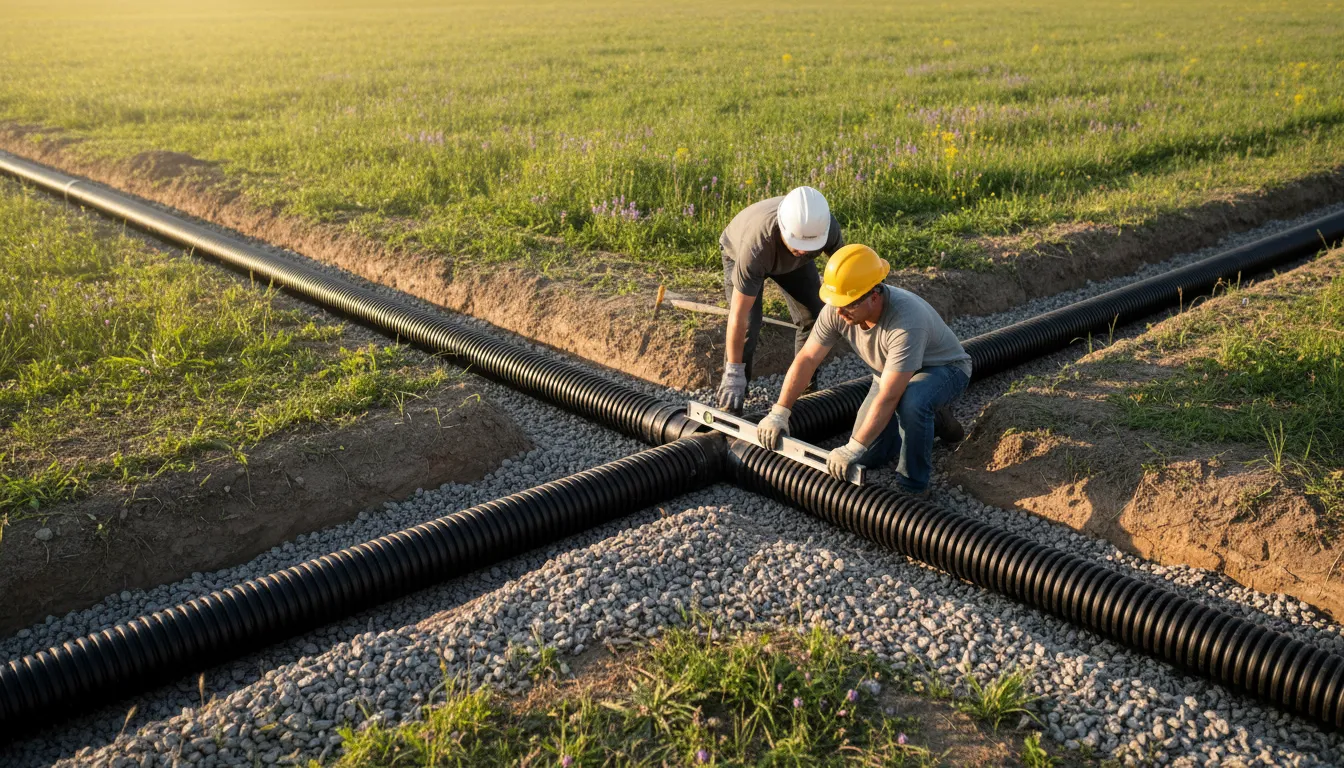
The drain field is the final and most crucial stage of your On-Site Sewage Facility (OSSF). After solids settle in the septic tank, liquid effluent flows through pipes into a network of perforated tubes buried in trenches filled with gravel. This effluent slowly percolates down through the soil, where natural processes filter out harmful bacteria and nutrients before the water rejoins the groundwater. A healthy drain field is essential for protecting both your property and the local environment. When it fails, the entire system's function is compromised, making timely leach field repair or replacement a necessity.
Why Drain Fields Fail in the Dallas Area
Several factors common to North Texas contribute to drain field failure. Understanding these can help with prevention and inform the repair strategy.
- Soil Composition: The Dallas region is known for its expansive heavy clay soils. Clay has very small pores, which severely slows the rate of water absorption (percolation). Over time, this can lead to premature clogging and ponding.
- Hydraulic Overload: Consistently sending more wastewater into the system than it was designed to handle floods the drain field. This can be caused by leaking fixtures, excessive water use, or an undersized system for the current household size.
- Physical Damage: Driving or parking heavy vehicles over the drain field area can crush the buried pipes and compact the soil. Similarly, planting trees or deep-rooted shrubs too close to the absorption area can lead to root intrusion that blocks and breaks pipes.
- Lack of Maintenance: Failure to pump the septic tank regularly allows solids and grease to flow out into the drain field, creating a biomat that seals the soil and prevents absorption.
- System Age: Like all components, drain fields have a finite lifespan, typically 20 to 30 years. Older systems may simply wear out.
The Regulatory Landscape: Texas and Dallas County Rules
All work on a septic system in Texas is governed by the Texas Commission on Environmental Quality (TCEQ) under Title 30, Chapter 285 of the Texas Administrative Code (30 TAC 285). Local authorities, like Dallas County Environmental Health, enforce these rules and often have additional requirements.
- Permit Required: A permit is mandatory for installing, altering, or repairing any part of an OSSF, including the drain field 1. The only exception is for specific emergency repairs, which must still be reported to the permitting authority within 72 hours 2.
- Licensed Professionals: With very few exceptions, all repairs and installations must be performed by a TCEQ-licensed Installer or Apprentice Installer 3. Furthermore, a licensed Site Evaluator or Professional Engineer must conduct the official soil analysis and design the system.
- System Setbacks: State and local codes dictate strict distances the drain field must be from other features. Common setbacks include at least 100 feet from private water wells, 5-10 feet from property lines, and 5 feet from building foundations 4. Evaluations must also consider floodplains, which can restrict placement 4.
The Step-by-Step Process for Repair or Replacement
Navigating a drain field project involves a series of defined steps to ensure compliance and long-term functionality.
- Professional Assessment & Site Evaluation: The process begins with a licensed evaluator inspecting the entire system. They will perform a soil morphology analysis, digging test pits to examine soil layers, texture, and depth to groundwater or bedrock. This determines the soil's application rate, which dictates the size and type of drain field needed.
- System Design & Permitting: Using the site evaluation data, a design plan is created. For challenging Dallas clay, this often means moving away from standard trench systems to engineered alternatives like raised sand mounds, low-pressure dose systems, or aerobic treatment units (ATUs). These plans are submitted with a permit application to the local authority.
- Installation/Repair Work: Once the permit is issued, a TCEQ-licensed installer executes the work. This involves excavation, laying new distribution pipes in gravel-filled trenches or beds, and connecting them to the existing or new septic tank.
- Final Inspection: Before the new drain field is covered with soil, the permitting authority must conduct a final inspection to verify the installation matches the approved design5.
- Ongoing Maintenance: Especially for aerobic systems (common in poor soils), Texas law requires homeowners to maintain a valid maintenance contract with a licensed provider and have the system inspected regularly6 7.
Find the perfect drain field repair companies for your needs
Get personalized recommendations and expert advice
Repair vs. Complete Replacement: Understanding Your Options
The best solution depends on the extent of the failure and the site conditions.
- Spot Repairs: If a failure is isolated to one section-perhaps due to a crushed pipe or root intrusion-a partial leach field repair may be possible. This involves excavating and replacing just the damaged portion. However, spot repairs are less common, as underlying soil issues often affect the entire area.
- Drain Field Replacement: Complete failure usually requires a full drain field replacement. This means constructing a entirely new absorption area at a different location on your property, following the new site evaluation and design. The old field is taken out of service.
- System Upgrade/Conversion: In many Dallas cases, replacement isn't just a like-for-like swap. Due to heavy clay, the new system will likely be an engineered alternative. Converting from a conventional system to an aerobic system is a common solution for poor percolation 8.
Cost Factors for Drain Field Projects in Dallas
Costs can vary widely based on system type, soil, and site accessibility. The figures below are typical ranges for the Dallas area9 10 11.
- Site Evaluation & Permitting: $500 - $3,000. This covers the professional soil analysis, system design, and permit fees.
- Standard Drain Field Repair: $3,000 - $7,000. This range typically applies to partial repairs or smaller conventional field replacements.
- Complete System/Drain Field Replacement: $5,000 - $12,000+. This is the expected range for a full engineered system replacement, such as installing an aerobic treatment unit with a new spray or mound dispersal field. Complex sites or larger homes can push costs higher.
Key Cost Drivers:
- System Type: Aerobic Treatment Units (ATUs) are more expensive upfront than conventional systems but are often necessary.
- Soil Conditions: Poor soil (like heavy clay) requires more complex-and costly-engineering.
- Property Accessibility: Tight lots, steep slopes, or limited equipment access can increase labor costs.
- Size of the System: The required drain field size is calculated based on bedroom count and soil application rate.
Maintaining Your New Drain Field
Protecting your investment is crucial. Proper maintenance extends the life of your new absorption area significantly.
- Pump the Tank Regularly: Have the septic tank pumped every 3-5 years to prevent solids from escaping into the new field.
- Practice Water Conservation: Spread out laundry loads, fix leaks promptly, and install water-efficient fixtures to avoid hydraulically overloading the system.
- Protect the Area: Never drive, park, or build structures over the drain field. Keep the area landscaped only with grass; avoid trees and deep-rooted plants.
- Mind What You Flush: Only human waste and toilet paper should go down the drain. Avoid chemicals, grease, wipes, and other non-biodegradables.
- Honor Maintenance Contracts: If you have an aerobic system, keep your maintenance contract current and ensure inspections are performed as required.
Frequently asked questions
Sources
Footnotes
-
SEPTIC SYSTEM LAWS IN TEXAS - https://www.terseptic.com/posts/septic-systems-its-the-law ↩
-
OSSF FREQUENTLY ASKED QUESTIONS - https://netmwd.com/documents/1216/OSSF_FREQUENTLY_ASKED_QUESTIONS_pdf.pdf ↩
-
Getting a Permit for an OSSF - Such as a Septic System - https://www.tceq.texas.gov/permitting/ossf/ossfpermits.html ↩
-
Septic System Inspections for Homes in Rural DFW Areas - https://www.sfrinspections.com/septic-system-inspections-for-homes-in-mckinney-and-rural-dfw-areas ↩ ↩2
-
Texas Septic Systems & OSSF Requirements | 2026 Guide - https://texaslandbrokerage.com/resources/texas-septic-systems-ossf-requirements-guide/ ↩
-
Advice for an Owner of an On-Site Sewage Facility (Septic System) - https://www.tceq.texas.gov/permitting/ossf/ossfadvice.html ↩
-
Texas OSSF Inspection Requirements: Complete Guide for 2025 - https://www.fieldbaseos.com/blog/texas-ossf-inspection-requirements.html ↩
-
Texas Septic System Regulations - https://dillonseptic.com/texas-septic-system-regulations/ ↩
-
Septic Drain Field Replacement Cost - https://dillonseptic.com/septic-drain-field-replacement-cost/ ↩
-
How Much Does a Septic System Cost? - https://septic-service-texas.com/how-much-does-a-septic-system-cost/ ↩
-
How Much Does It Cost To Install a Septic System in Dallas, TX? | Angi - https://www.angi.com/articles/what-does-it-cost-install-septic-system/tx/dallas ↩