Find the Best Drain Field Repair Companies for Your Business
No obligation • Fast responses • Nationwide coverage

Why you can trust Septic Spot
Septic Spot is a leading United States resource for understanding and comparing septic services. Our editors review providers using consistent criteria and verify key business details. Listings and scores are independent, and companies cannot pay to influence our content.
Search providers near you
Top Drain Field Repair Companies in Mesquite, Texas Ranked
A failing drain field is a serious issue for any home with a septic system, leading to soggy yards, foul odors, and potential health hazards. Drain field repair and replacement involves diagnosing and fixing the underground network of pipes and soil that treats and disperses wastewater from your home. In Mesquite, this work is strictly regulated to protect public health and the local environment. This guide helps you understand the process, regulations, and costs, so you can make informed decisions when seeking qualified local professionals for your septic absorption field or leach field needs.

Understanding Drain Field Failure in Mesquite
The drain field, also known as a leach field or soil absorption field, is the final and most critical stage of your onsite sewage facility (OSSF). When it fails, untreated wastewater can surface, creating unsanitary conditions. In Mesquite, common causes of failure are directly tied to local soil conditions and maintenance habits.
The clay-rich soil prevalent in much of the Dallas County area is a primary culprit. Clay particles are tiny and compact easily, slowing the rate at which water can percolate (or "perc") through the soil. Over time, this can lead to a saturated drain field that simply cannot accept more effluent from the septic tank. A high water table, which can be seasonal, exacerbates this problem by leaving little room for the wastewater to disperse 1.
Beyond soil, failure often stems from a lack of maintenance. If the septic tank is not pumped regularly (typically every 3-5 years), solids and scum can flow out into the drain field, clogging the perforated pipes and the surrounding soil biomat. Physical damage from driving or building over the field can crush pipes or compact the soil. Even diverting roof runoff or sprinklers toward the field can overload it with excess water.
Texas and Local Regulations You Must Follow
Any work on a septic system in Mesquite is governed by state law and local codes. The Texas Commission on Environmental Quality (TCEQ) sets the minimum standards under Title 30, Chapter 285 of the Texas Administrative Code (30 TAC 285), which all local authorities, including Dallas County, must enforce.
Permits are mandatory. You cannot legally repair or replace a drain field component without first obtaining a permit from the local permitting authority (often the county health department). The only exception is for a true emergency repair, such as a broken pipe, where work can begin immediately but must be reported to the authority within 72 hours 2. The permit process ensures the work is designed and performed to code, protecting your property and your neighbors'.
Licensing is non-negotiable. Only TCEQ-licensed installers and designers can perform septic system repairs and replacements 3 4. A licensed site evaluator must also conduct the initial assessment. Hiring an unlicensed individual can result in improper work, failed inspections, and legal liability.
Setback requirements are strict. Your drain field must be located a specific distance from various features. Common setbacks include being at least 100 feet from a water well, 5 feet from property lines and structures, and 50 to 100 feet from streams or other surface water 5. These rules prevent wastewater from contaminating drinking water sources.
The Professional Repair and Replacement Process
Addressing a failed leach field is a multi-step process that requires professional expertise from start to finish.
-
Professional Inspection & Site Evaluation: The first step is not guesswork. A licensed technician will inspect the entire system to confirm the drain field is the problem and identify the cause (e.g., hydraulic failure, broken pipe). A licensed site evaluator will then conduct a thorough site evaluation, including soil tests to determine the depth to groundwater, soil texture, and percolation rate 6 7. This evaluation dictates the legally approved solution.
-
System Design & Permit Application: Based on the site evaluation, a licensed designer will create an engineered plan for the repair or new drain field. This plan, including detailed site drawings, is submitted with the permit application to the local authority for approval.
-
Execution of Work:
- Repair: If the problem is localized, repairs may be possible. This can involve high-pressure jetting to clear clogged lateral lines, adding aeration systems to improve soil treatment, or excavating to replace a section of broken pipe 8.
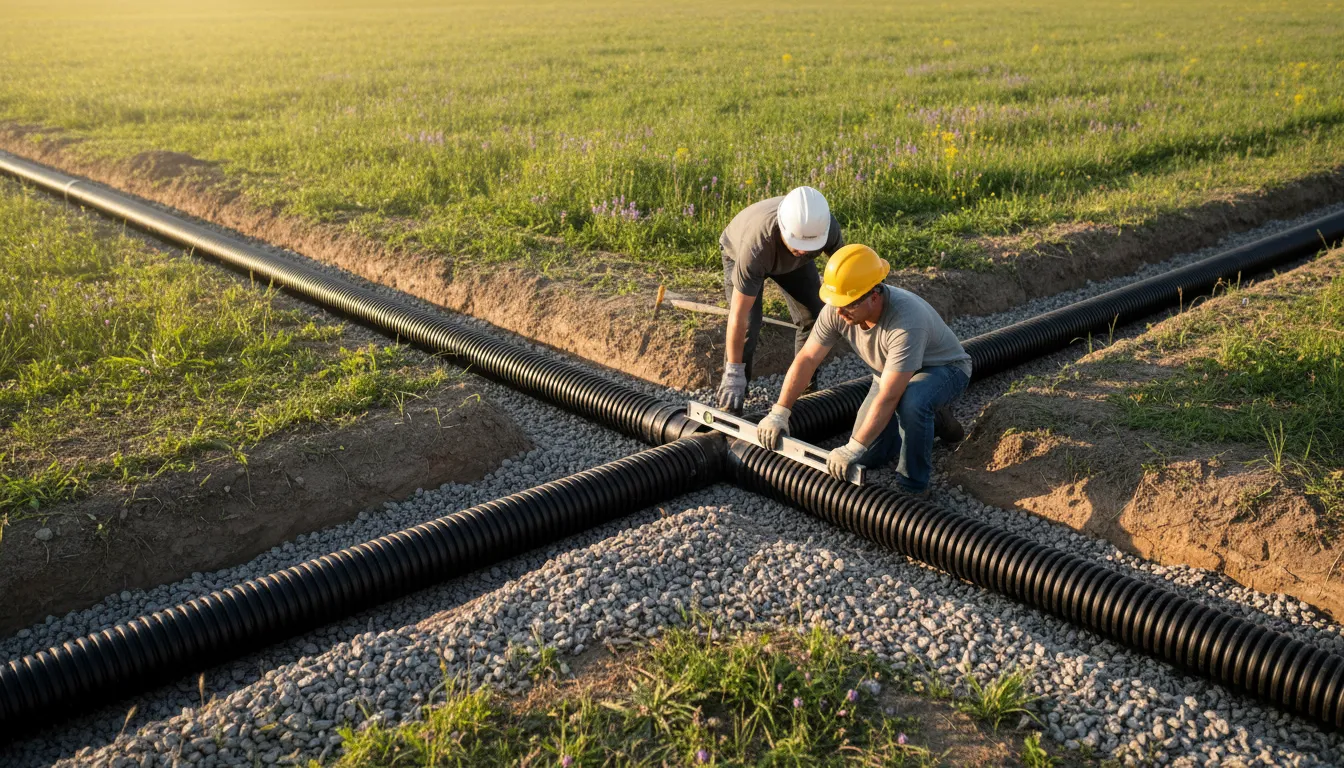
- Replacement: If the entire soil absorption field is saturated or clogged beyond repair, a new drain field must be installed. The new trenches are typically dug 18 inches to 3 feet deep with specific spacing (12-24 inches apart) and filled with gravel and distribution pipes 9. In cases where the soil fails a standard perc test, an alternative system like an aerobic treatment unit (ATU) may be required.
- Final Inspection: Once work is complete but before the trenches are backfilled, the local permitting authority must conduct a final inspection to ensure everything matches the approved plans and meets code 10. Only after receiving this approval should the system be covered and put into use.
Find the perfect drain field repair companies for your needs
Get personalized recommendations and expert advice
Cost Considerations for Drain Field Work
The cost for drain field solutions in Mesquite varies widely based on the scope of work, soil conditions, and system type. It's important to get multiple estimates from licensed professionals.
- Site Evaluation & Soil Testing: This necessary first step typically costs between $350 and $750.
- Drain Field Repair: For repairs like jetting lines or fixing broken laterals, homeowners can expect to pay between $2,000 and $6,000.
- Drain Field Replacement: Installing a new conventional leach field is a significant investment, with average costs around $7,000 and often ranging much higher 11.
- Complete New System Installation: If a full system is needed, a conventional septic tank and drain field system can cost $6,000 to $12,000 or more. For properties requiring an aerobic treatment system due to poor soil, costs can range from $12,000 to over $20,00012 13.
Maintaining Your Drain Field After Service
Protecting your investment after a repair or replacement is crucial. Consistent maintenance can prevent premature failure and extend the life of your soil absorption field for decades.
- Pump Regularly: Have your septic tank pumped by a professional every 3 to 5 years to prevent solids from escaping into the drain field 14 15.
- Protect the Area: Never drive, park, or build structures (like sheds or patios) over your drain field. The weight can compact the soil and crush pipes.
- Manage Water: Direct all roof drains, gutter downspouts, and sump pump discharge away from the drain field area. Also, avoid over-irrigating the lawn above it.
- Be Mindful of Inputs: Do not flush non-biodegradable items or pour grease, chemicals, or paints down the drain, as these can kill the beneficial bacteria in your system and clog the soil.
Frequently asked questions
Sources
Footnotes
-
Are There Regulations or Guidelines for Septic Tank Drain Field ... - https://weebeewasteservices.com/are-there-regulations-or-guidelines-for-septic-tank-drain-field-maintenance-in-texas/ ↩
-
Septic System FAQs - https://newtools.cira.state.tx.us/upload/page/7913/docs/Health/Water%20Quality/Water%20Quality%20FAQs%20%282%29.pdf ↩
-
Septic Tank Laws in Texas - https://dillonseptic.com/septic-tank-laws-in-texas/ ↩
-
Septic System Install - https://septic-service-texas.com/septic-system-install/ ↩
-
Advice for an Owner of an On-Site Sewage Facility (Septic ... - https://www.tceq.texas.gov/permitting/ossf/ossfadvice.html ↩
-
Septic Systems Reports, Regulations, Guidance, and Manuals - https://www.epa.gov/septic/septic-systems-reports-regulations-guidance-and-manuals ↩
-
Septic Tank Laws in Texas - https://dillonseptic.com/septic-tank-laws-in-texas/ ↩
-
Drain Field Repair - https://www.amseptic.com/drain-field-repair ↩
-
What is the best septic system if your land fails a perc test? - https://www.premiertechaqua.com/en-us/blog/best-septic-system-failed-perc-test ↩
-
SEPTIC SYSTEM LAWS IN TEXAS - https://www.terseptic.com/posts/septic-systems-its-the-law ↩
-
Cost to Replace Septic Tank and Drain Field [2026 Data] | Angi - https://www.angi.com/articles/how-much-new-drain-fields-foot.htm ↩
-
Texas Septic Systems & OSSF Requirements | 2026 Guide - https://texaslandbrokerage.com/resources/texas-septic-systems-ossf-requirements-guide/ ↩
-
Conventional septic tank/drain field - Texas A&M University - https://ossf.tamu.edu/files/2023/01/L-5234-8.99-Conventional-septic-tank-drain-field.pdf ↩
-
Basics for Septic Systems - https://www.tceq.texas.gov/assistance/water/fyiossfs.html ↩
-
Septic System - Texas Water Resources Institute - https://twri.tamu.edu/wp-content/uploads/2024/04/em-126-septic-system-maintenance-inspection-pocket-guide.pdf ↩