Find the Best Drain Field Repair Companies for Your Business
No obligation • Fast responses • Nationwide coverage

Why you can trust Septic Spot
Septic Spot is a leading United States resource for understanding and comparing septic services. Our editors review providers using consistent criteria and verify key business details. Listings and scores are independent, and companies cannot pay to influence our content.
Search providers near you
Top Drain Field Repair Companies in Missouri City, Texas Ranked
A failing septic system drain field is a serious issue that can lead to sewage backups, foul odors, and environmental contamination. Drain field repair and replacement involves diagnosing and fixing the area where treated wastewater is dispersed into the soil. In Missouri City, this work is strictly regulated to protect public health and local groundwater. This guide explains the local process, costs, and regulations to help you find qualified professionals for your leach field or absorption field project.
Brown Aerobic Septic Specialists
17618 South Dr, Cypress, TX 77433
Brown Aerobic Septic Specialists is a licensed septic and excavation company serving Houston, TX, and surrounding counties. They provide a wide range of services including aerobic and conventional septic system installation, repair, pumping, inspections, and drain field replacement. Their team also offers excavation services such as grading, land clearing, trenching, and pond construction. With a focus on local soil and weather conditions, they ensure systems meet code and perform reliably. The company is led by a second-generation septic professional and has experience servicing over 1,000 systems.

Brumfield Sanitation
Pasadena, TX
Brumfield Sanitation is a septic system service provider based in Pasadena, TX, offering comprehensive septic tank pumping, inspection, repair, and drain field services. Serving the local community, they specialize in maintaining and repairing septic systems to prevent costly issues such as tank overflows and field line leaks. With 20 years of experience, Brumfield Sanitation uses advanced equipment and microbiological treatments to ensure optimal system performance. They also provide routine monthly inspections and maintenance programs designed to keep septic systems functioning effectively year-round.
Understanding Drain Fields and Local Soil Challenges
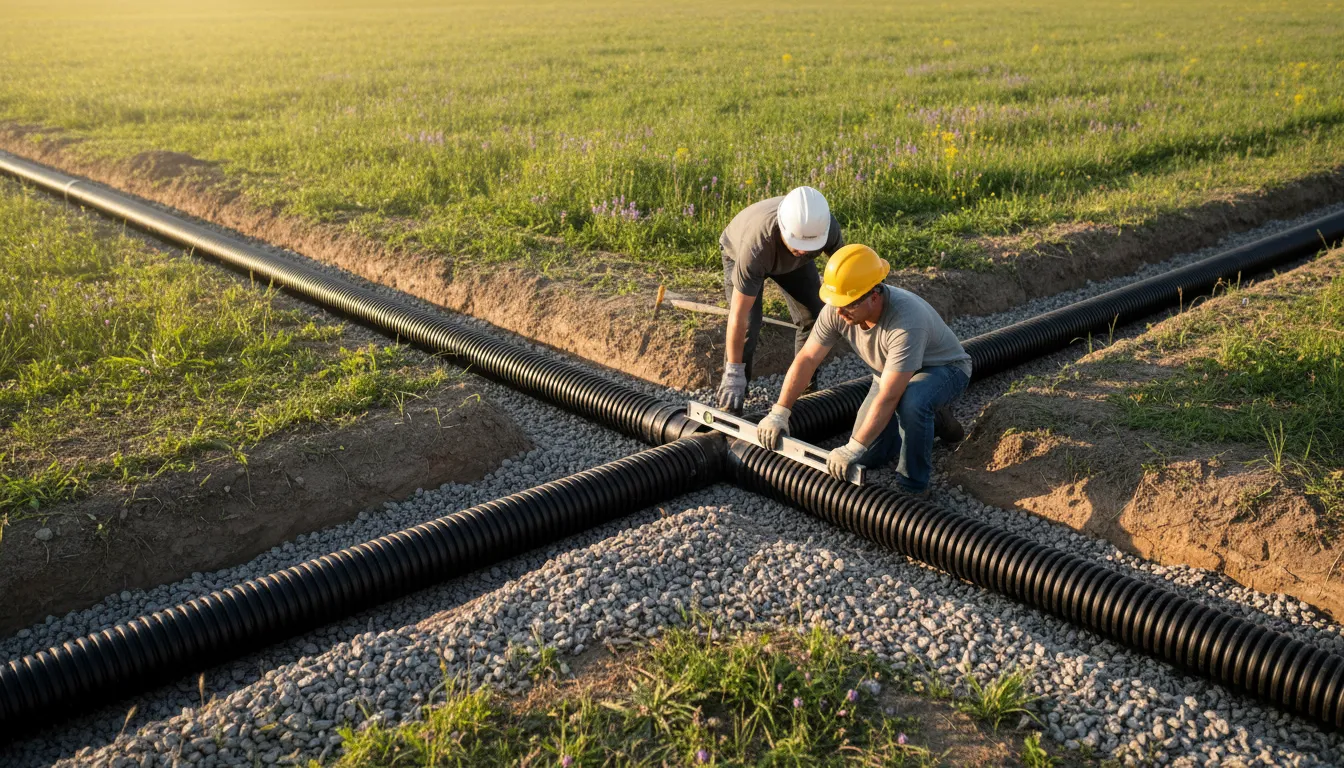
The drain field, also known as a leach field or absorption field, is the final and most critical stage of a septic system. After solids settle in the tank, liquid effluent flows into a network of perforated pipes buried in trenches filled with gravel. This effluent slowly percolates into the soil, where natural processes provide final treatment.
In Missouri City and much of Fort Bend County, the primary challenge is soil composition. The area is known for its heavy clay soils, which have very low permeability. Clay absorbs and releases water slowly, making it difficult for effluent to percolate. This often leads to premature system failure, where the field becomes saturated and can no longer accept liquid. Consequently, repairs here frequently require engineered solutions rather than simple fixes.
Texas and Local Regulations You Must Know
All septic system work in Texas is governed by the Texas Commission on Environmental Quality (TCEQ). For homeowners in Missouri City, this means any significant repair or full replacement of your drain field requires navigating a permit process.
Key Regulatory Points:
- Permit Requirement: A permit from the local permitting authority (typically the county health department) is required for any repair involving structural changes or soil disturbance 1. This includes most drain field work.
- Licensed Professionals: All installation, repair, and replacement work must be performed by a TCEQ-licensed On-Site Sewage Facility (OSSF) installer 2. Homeowners may perform work on their primary residence, but must still adhere to all codes and may face challenges during a future home sale.
- Current Standards: If a drain field is replaced, the entire system must be brought up to current TCEQ design standards, which are often more stringent than when older systems were installed 3.
- Emergency Repairs: Minor repairs, such as replacing a broken pipe, may be classified as emergency work. While a permit may not be required in advance, the work must be reported to the permitting authority within 72 hours of starting 4.
- Setbacks: Drain fields must be located a minimum of 100 feet from water wells and at least 50 feet from building foundations, though variances may be possible with approval 5 6.
The Step-by-Step Process for Repair or Replacement
1. Diagnosis and Inspection
The first step is a professional inspection to confirm drain field failure. Signs include soggy ground or standing water over the field, sewage odors, and slow-draining household fixtures. A licensed professional will:
- Locate the System: Use as-built drawings or electronic locating equipment to find the tank and field lines 7.
- Inspect the Tank: Check liquid levels; a level above the outlet pipe indicates a drain field blockage 8.
- Check Distribution: Inspect the distribution box and drain field lines for clogs or collapse, often using a camera 9.
2. Site Evaluation and Design
If replacement is needed, a licensed site evaluator must conduct a formal site evaluation. This includes a soil analysis and percolation (perc) test to determine the soil's absorption rate 10 11. The results dictate the type and size of the replacement system. Given the local clay soils, conventional systems are often not viable, and an engineered alternative like an aerobic treatment system (ATS) may be required 12.
3. Permitting
Your licensed installer will submit the engineered design plans, site evaluation, and permit application to the local authority. The permit must be approved before any construction begins 13.
4. Construction and Installation
The old, failed drain field is excavated. The new system is installed according to the permitted plans. For an aerobic system, this includes installing the treatment unit, pump tank, and a new, specially designed spray or drip irrigation field.
5. Final Inspection
Once installation is complete but before the trenches are backfilled, a municipal or county inspector must visit the site to approve the work 14. Only after passing this inspection can the system be covered and put into use.
Find the perfect drain field repair companies for your needs
Get personalized recommendations and expert advice
Common Repair vs. Complete Replacement
Not all drain field problems require a full replacement. Understanding the options can help manage costs.
Minor Repairs ($1,000 - $5,000): These are viable if the problem is localized. Examples include:
- Pipe Replacement: Excavating and replacing a single clogged or crushed lateral line.
- Jet Cleaning: Using high-pressure water to clear biological matting from pipes (a temporary fix).
- Distribution Box Fix: Leveling or repairing a malfunctioning d-box.
- Soil Aeration: Using specialized tools to fracture compacted soil around the trenches to restore flow.
Complete Drain Field Replacement ($3,000 - $15,000+): This is necessary when the entire soil absorption area has failed. The old field is abandoned, and a new one is constructed in a different location on your property. Due to clay soils, the replacement often must be an Aerobic Treatment System, which can cost $9,500 to $15,000 or more 15. These systems actively oxygenate the wastewater, providing a higher level of treatment that is suitable for difficult soils and can use spray irrigation.
Cost Factors for Missouri City Homeowners
Costs for leach field work vary widely based on your specific situation. The figures below are estimates based on regional data 16.
- Permitting & Design Fees: $500 - $3,000. This covers the mandatory site evaluation, soil testing, and engineered design plans.
- Minor Drain Field Repair: $1,000 - $5,000. For targeted fixes like line replacement.
- Complete Conventional Replacement: $3,000 - $15,000. Highly dependent on system size and soil conditions, often not an option in clay.
- Aerobic System Replacement: $9,500 - $15,000+. The most common full replacement solution in the area due to soil type.
- Annual Maintenance (Aerobic Systems): $200 - $350. State law requires aerobic systems to be inspected and serviced by a licensed maintenance provider at least annually 17.
Disclaimer: These are average cost ranges. Your final price will depend on site accessibility, the exact soil conditions, and the contractor you select. Always get detailed, written quotes from multiple licensed installers 18.
Choosing a Licensed Professional
Selecting the right contractor is critical. Always verify their TCEQ OSSF installer license is current. Ask for references from recent jobs in Fort Bend County and proof of insurance. A reputable professional will handle the permit process, provide a detailed contract, and clearly explain why a particular repair or system type is recommended for your property.
Frequently asked questions
Sources
Footnotes
-
Basics for Septic Systems - https://www.tceq.texas.gov/assistance/water/fyiossfs.html ↩
-
SEPTIC SYSTEM LAWS IN TEXAS - https://www.terseptic.com/posts/septic-systems-its-the-law ↩
-
Advice for an Owner of an On-Site Sewage Facility (Septic ... - https://www.tceq.texas.gov/permitting/ossf/ossfadvice.html ↩
-
Septic Permits - Environmental Control - Jefferson County TX - https://jeffersoncountytx.gov/env_cntrl/septicpermits.htm ↩
-
Septic Tank Laws in Texas - https://dillonseptic.com/septic-tank-laws-in-texas/ ↩
-
Are There Regulations or Guidelines for Septic Tank Drain ... - https://weebeewasteservices.com/are-there-regulations-or-guidelines-for-septic-tank-drain-field-maintenance-in-texas/ ↩
-
How to Inspect a Private Septic System - https://www.youtube.com/watch?v=URhIPaX-csA&t=20 ↩
-
Septics 201 (Full Course): DIY Septic System Inspection - https://www.youtube.com/watch?v=jmBqNABTuPE&t=250 ↩
-
What Does a Septic Inspection Entail? - HomeLight - https://www.homelight.com/blog/septic-inspection/ ↩
-
Septic Tank/Absorption Field Systems: A Homeowner's Guide ... - https://extension.missouri.edu/publications/eq401 ↩
-
Septic System Approval: Percolation Test & Expert Guidance - https://smartsepticpros.com/blog/how-to-do-a-percolation-test/ ↩
-
Texas Septic System Regulations - https://dillonseptic.com/texas-septic-system-regulations/ ↩
-
Getting a Permit for an OSSF - Such as a Septic System - https://www.tceq.texas.gov/permitting/ossf/ossfpermits.html ↩
-
Inspection Process | Missouri City, TX - Official Website - https://www.missouricitytx.gov/331/Inspection-Process ↩
-
Septic Drain Field Replacement Cost - https://dillonseptic.com/septic-drain-field-replacement-cost/ ↩
-
How much does septic tank system repair cost? - HomeGuide - https://homeguide.com/costs/septic-tank-repair-cost ↩
-
Cost of a Septic System in Texas - https://dillonseptic.com/cost-of-a-septic-system-in-texas/ ↩
-
Worried About Septic Costs? Here's What You Can Expect in Amarillo, TX - https://www.barjservices.com/septic-installation/worried-about-septic-costs-heres-what-you-can-expect-in-amarillo-tx/ ↩