Find the Best Drain Field Repair Companies for Your Business
No obligation • Fast responses • Nationwide coverage

Why you can trust Septic Spot
Septic Spot is a leading United States resource for understanding and comparing septic services. Our editors review providers using consistent criteria and verify key business details. Listings and scores are independent, and companies cannot pay to influence our content.
Search providers near you
Top Drain Field Repair Companies in Rockwall, Texas Ranked
A failing drain field, also known as a leach field or absorption field, is a serious issue for any homeowner with a septic system. This critical component is responsible for safely filtering and dispersing treated wastewater into the soil. When it fails, it can lead to unsanitary conditions, property damage, and environmental contamination. In Rockwall, navigating drain field issues requires understanding local regulations and working with qualified professionals. This guide explains the process, costs, and key considerations for repairing or replacing your septic system's drain field in Rockwall, Texas.

Understanding Your Drain Field's Role
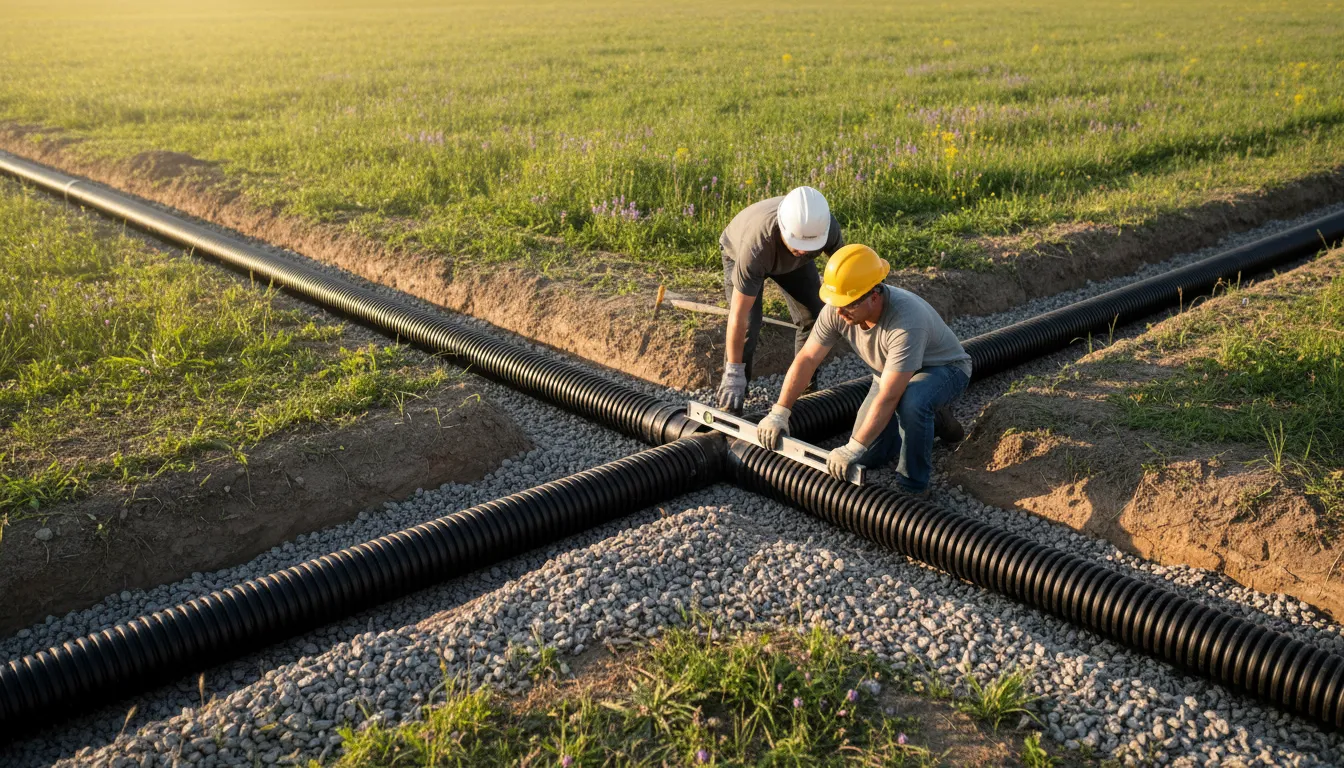
The drain field is the final stage of your onsite sewage facility (OSSF). After solids settle in the septic tank, the liquid effluent flows into a network of perforated pipes buried in gravel-filled trenches. This effluent slowly percolates into the soil, where natural processes provide final treatment. A healthy drain field is essential for protecting groundwater, which is a shared resource in our community.
Signs of a Failing Drain Field in Rockwall
Recognizing early warning signs can help you address problems before they become an emergency. Common indicators of a failing leach field include:
- Soggy Ground or Surfacing Effluent: The most obvious sign is standing water or persistently wet, mushy spots in your yard above the drain field area, especially after rain. 1
- Sewage Odors: Unpleasant smells near the drain field or even inside your home can indicate that wastewater is not properly filtering into the soil.
- Slow Drains and Backups: Gurgling toilets, slow-draining sinks, or sewage backups in the home can point to a saturated drain field that is no longer accepting water.
- Unusually Green Grass: Patches of grass over the drain field that are much lusher and greener than the rest of the lawn can signal a nutrient overload from surfacing effluent.
If you notice any of these signs, it's time to contact a licensed professional for an inspection.
The Regulatory Landscape in Texas and Rockwall County
Drain field work in Texas is not a simple DIY project. It is strictly regulated by the Texas Commission on Environmental Quality (TCEQ) to protect public health and water quality. 2 Local county health departments, such as Rockwall County Environmental Health, oversee permitting and enforcement.
Key regulations you must know:
- Permit Required: A permit is mandatory for any repair, alteration, or replacement of a drain field. This includes replacing components or expanding the field. 3
- Licensed Professionals: All work must be performed by a TCEQ-licensed installer, unless you are a homeowner working on your primary residence. Even then, a permit is still required. 4
- Current Standards: Any repaired or replaced system must meet today's TCEQ standards (Texas 30 TAC 285), not the potentially less stringent rules from when your home was built.
- Setback Requirements: New drain fields must be located a minimum of 100 feet from private water wells and 50 feet from building foundations. 5
The Step-by-Step Process for Repair or Replacement
1. Professional Site Evaluation
The first and most critical step is a site evaluation conducted by a licensed Site Evaluator or Professional Engineer (PE). 6 This evaluation determines:
- Soil Classification: Rockwall's prevalent clay-heavy soils have slow percolation rates, which directly impacts drain field design. 7
- Percolation Rate: How quickly water absorbs into the soil.
- Groundwater Level: The depth to seasonal high water table.
- Topography: The slope and layout of your property.
This evaluation dictates whether a conventional drain field is possible or if an advanced treatment system (like an aerobic system) is required.
2. System Design and Permit Submission
Based on the site evaluation, a design plan is created. This plan details the size, type, and location of the proposed drain field or alternative system. These plans are then submitted to the local permitting authority (e.g., Rockwall County) for review and approval. You cannot proceed without this permit.
3. Construction and Critical Inspection
Once the permit is issued, construction begins. A crucial milestone occurs before the new drain field trenches are covered. The permitting authority must inspect the trench depth, gravel bed, and pipe placement. 8 9 Passing this inspection is required to move forward.
4. Final Approval
After the system is fully installed and connected, a final inspection is conducted. Upon passing, the authority issues a "Notice of Approval," officially allowing you to use your new septic system. 10
Find the perfect drain field repair companies for your needs
Get personalized recommendations and expert advice
Cost Considerations for Rockwall Homeowners
The cost to address a failing absorption field in Rockwall can vary widely based on soil conditions and system type. Here is a general breakdown:
- Site Evaluation/Soil Test: $350 - $750.
- Conventional Drain Field Replacement: $6,000 - $12,000+. This is for a standard system if soil conditions allow.
- Aerobic Treatment System (ATS): $12,000 - $20,000+. Often required in Rockwall due to poor clay soil, these systems treat effluent more thoroughly before dispersal. 11
- Permit Fees: Vary by local municipality.
- Emergency Repairs: If a tank issue can be fixed without removal, it may be classified as an emergency repair, but the permitting authority must be notified within 72 hours. 12
Repair vs. Replacement: What's Possible?
Sometimes, a drain field can be repaired instead of fully replaced, which can be more cost-effective.
- Repair Options: These may include cleaning clogged pipes, adding additional trenches to expand the field (called an "extension"), or using technologies like terralift to fracture compacted soil.
- Replacement Necessity: If the soil is completely saturated and biomat (a clogging layer) is extensive, or if the system is old and undersized for your home, full replacement is usually the only permanent solution. The site evaluation will determine the best path forward.
Maintaining Your New Drain Field
Protect your investment with proper care:
- Practice Water Conservation: Spread out laundry loads and fix leaks to avoid hydraulically overloading the field.
- Mind What You Flush: Only human waste and toilet paper should go down the drain. Avoid chemicals, grease, and non-biodegradable items.
- Keep It Clear: Never drive or park vehicles over the drain field, and avoid planting trees or deep-rooted shrubs nearby.
- Pump Regularly: Have your septic tank pumped every 3-5 years by a licensed pumper to prevent solids from escaping into and clogging the drain field.
Frequently asked questions
Sources
Footnotes
-
Drain Field Inspection - Keep Your Septic System Healthy - https://www.vevor.com/diy-ideas/drain-field-inspection/ ↩
-
What laws in Texas apply to septic systems? - Water School - https://brazos.org/about-us/education/water-school/articleid/349/what-laws-in-texas-apply-to-septic-systems ↩
-
Basics for Septic Systems - https://www.tceq.texas.gov/assistance/water/fyiossfs.html ↩
-
Advice for an Owner of an On-Site Sewage Facility (Septic ... - https://www.tceq.texas.gov/permitting/ossf/ossfadvice.html ↩
-
SEPTIC SYSTEM LAWS IN TEXAS - https://www.terseptic.com/posts/septic-systems-its-the-law ↩
-
Texas Septic System Regulations - https://dillonseptic.com/texas-septic-system-regulations/ ↩
-
Are There Regulations or Guidelines for Septic Tank Drain ... - https://weebeewasteservices.com/are-there-regulations-or-guidelines-for-septic-tank-drain-field-maintenance-in-texas/ ↩
-
Onsite Wastewater Treatment Systems: Selecting and Permitting - https://www.h-gac.com/getmedia/853b5138-5a67-4bd3-a48a-8af036c2b9c6/OSSF-Treatment-Systems_Selecting-and-Permitting.pdf ↩
-
Navigating Septic Laws in Harris County: What Homeowners Need to Know - https://www.terseptic.com/posts/navigating-septic-laws-in-harris-county-what-homeowners-need-to-know ↩
-
Texas Septic Tank Rules - https://dillonseptic.com/texas-septic-tank-rules/ ↩
-
Texas Septic Systems & OSSF Requirements | 2026 Guide - https://texaslandbrokerage.com/resources/texas-septic-systems-ossf-requirements-guide/ ↩
-
Advice for an Owner of an On-Site Sewage Facility (Septic ... - https://www.tceq.texas.gov/permitting/ossf/ossfadvice.html ↩