Find the Best Drain Field Repair Companies for Your Business
No obligation • Fast responses • Nationwide coverage

Why you can trust Septic Spot
Septic Spot is a leading United States resource for understanding and comparing septic services. Our editors review providers using consistent criteria and verify key business details. Listings and scores are independent, and companies cannot pay to influence our content.
Search providers near you
Top Drain Field Repair Companies in Rowlett, Texas Ranked
A failing drain field is a serious issue for any home with a septic system, leading to soggy yards, foul odors, and potential environmental contamination. In Rowlett, addressing problems with your leach field or soil absorption area is a regulated process that requires specific expertise and adherence to local and state codes. This guide explains the critical steps, regulations, and considerations for drain field repair and replacement in Rowlett, helping you understand the process and connect with qualified local professionals who can assess your system and perform the necessary work.

Understanding Your Drain Field's Role
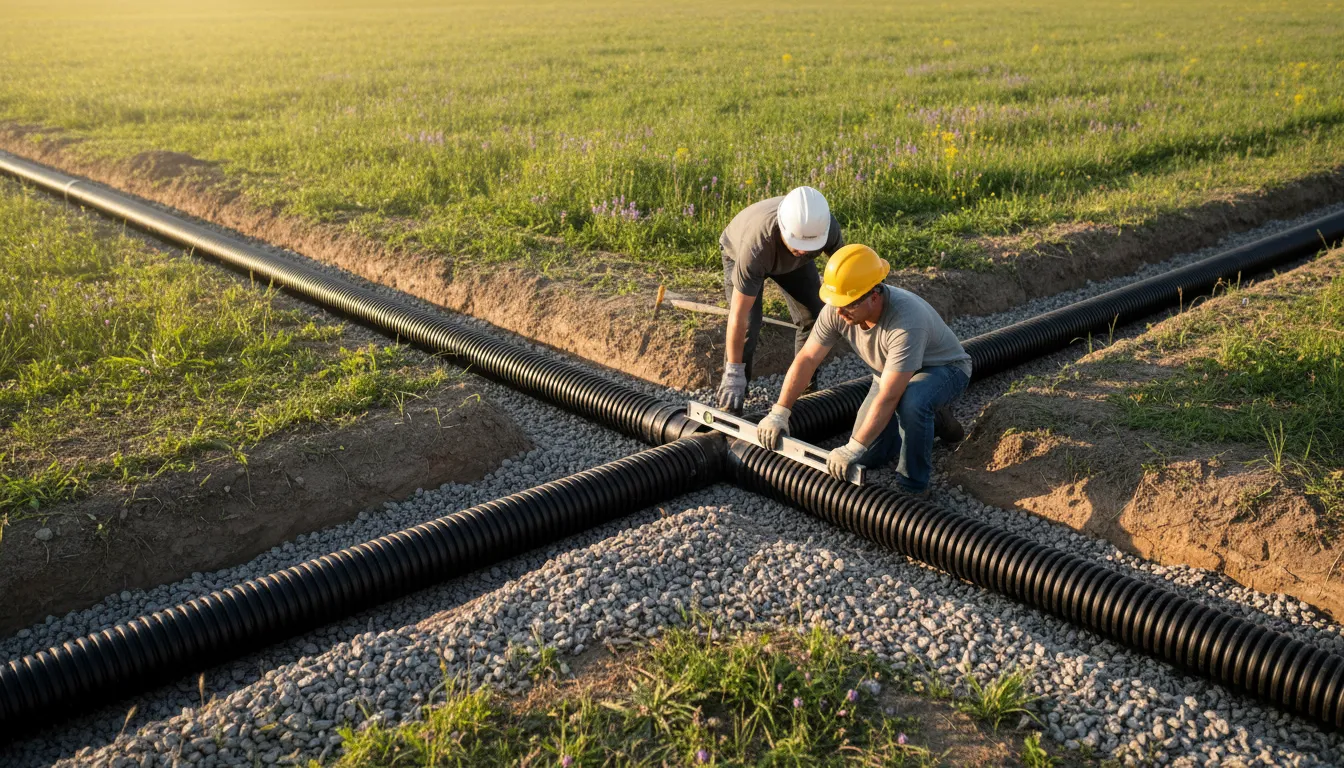
The drain field, also known as a leach field or soil absorption area, is the final and most crucial stage of your On-Site Sewage Facility (OSSF). After solids settle in the septic tank, liquid effluent flows into a network of perforated pipes buried in trenches. This effluent slowly percolates through the soil, where natural processes filter and treat it before it rejoins the groundwater. When this area fails, untreated wastewater can surface, creating health hazards and violating environmental regulations.
Rowlett and Dallas County Regulations You Must Know
All septic system work in Rowlett, including any repair or replacement of the disposal area, falls under the Texas Commission on Environmental Quality (TCEQ) Chapter 285 regulations 1. Oversight is typically managed by Dallas County Public Works or Rockwall County Environmental Health, depending on your property's exact location.
A core rule is that a permit is always required to construct, alter, extend, or repair an OSSF2 3. Even emergency repairs must be reported to the local authority within 72 hours. Furthermore, all OSSF components, including your new drain field, must be located above the 100-year flood plain, a detail verified by Dallas County Public Works4.
For homeowners with aerobic treatment systems, note that a maintenance contract with a licensed provider is typically required upon installation or repair 5.
The Critical First Step: Site and Soil Evaluation
Before any shovel hits the ground, a professional assessment is mandatory. A licensed Site Evaluator or Professional Engineer must conduct a site evaluation to determine key factors:
- Soil Permeability: The rate at which water moves through your soil. Rowlett and much of North Texas have clay-heavy (Class IV) soils, which drain poorly and significantly impact design.
- Groundwater Depth: The drain field must have adequate separation from the seasonal high water table.
- Slope: The topography of your property affects placement and design.
This evaluation will dictate if a conventional repair is possible or if advanced treatment or soil substitution is needed. For difficult Class IV soils, a common solution is to create a soil substitution mound or bed, where native clay is replaced with suitable sandy loam (Class Ib or II soil) to ensure proper percolation 6.
Design Standards and Setback Requirements
Your new or repaired leach field must be designed according to TCEQ standards and respect strict setback distances from property features7:
- 100 feet from any water well.
- 50 feet from your home's foundation, property lines, and pools.
- 10 feet from pressurized water lines.
Typical trench specifications call for depths between 18 inches and 3 feet, with 12 to 24 inches of spacing between individual trenches8. The design must be approved as part of your permit application.
The Repair and Replacement Process: Step-by-Step
Navigating a drain field project involves multiple coordinated steps:
- Professional Assessment & Soil Test: Hire a licensed evaluator to diagnose the failure and perform the required soil analysis. (Cost: approximately $350-$750)9.
- System Design & Permit Application: A licensed installer or engineer creates plans meeting TCEQ and county standards. You or your contractor submits these plans, the soil report, and the application fee to Dallas County Health and Human Services 10.
- Initial Inspection: A county inspector may visit to verify the proposed design and location before work begins.
- Installation/Repair: The licensed installer (Installer I or II) executes the work. Homeowners may perform work on their own single-family residence, but they assume full liability and must still meet all codes11.
- Installation Inspection: The inspector visits again to verify the drain field is built correctly before the trenches are backfilled.
- Final Inspection & Camera Report: A critical Rowlett-specific requirement: As of February 2022, the City of Rowlett requires an internal camera video of all sewer lines from the home to the septic tank to be submitted for final approval12 13. This ensures the household plumbing is sound before the new field is put into service.
Find the perfect drain field repair companies for your needs
Get personalized recommendations and expert advice
Understanding Costs for Drain Field Work in Rowlett
The cost to fix or replace a leach field in Rowlett varies widely based on soil conditions, system type, and property accessibility. The following estimates are based on regional averages for the work itself, excluding permits and engineering:
- Soil Test / Site Evaluation: $350 - $750
- Conventional Drain Field Repair/Replacement: $6,000 - $12,000+
- Full Aerobic System Replacement (including drain field): $12,000 - $20,000+
- Annual Aerobic System Maintenance Contract: $400 - $800
The most significant cost factor is often the soil type. Clay soils that require extensive soil substitution or the installation of an elevated mound system will be at the higher end of the cost spectrum14 15.
Why Drain Fields Fail and How to Prevent Future Issues
Common causes of failure in Rowlett include:
- Soil Clogging: Over time, biomat (a bacterial layer) and solids can clog the soil pores.
- Compaction: Driving or building over the drain field compacts the soil, destroying its ability to absorb water.
- Hydraulic Overload: Excessive water use from leaks, long showers, or doing all laundry in one day floods the field.
- Root Intrusion: Tree and shrub roots can clog and break distribution pipes.
To protect your new investment, practice water conservation, avoid pouring grease or chemicals down drains, and never park or pave over the drain field area. Have your septic tank pumped regularly (every 3-5 years) to prevent solids from washing out into the field16 17.
Choosing a Licensed Professional
Given the regulatory complexity, choosing the right contractor is essential. Always verify that the professional holds a current TCEQ Installers License (Class I or II). They should be familiar with Dallas County and Rowlett's specific requirements, including the final sewer camera mandate. Ask for references, proof of insurance, and a detailed written estimate that breaks down permitting, design, installation, and inspection costs.
Frequently asked questions
Sources
Footnotes
-
Ordinance - Rowlett, TX - https://www.rowletttx.gov/DocumentCenter/View/11241 ↩
-
Building Safety | Rowlett, TX - Official Website - https://www.rowletttx.gov/101/Building-Safety ↩
-
Getting a Permit for an OSSF - Such as a Septic System - https://www.tceq.texas.gov/permitting/ossf/ossfpermits.html ↩
-
Advice for an Owner of an On-Site Sewage Facility (Septic System) - https://www.tceq.texas.gov/permitting/ossf/ossfadvice.html ↩
-
OSSF FREQUENTLY ASKED QUESTIONS - https://netmwd.com/documents/1216/OSSF_FREQUENTLY_ASKED_QUESTIONS_pdf.pdf ↩
-
Septic Tank Laws in Texas - https://dillonseptic.com/septic-tank-laws-in-texas/ ↩
-
Are There Regulations or Guidelines for Septic Tank Drain ... - https://weebeewasteservices.com/are-there-regulations-or-guidelines-for-septic-tank-drain-field-maintenance-in-texas/ ↩
-
30 Tex. Admin. Code § 285.33 - Criteria for Effluent Disposal Systems - https://www.law.cornell.edu/regulations/texas/30-Tex-Admin-Code-SS-285-33 ↩
-
Texas Septic Systems & OSSF Requirements | 2026 Guide - https://texaslandbrokerage.com/resources/texas-septic-systems-ossf-requirements-guide/ ↩
-
DALLAS COUNTY HEALTH DEPARTMENT - https://www.dallascounty.org/Assets/uploads/docs/hhs/environmental-health/OSSF-APPLICATION-July-2025.pdf ↩
-
Advice for an Owner of an On-Site Sewage Facility (Septic ... - https://www.tceq.texas.gov/permitting/ossf/ossfadvice.html ↩
-
Building Safety | Rowlett, TX - Official Website - https://www.rowletttx.gov/101/Building-Safety ↩
-
Texas Septic Tank Rules - https://dillonseptic.com/texas-septic-tank-rules/ ↩
-
How Much Does Replacing a Septic System Cost - https://www.rismedia.com/2023/12/04/how-much-does-replacing-a-septic-system-cost/ ↩
-
How Much Does a Leach or Drain Field Replacement Cost? (2026) - https://homeguide.com/costs/drain-leach-field-replacement-cost ↩
-
Basics for Septic Systems - https://www.tceq.texas.gov/assistance/water/fyiossfs.html ↩
-
Maintenance of On-Site Sewage Facilities (Septic Systems) - https://www.tceq.texas.gov/permitting/ossf/ossfmaintenance.html ↩