Find the Best Drain Field Repair Companies for Your Business
No obligation • Fast responses • Nationwide coverage

Why you can trust Septic Spot
Septic Spot is a leading United States resource for understanding and comparing septic services. Our editors review providers using consistent criteria and verify key business details. Listings and scores are independent, and companies cannot pay to influence our content.
Search providers near you
Top Drain Field Repair Companies in Sugar Land, Texas Ranked
A failing drain field, also known as a leach field or absorption field, is a serious issue for any home with a septic system. In Sugar Land, where heavy clay soils and a high water table are common, these problems can arise more frequently and require specialized solutions. This guide explains the local process, regulations, and costs for repairing or replacing a septic drain field, helping you understand your options and connect with qualified, licensed professionals in the Sugar Land area.
Brown Aerobic Septic Specialists
17618 South Dr, Cypress, TX 77433
Brown Aerobic Septic Specialists is a licensed septic and excavation company serving Houston, TX, and surrounding counties. They provide a wide range of services including aerobic and conventional septic system installation, repair, pumping, inspections, and drain field replacement. Their team also offers excavation services such as grading, land clearing, trenching, and pond construction. With a focus on local soil and weather conditions, they ensure systems meet code and perform reliably. The company is led by a second-generation septic professional and has experience servicing over 1,000 systems.

Brumfield Sanitation
Pasadena, TX
Brumfield Sanitation is a septic system service provider based in Pasadena, TX, offering comprehensive septic tank pumping, inspection, repair, and drain field services. Serving the local community, they specialize in maintaining and repairing septic systems to prevent costly issues such as tank overflows and field line leaks. With 20 years of experience, Brumfield Sanitation uses advanced equipment and microbiological treatments to ensure optimal system performance. They also provide routine monthly inspections and maintenance programs designed to keep septic systems functioning effectively year-round.
Understanding Drain Fields and Common Failures in Sugar Land
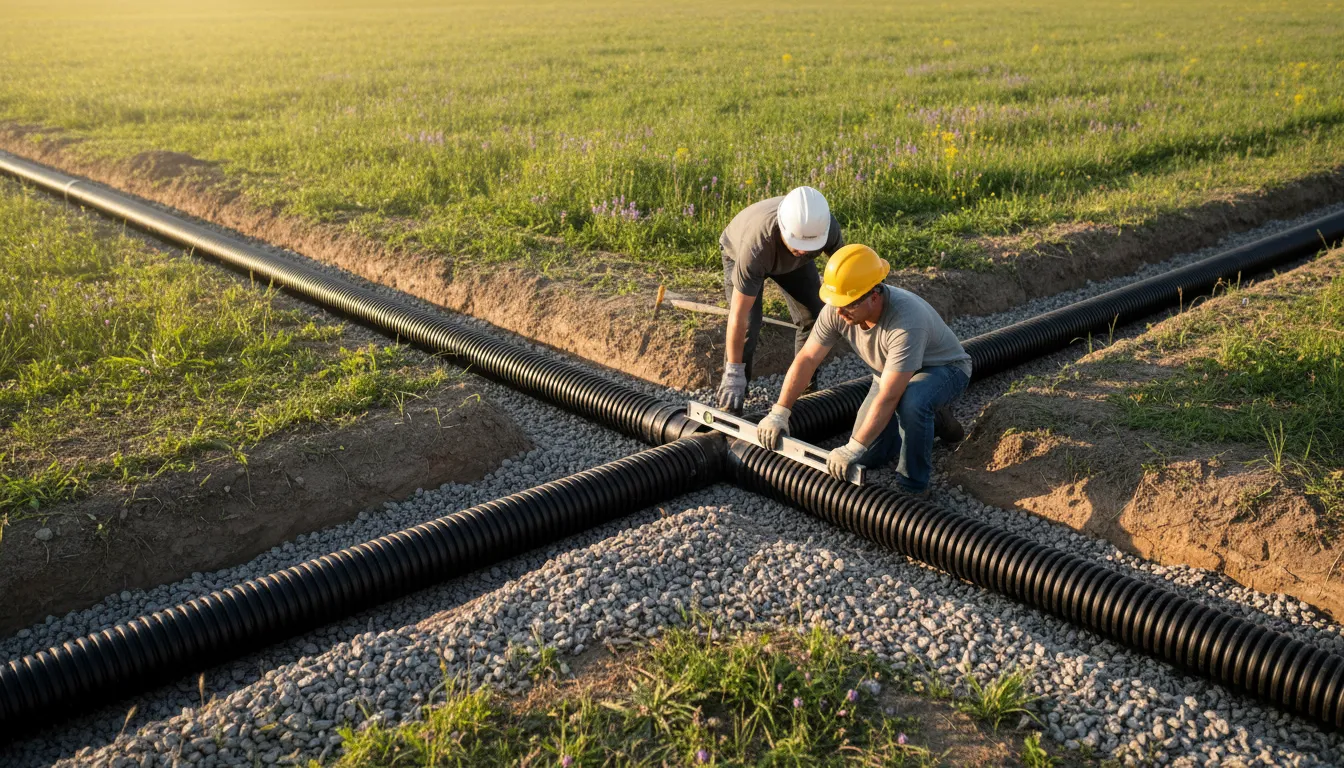
The drain field is the final, critical stage of your On-Site Sewage Facility (OSSF). After solids settle in the septic tank, liquid effluent flows into a network of perforated pipes buried in trenches. This effluent slowly percolates through a layer of gravel and into the soil, where natural processes provide final treatment. When this system fails, untreated wastewater can surface, creating health hazards and environmental issues.
In Sugar Land, failures are often accelerated by two key local factors:
- Heavy Clay Soils: The region's dense, non-porous clay soil has a very slow percolation rate, limiting the soil's ability to absorb and treat effluent. This can lead to premature saturation.
- High Water Table: A high groundwater level means there is less vertical separation between the drain field trenches and the water table. Texas regulations require a minimum two-foot separation, which can be difficult to achieve in some Sugar Land locations, necessitating alternative system designs 1.
Common signs of a failing leach field include:
- Sewage odors in the yard, especially after rainfall.
- Spongy, soggy ground or standing water over the drain field area.
- Slow drains and gurgling plumbing fixtures throughout the home.
- Unusually lush, green grass growing over the field.
Sugar Land and Fort Bend County Regulations: What You Must Know
All septic system work in Sugar Land is strictly regulated. The Fort Bend County Environmental Health Department acts as the authorized agent for the Texas Commission on Environmental Quality (TCEQ), enforcing state OSSF rules locally. Ignoring these rules can result in significant fines and an unusable system.
Permits are Mandatory: A permit is required for any repair, replacement, or alteration of a septic system, including its drain field 2. You cannot legally begin excavation or installation without county approval.
Licensed Professionals Required: Homeowners are generally prohibited from performing their own drain field work. You must hire a TCEQ-licensed Installer II for the installation. Furthermore, the system design must be prepared by a licensed Site Evaluator, Professional Engineer (PE), or Registered Sanitarian.
Critical Setback Requirements: A new or replacement absorption field must be sited with strict distances from other features:
- At least 100 feet from any water well.
- At least 50 feet from the home's foundation 3. These setbacks ensure wastewater does not contaminate drinking water sources or undermine structures.
The Step-by-Step Process for Repair or Replacement
Navigating a drain field project involves a defined sequence of steps to ensure compliance and system longevity.
1. Professional Site and Soil Evaluation
This is the non-negotiable first step. A licensed evaluator will conduct a thorough analysis of your property, including a percolation (perc) test to determine the soil's absorption rate and an assessment of the groundwater depth 4. They will also check the slope; an area with a slope greater than 30% is deemed unsuitable for a conventional field 5. This evaluation determines the soil class and dictates what type of system your property can support.
2. System Design and Planning
Based on the soil evaluation, a design professional will create a plan for your septic system. For many Sugar Land properties with poor percolation or high groundwater, a conventional gravel trench system may not be viable. The design may call for an aerobic treatment unit (ATU) with a spray field, which provides additional treatment and can disperse effluent above ground in accordance with TCEQ rules 6. The design plans must be submitted as part of the permit application packet to the Fort Bend County Environmental Health Department 7.
3. Securing the Permit
Your licensed installer will typically handle the permit submission, which includes the design, site plan, and applicable fees. The county will review the plans for compliance with all regulations. Do not start work until the permit is issued.
4. Installation and Inspections
The installation process involves:
- Pre-Construction Inspection: An inspector may visit the site before installation begins.
- Installation: The old, failed field is properly abandoned (often filled with clean sand or gravel), and the new system is installed according to the approved design.
- Final Inspection: Before any components are buried, the county inspector must conduct a final review. Tanks and piping must be exposed, the system must be filled with water, and any electrical components for aerobic systems must be operational 8. Only after passing this inspection can the system be covered.
Find the perfect drain field repair companies for your needs
Get personalized recommendations and expert advice
Repair vs. Complete Replacement: Understanding Your Options
The best course of action depends on the nature and extent of the failure.
Drain Field Repair: A repair might be possible if the problem is isolated, such as a crushed or clogged section of distribution pipe. The goal of a repair is to bring the affected portion up to current standards 9. However, in Sugar Land's challenging soil conditions, a localized repair is often a temporary fix if the underlying issue is overall soil saturation or biomat buildup.
Drain Field Replacement: This is necessary when the entire soil absorption area has failed. Replacement doesn't always mean putting a new field in the same spot. Often, a new location on the property must be found that meets all setback and soil requirements. If no suitable area exists for a conventional field, you will need to install an alternative system, like an aerobic unit 10.
Cost Considerations for Sugar Land Homeowners
The cost for leach field work in Sugar Land is highly variable, driven by soil conditions and system type. Below are general estimates; always get detailed quotes from licensed local providers.
- Site Evaluation/Soil Test: This essential first step typically costs between $350 and $75011.
- Conventional Drain Field Repair/Replacement: For a full replacement of a traditional system, homeowners can expect costs ranging from $3,000 to over $6,000, heavily dependent on the size of the field and excavation complexity 12.
- Aerobic System Installation: Due to Sugar Land's soil, many properties require an aerobic treatment system. Installing a new aerobic system, including the treatment unit, pumps, and spray field, is a significant investment, generally ranging from $12,000 to $20,000+13.
- Permit Fees: Fort Bend County charges fees for plan review and inspections. These vary by project scope, so check with the Environmental Health Department for the most current fee schedule 14.
Important Disclaimer: Regulations and fees can change. It is always best to contact the Fort Bend County Environmental Health Department at (281) 342-3411 for the most current rules and requirements before planning any work 15.
Maintaining Your New or Repaired Drain Field
Protect your investment with proper care:
- Divert Water: Ensure roof gutters, sump pumps, and surface runoff are directed away from the drain field area.
- Mind Your Load: Space out laundry loads and avoid excessive water use in short periods.
- No Driving or Building: Never park vehicles or build structures (like sheds or patios) over any part of your septic system.
- Landscaping: Only plant grass over the field. Tree and shrub roots can invade and clog pipes.
- Pump the Tank: Regular septic tank pumping (every 3-5 years) prevents solids from washing out into the drain field, which is a primary cause of failure.
Frequently asked questions
Sources
Footnotes
-
30 Tex. Admin. Code § 285.33 - Criteria for Effluent Disposal Systems - https://www.law.cornell.edu/regulations/texas/30-Tex-Admin-Code-SS-285-33 ↩
-
Aerobic Maintenance Information | Fort Bend County - https://www.fortbendcountytx.gov/government/departments/health-and-human-services/environmental-health/aerobic-maintenance-information ↩
-
Are There Regulations or Guidelines for Septic Tank Drain ... - https://weebeewasteservices.com/are-there-regulations-or-guidelines-for-septic-tank-drain-field-maintenance-in-texas/ ↩
-
Texas Septic Tank Rules - https://dillonseptic.com/texas-septic-tank-rules/ ↩
-
Septic System FAQs - https://www.co.ector.tx.us/upload/page/7901/docs/Health/Water%20Quality/Water%20Quality%20FAQs.pdf ↩
-
Choosing a Septic System (On-Site Sewage Facility System) - https://www.tceq.texas.gov/permitting/ossf/ossfsystems.html ↩
-
ENVIRONMENTAL HEALTH DEPARTMENT - FBCTX Documents - https://fbctxdocs.fortbendcountytx.gov/Forms_Library/On-Site%20Sewage%20Facility%20Packet/OnSiteSewageFacilityPlanRe.pdf ↩
-
Are There Regulations or Guidelines for Septic Tank Drain Field Maintenance in Texas? - https://weebeewasteservices.com/are-there-regulations-or-guidelines-for-septic-tank-drain-field-maintenance-in-texas/ ↩
-
Advice for an Owner of an On-Site Sewage Facility (Septic ... - https://www.tceq.texas.gov/permitting/ossf/ossfadvice.html ↩
-
What To Do If Your Septic Drain Field Needs to Be Replaced - https://www.anzaldoseptic.com/what-to-do-if-your-septic-drain-field-needs-to-be-replaced/ ↩
-
Conventional septic tank/drain field - https://www.h-gac.com/getmedia/eb908b2e-61a1-4180-9b8e-8652ded0ceec/OSSF-Treatment-Systems_Conventional-Septic-Tank-Drain-Field.pdf ↩
-
Texas Septic Systems & OSSF Requirements | 2026 Guide - https://texaslandbrokerage.com/resources/texas-septic-systems-ossf-requirements-guide/ ↩
-
Average Cost of a Septic System in Texas - https://dillonseptic.com/cost-of-a-septic-system-in-texas/ ↩
-
On-Site Sewage Facility Permits / Packets | Fort Bend County - https://www.fortbendcountytx.gov/government/departments/health-and-human-services/environmental-health/on-site-sewage-facility-permits-packets ↩
-
On-Site Sewage Facility (OSSF) Program - Fort Bend County - https://www.fortbendcountytx.gov/government/departments/health-and-human-services/environmental-health/on-site-sewage-facility-ossf-program ↩