Find the Best Drain Field Repair Companies for Your Business
No obligation • Fast responses • Nationwide coverage

Why you can trust Septic Spot
Septic Spot is a leading United States resource for understanding and comparing septic services. Our editors review providers using consistent criteria and verify key business details. Listings and scores are independent, and companies cannot pay to influence our content.
Search providers near you
Top Drain Field Repair Companies in Wylie, Texas Ranked
A failing drain field, also known as a leach field or absorption field, is a serious issue for any home with a septic system. When this critical component stops absorbing and filtering wastewater, it can lead to soggy yards, foul odors, and even sewage backups into your home. In Wylie, Texas, local soil conditions and strict state regulations make professional assessment and repair essential. This guide helps you understand the process, costs, and key considerations for drain field work, connecting you with qualified local specialists to evaluate and restore your system's function.

Understanding Drain Field Failure in Wylie
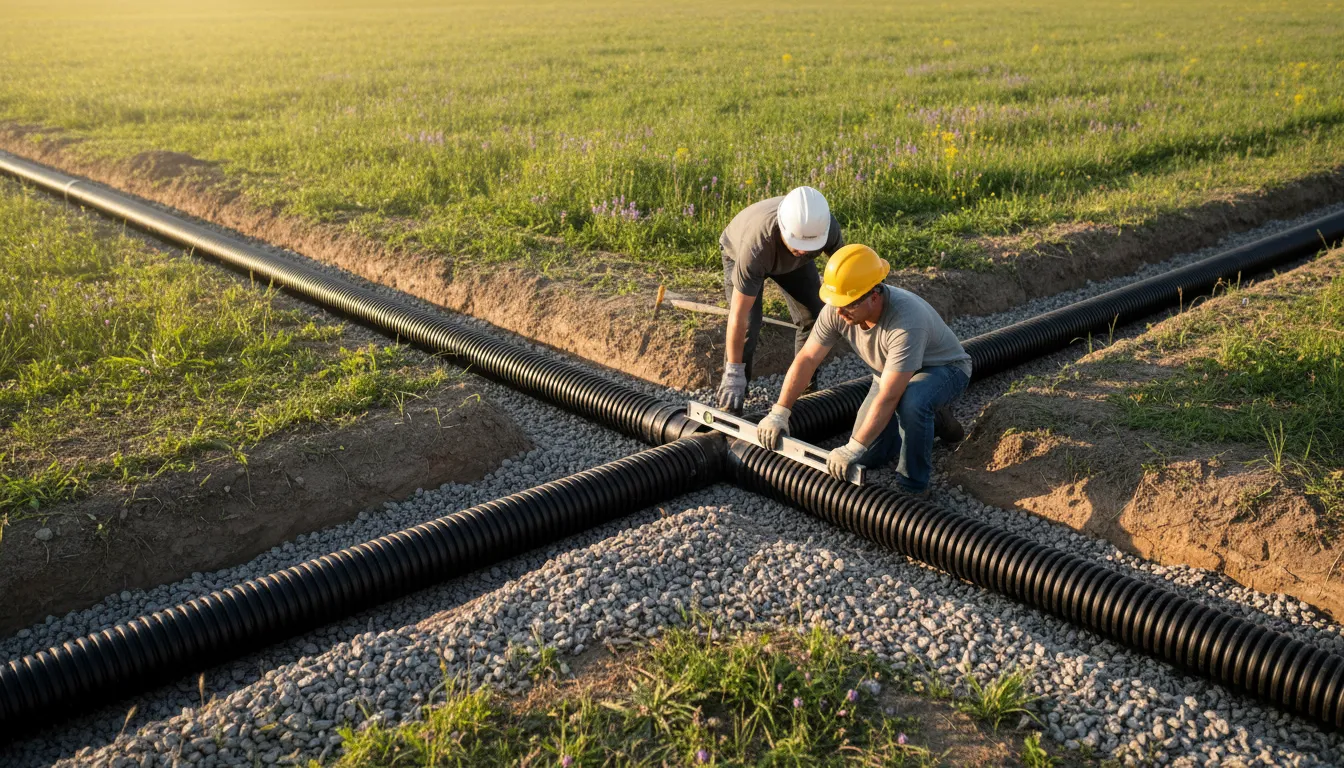
The drain field is the final stage of your onsite sewage facility (OSSF). After solids settle in the septic tank, liquid effluent flows into a network of perforated pipes buried in trenches filled with gravel. This effluent slowly percolates into the soil, where natural processes purify it before it rejoins the groundwater. Failure occurs when the soil can no longer absorb the liquid, causing it to surface or back up.
Common signs include:
- Persistently soggy or spongy ground over the drain field area, even in dry weather.
- Lush, green grass growing over the field while the rest of the lawn is brown.
- Foul sewage odors near the tank, drain field, or inside the home.
- Slow drains or gurgling plumbing fixtures throughout the house.
- Sewage backing up into household drains.
In Wylie, two primary environmental factors accelerate drain field problems: heavy clay soil and a high water table 1. Clay soil has very small pores, severely limiting the rate at which water can seep through (percolate). A high water table means the ground is already saturated near the surface, leaving no room for additional effluent. These conditions often cause conventional systems to fail prematurely and dictate the need for specific, engineered solutions.
Wylie's Regulatory Landscape: Permits and Compliance
Any significant repair or full replacement of a drain field in Texas is not a simple DIY project; it is a regulated activity requiring official oversight. The Texas Commission on Environmental Quality (TCEQ) sets the standards under Title 30, Chapter 285 of the Texas Administrative Code (30 TAC §285) 2.
The Permit Requirement: Before any construction begins on a drain field, you must obtain a permit from the local authorized permitting authority. This could be the TCEQ directly, your county, or a city that has local rules. The permit process ensures the proposed repair or new installation meets current health and environmental standards. Skipping this step can result in fines and an order to remove non-compliant work.
Emergency Repairs: There is a narrow exception for emergencies. If a repair is made to prevent an imminent health hazard-such as repairing a tank without removing it-work may begin immediately. However, you are legally required to report this emergency repair to the permitting authority within 72 hours of starting the work 3.
The Importance of Professionalism: Because of these regulations, hiring a licensed septic system installer or site evaluator is crucial. They understand the paperwork, the soil evaluation requirements, and the design standards necessary to get your project approved and completed legally.
Site Evaluation: The Critical First Step
You cannot properly fix what you haven't fully diagnosed. A professional site evaluation is the mandatory foundation for any drain field project in Wylie. A licensed site evaluator will conduct tests to understand your property's unique constraints 4 5.
This evaluation typically includes:
- Soil Analysis: Determining the soil type (texture and structure) and classification. Wylie's prevalent clay soils often fail standard percolation tests, immediately ruling out conventional drain fields 6.
- Depth to Groundwater: Measuring the seasonal high water table. A high water table may require a raised (mounded) drain field to ensure proper separation between the effluent and groundwater.
- Identification of Restrictive Layers: Locating bedrock or other impermeable layers that could block effluent movement.
- Slope Assessment: Evaluating the land's gradient, as steep slopes can complicate system design.
The results of this evaluation, which can cost between $350 and $750, directly determine which types of repair or replacement systems are legally and functionally viable for your property.
Repair vs. Replacement: Options for Wylie Properties
The best solution depends on the extent of the failure and the site evaluation results.
Partial Repairs: In some cases, only a section of the drain field is clogged or damaged. Techniques like jetting (high-pressure water cleaning of pipes) or replacing a single failed lateral line may be possible. However, even these repairs usually require a permit in Texas. Costs for conventional system repairs typically start around $6,000.
Full System Replacement: When the entire absorption field has failed or the existing system is fundamentally incompatible with current site conditions (like a conventional system in clay), a full replacement is necessary. For Wylie homes, this almost always means installing an Advanced Aerobic Treatment Unit (ATU).
An aerobic system actively pumps air into the treatment tank, supporting bacteria that break down waste more efficiently than a standard anaerobic tank. The resulting effluent is much cleaner and can be dispersed in ways suitable for difficult soils, such as:
- Spray Irrigation: The treated effluent is sprayed over a designated area of lawn.
- Shallow, Pressurized Drain Fields: Effluent is pumped through a network of small-diameter pipes buried in shallow trenches, allowing for better distribution in tight soils.
Find the perfect drain field repair companies for your needs
Get personalized recommendations and expert advice
Cost Considerations for Drain Field Projects
Drain field work is a significant investment. Understanding the cost components helps in planning and budgeting.
- Site Evaluation & Design: $350 - $750.
- Permit Fees: Vary by local authority but are a required cost.
- Conventional System Repair: $6,000 - $12,000+.
- Aerobic System Replacement: Given the engineering and components required, full aerobic system replacements in Wylie typically range from $12,000 to over $20,000.
- Annual Maintenance: Aerobic systems have mechanical parts (aerators, pumps, alarms) that require quarterly or semi-annual servicing. Budget approximately $400 to $800 per year for a maintenance contract 7.
While cost is a major factor, the cheapest option is rarely the best long-term solution in challenging soil. A properly permitted and installed system designed for your site will last longer and prevent costly repeat failures.
Maintaining Your New or Repaired Drain Field
Protecting your investment is key. Proper maintenance extends the life of any drain field.
- Pump the Tank Regularly: Even with an aerobic system, the septic tank must be pumped every 3-5 years, or when solids fill 25-33% of the tank 8 9. This prevents solids from washing out and clogging the drain field.
- Schedule Professional Inspections: For aerobic systems, TCEQ rules require regular maintenance by a licensed maintenance provider. Inspections should check the aerator, pumps, high-water alarm, and sprinkler heads (if applicable).
- Practice Good Drain Habits: Avoid pouring grease, chemicals, or non-biodegradable items down the drain. Use water efficiently to avoid hydraulically overloading the system.
- Protect the Drain Field Area: Never drive, park, or build heavy structures over the drain field. The soil compaction can crush pipes and ruin the absorption area. Also, avoid planting trees or large shrubs nearby, as roots can infiltrate and damage pipes.
Frequently asked questions
Sources
Footnotes
-
Texas Septic Tank Rules - https://dillonseptic.com/texas-septic-tank-rules/ ↩
-
Basics for Septic Systems - https://www.tceq.texas.gov/assistance/water/fyiossfs.html ↩
-
Advice for an Owner of an On-Site Sewage Facility (Septic ... - https://www.tceq.texas.gov/permitting/ossf/ossfadvice.html ↩
-
Septic Tank Laws in Texas - https://dillonseptic.com/septic-tank-laws-in-texas/ ↩
-
SEPTIC SYSTEM LAWS IN TEXAS - https://www.terseptic.com/posts/septic-systems-its-the-law ↩
-
What is the best septic system if your land fails a perc test? - https://www.premiertechaqua.com/en-us/blog/best-septic-system-failed-perc-test ↩
-
Texas Septic Systems & OSSF Requirements | 2026 Guide - https://texaslandbrokerage.com/resources/texas-septic-systems-ossf-requirements-guide/ ↩
-
Septic System - Texas Water Resources Institute - https://twri.tamu.edu/wp-content/uploads/2024/04/em-126-septic-system-maintenance-inspection-pocket-guide.pdf ↩
-
Texas OSSF Inspection Requirements: Complete Guide for 2025 - https://www.fieldbaseos.com/blog/texas-ossf-inspection-requirements.html ↩