Find the Best Drain Field Repair Companies for Your Business
No obligation • Fast responses • Nationwide coverage

Why you can trust Septic Spot
Septic Spot is a leading United States resource for understanding and comparing septic services. Our editors review providers using consistent criteria and verify key business details. Listings and scores are independent, and companies cannot pay to influence our content.
Search providers near you
Top Drain Field Repair Companies in Apple Valley, California Ranked
A failing drain field is a serious issue for any home with a septic system, leading to soggy yards, foul odors, and potential environmental contamination. In Apple Valley's unique high-desert environment, proper leach field function is critical for protecting local groundwater and ensuring your home's wastewater is safely treated. This guide explains the local process, regulations, and costs for drain field restoration, helping you understand your options and connect with qualified professionals in the Apple Valley area.
Foureverfresh Septic & Sewer Solutions
Los Angeles, CA
Foureverfresh Septic & Sewer Solutions provides a range of septic system services in Los Angeles, CA. Their offerings include septic tank pumping, inspections, repairs, installations, and sewer line repairs. They use advanced diagnostic tools like video inspections and leak detection to address issues such as tree root intrusion and blockages efficiently. With over 20 years of experience, the company emphasizes eco-friendly practices and customer satisfaction in their work.
Alpha Omega Plumbing & Septic Services
11755 Santa Fe Ave E, Hesperia, CA 92345
Alpha Omega Plumbing & Septic Services has been providing septic system repair, installation, and maintenance since 1984. Based near Los Angeles, CA, they serve the High Desert area with expertise in septic tanks, leach lines, seepage pits, and grease trap maintenance. Their team follows environmentally safe practices to help protect the environment while handling a wide range of plumbing and septic needs.
Understanding Your Septic Drain Field
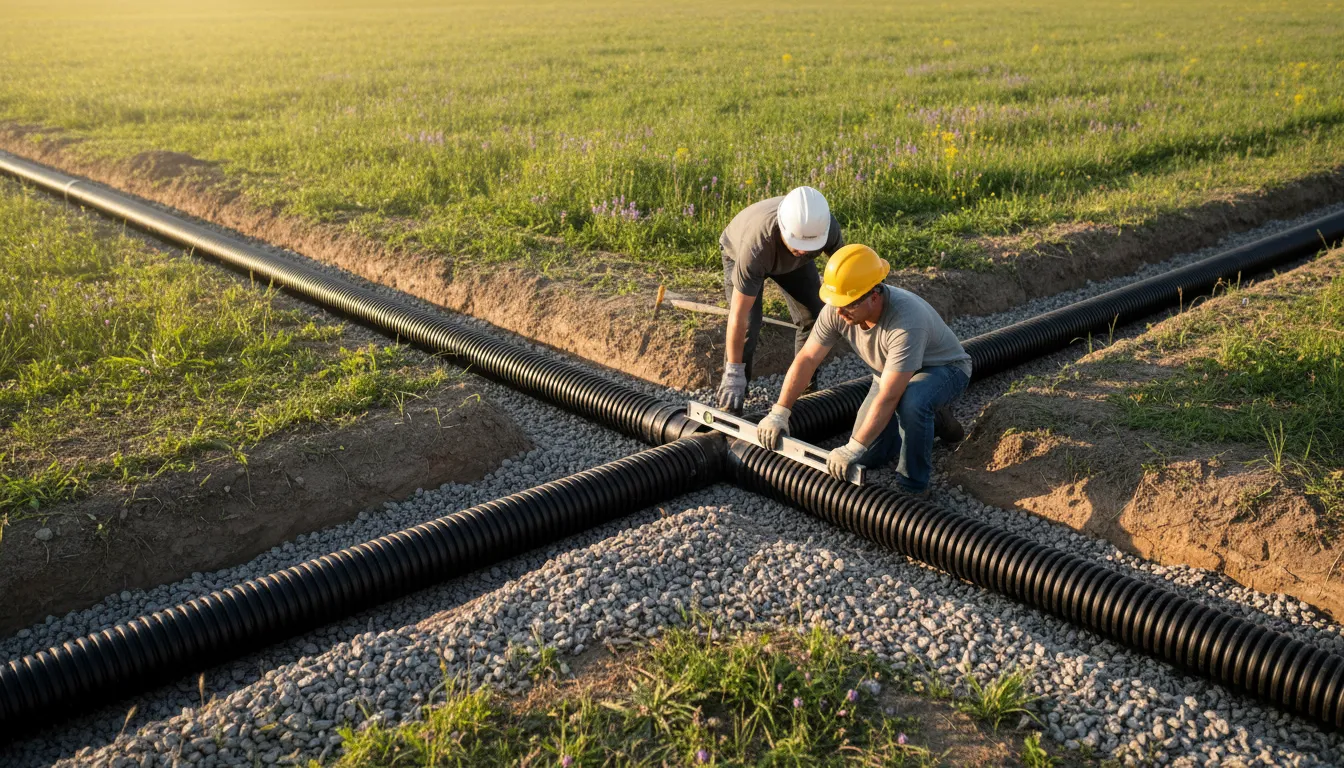
The drain field, also known as a leach field or absorption field, is the final and most crucial stage of your onsite wastewater treatment system (OWTS). After solids settle in the septic tank, the clarified liquid effluent flows into a network of perforated pipes buried in gravel-filled trenches. This effluent slowly percolates down through the soil, where natural biological processes provide the final treatment before the water rejoins the groundwater table. When this area becomes saturated, clogged, or otherwise compromised, it can no longer absorb and treat wastewater, leading to system failure.
Why Drain Fields Fail in Apple Valley
Several factors specific to the Apple Valley region can contribute to leach field problems:
- Soil Composition: The high-desert soil can contain layers of dense clay or hardpan that severely restrict water percolation. Over time, a biomat (a layer of organic material) can build up at the soil interface in the trenches, further slowing drainage.
- System Age and Overuse: All septic system components have a finite lifespan. Older systems may simply be worn out. Additionally, exceeding the system's daily design capacity-through increased household size or water usage-can overwhelm the absorption field.
- Physical Damage: Compaction from driving or parking vehicles over the field, or planting deep-rooted trees and shrubs too close to the lines, can crush pipes or clog them with roots.
- Lack of Maintenance: Failure to pump the septic tank regularly allows excess solids to wash out into the drain field, causing rapid clogging and irreversible damage.
Local Regulations and the LAMP Program
Apple Valley operates under a locally adopted Local Area Management Plan (LAMP) approved by the California Regional Water Quality Control Board (Lahontan Region). This plan sets the rules for all septic system repairs and replacements to protect public health and water quality.
Key regulations for drain field work include:
- Permits Are Mandatory: Any repair or replacement of a septic system component requires a permit from the Town of Apple Valley. You cannot legally begin excavation or construction without approved plans 1.
- Site Evaluation: A comprehensive site evaluation, including new soil percolation tests, is almost always required for a new leach field design. Systems cannot be placed in areas with unsuitable conditions, such as high groundwater tables or impermeable clay layers 2 3.
- Setback Requirements: State and local codes enforce strict setbacks from property lines, wells, waterways, and structures. Crucially, there must be a minimum of 3 to 5 feet of vertical separation between the bottom of the drain field trench and the seasonal high groundwater table 4.
- Approved System Types: Due to space limitations and soil conditions, concrete septic tanks with seepage pits are a common design in parts of Apple Valley, though traditional trench-style leach fields are also used where feasible.
The Drain Field Repair & Replacement Process
Navigating a drain field project involves a series of defined steps to ensure compliance and long-term functionality.
1. Professional Assessment and Diagnosis
The first step is a thorough inspection by a licensed septic professional. They will locate the system, assess the tank's condition, and perform diagnostic tests on the leach field (like a "deep hole" inspection to check groundwater levels and soil conditions) to confirm the cause and extent of the failure. This diagnosis determines whether a minor repair or a full replacement is necessary.
2. Design, Permitting, and Approval
If the field cannot be salvaged, a new system must be designed. A qualified engineer or designer will create plans based on the current household size, soil data, and all LAMP requirements. These plans, along with the permit application, are submitted to the Town of Apple Valley for review and approval 5. This step ensures the proposed solution meets all health and environmental codes.
3. Site Preparation and Installation
Once permitted, the contractor will schedule the installation. This involves:
- Safely pumping and disposing of contents from the old septic tank.
- Excavating the failed leach field area.
- Removing old gravel, pipes, and any contaminated soil.
- Installing new gravel beds, perforated distribution pipes, and a new distribution box.
- For full replacements, this may include installing an entirely new set of trenches in a different area of the property, known as a "repair area."
4. Final Inspection and Restoration
Before the new trenches are covered with soil, a final inspection from the town building department is required to verify the installation matches the approved plans 6. After passing inspection, the area is backfilled, graded, and seeded or sodded to restore your landscape.
Find the perfect drain field repair companies for your needs
Get personalized recommendations and expert advice
Cost Considerations for Drain Field Work in Apple Valley
The cost for leach field work varies widely based on the scope of the project, soil conditions, and system size. It's one of the most significant investments a homeowner with a septic system can face.
- Complete Drain Field Replacement: This is the most extensive and costly option, often necessary when the original field is irreparably clogged or the soil has failed. In the Apple Valley area, a full leach field replacement commonly ranges between $4,500 and $6,500, with averages often cited around $7,000 or more for standard systems 7 8.
- Minor Repairs: If the problem is isolated-such as a crushed pipe section or a clogged distribution box-repairs may be possible. These smaller fixes can range from $300 to $900, but they are only a solution for specific, limited issues.
- Major System Repairs: More involved repairs that fall short of a full replacement, such as adding a new expansion field or repairing significant portions of the network, can typically cost $5,000 to $15,000 or more, depending on complexity 9.
- Additional Cost Factors: Remember to budget for the required permit fees, soil testing and design engineering, and landscape restoration after the construction is complete. These are typically separate from the contractor's installation quote.
Choosing a System for Challenging Sites
Apple Valley's soil doesn't always pass a standard percolation test. In cases where traditional trench systems aren't feasible, alternative technologies may be approved:
- Seepage Pits (Dry Wells): These are deep, cylindrical pits filled with gravel that allow effluent to seep out through the sides. They are a space-efficient option often paired with concrete septic tanks in the area but require specific geological conditions 10.
- Advanced Treatment Systems: Systems that include aerobic treatment units (ATUs) or sand filters provide a higher level of treatment before the effluent reaches the drain field, sometimes allowing for a smaller leach field or use on more challenging lots 11.
- Mound Systems: An engineered system where suitable soil is brought in to create an elevated absorption area above the native restrictive soil layer.
Your licensed professional can advise on which system types are permissible under the local LAMP and best suited for your property's specific constraints.
Frequently asked questions
Sources
Footnotes
-
0" Min. - Town of Apple Valley - https://applevalley.org/wp-content/uploads/2025/07/Sewage-Disposal-System.pdf ↩
-
The Californian's Guide To Septic Tanks - https://cacciaplumbing.com/blog/california-septic-tank-guide/ ↩
-
Town of Apple Valley Draft LAMP - California Water Boards - https://www.waterboards.ca.gov/lahontan/water_issues/programs/owts/docs/lamp_tracking/19.pdf ↩
-
Town of Apple Valley - https://www.waterboards.ca.gov/rwqcb6/water_issues/programs/owts/docs/lamp_tracking/applevalleylamp.pdf ↩
-
California Septic Tank Requirements | Onsite Wastewater ... - https://www.ntotank.com/blog/california-septic-tank-requirements ↩
-
Answering Top Questions About Drain Field Replacement - https://tampabayseptic.com/blog/answering-top-questions-about-drain-field-replacement/ ↩
-
Cost to Replace Septic Tank and Drain Field [2026 Data] | Angi - https://www.angi.com/articles/how-much-new-drain-fields-foot.htm ↩
-
Septic Tank Installation in Apple Valley, CA - Costs 03 / 2026 - https://www.homeyou.com/ca/septic-tank-installation-apple-valley-costs ↩
-
How Much Does Septic System Repair Really Cost in California - https://www.lanikseptic.com/septic-repair-cost/ ↩
-
Installing a New Septic System in Apple Valley - https://usaseptic.com/the-usa-septic-story-high-desert-san-diego-septic-experts/blog/installing-a-new-septic-system-in-apple-valley-concrete-septic-tanks-seepage-pits ↩
-
What is the best septic system if your land fails a perc test? - https://www.premiertechaqua.com/en-us/blog/best-septic-system-failed-perc-test ↩