Find the Best Septic Tank Installation & Replacement Contractors for Your Business
No obligation • Fast responses • Nationwide coverage

Why you can trust Septic Spot
Septic Spot is a leading United States resource for understanding and comparing septic services. Our editors review providers using consistent criteria and verify key business details. Listings and scores are independent, and companies cannot pay to influence our content.
Search providers near you
Top Septic Tank Installation & Replacement Contractors in San Francisco, California Ranked
Installing or replacing a septic system is a significant undertaking that requires careful planning, professional expertise, and strict adherence to local regulations. For properties in the San Francisco Bay Area not connected to the municipal sewer, a properly functioning septic system is essential for managing household wastewater safely and protecting the environment. This guide provides a detailed overview of the process, costs, and key considerations for septic system work in the region, helping you understand what's involved in finding and vetting qualified local professionals for your project.
Understanding Septic System Basics in the Bay Area
Before diving into installation, it's crucial to understand the local context. In the immediate City and County of San Francisco, municipal sewers are universal 1. Therefore, septic tank installation and onsite wastewater treatment system projects are primarily relevant for rural and unincorporated areas within surrounding Bay Area counties, such as San Mateo, Napa, Sonoma, and Marin. These systems are private wastewater treatment plants for your property, typically consisting of a tank that separates solids and a leach field (or drain field) where liquid effluent is filtered through the soil.
A failing or outdated system poses health risks and environmental hazards, making timely replacement or professional installation critical. The process is heavily regulated to ensure groundwater protection, which is why every step-from soil testing to final inspection-must be approved by local health authorities.
The Permit Process: Your First Official Step
You cannot begin any septic system construction without the proper permits. In the Bay Area, this authority falls to the local county's Environmental Health Department.
- Primary Authority: For instance, in San Mateo County, the Environmental Health Services (EHS) department handles all septic permitting, often through an online "MyEHS" portal.
- Key Requirement: A permit is mandatory to construct, replace, or repair any part of an onsite sewage system 2. It's important to note that if a public sewer line is available within 300 feet of your property line, you may be legally required to connect to it instead of installing or repairing a septic system 2.
- Submission Package: Obtaining a permit involves submitting a detailed site plan and engineered system design for review. This plan is based on the results of a professional site evaluation and soil percolation test.
Critical Step: The Soil Percolation Test
The heart of any septic system design is the soil's ability to absorb and treat wastewater. A percolation test (often called a "perc test") is a mandatory, professional assessment that determines this.
- Purpose: The test measures the soil's absorption rate, which directly dictates the size and type of leach field required 3.
- Process: A qualified professional digs test holes in the proposed leach field area, saturates the soil with water, and then measures the rate at which the water level drops. This rate is expressed in Minutes Per Inch (MPI) 4.
- Standards: Soil with a percolation rate between 5 and 60 minutes per inch is generally suitable for conventional trench systems 5 6. Rates outside this range may require a more complex (and costly) engineered system.
This test is so vital that county inspectors, such as those in San Bernardino County, may observe the procedure to verify its accuracy. The results form the basis of the engineered design that must be submitted for permit approval.
Site Evaluation and System Design
Concurrent with or following the perc test, a comprehensive site evaluation is conducted. This assessment looks at factors beyond just soil absorption:
- Soil Composition and Depth: The type and depth of soil to bedrock or groundwater are assessed.
- Groundwater Level: The system must be installed at a safe distance above the seasonal high groundwater table.
- Topography and Slope: The land's slope can affect system design. For example, specific guidelines exist for permitting systems on sloped parcels in counties like Sonoma.
- Setback Distances: Regulations specify minimum distances from the system to wells, property lines, buildings, and waterways.
Based on these findings, a licensed designer or engineer will create a system design. This could be a conventional gravity-fed system or an engineered septic system featuring pumps, pressure distribution, or mound systems for challenging sites.
Installation and Inspection Phases
Once permits are secured, the physical installation can begin. This is a multi-stage process with mandatory inspections to ensure compliance with the approved plans.
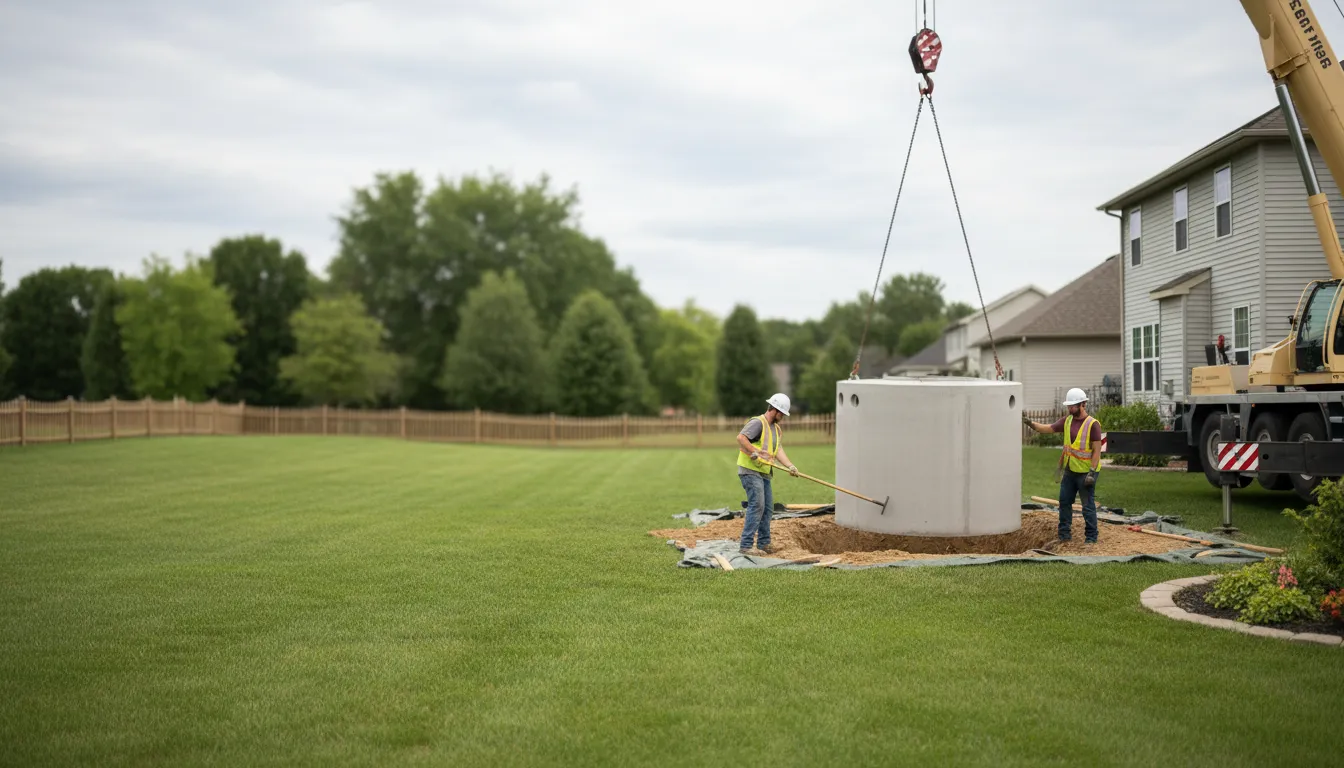
- Excavation and Tank Placement: The tank and leach field area are excavated. Tanks are typically concrete, fiberglass, or polyethylene and must be carefully leveled and set.
- Leach Field Construction: Trenches or beds are dug and filled with gravel and perforated pipes according to the design specifications.
- Plumbing Connection: All household wastewater lines are connected to the inlet of the septic tank.
- Inspections: Critical inspections occur at multiple points:
- Pre-construction: Verification of the site and stakes.
- During Installation: Inspectors may check the perc test observation, tank placement, and pipe bedding 7.
- Final Inspection: Before the system is backfilled, a county inspector will verify the entire installation-tank, plumbing, and leach field construction-against the approved plans 8. Only after passing this final inspection can the system be covered and put into use.
Find the perfect septic tank installation & replacement contractors for your needs
Get personalized recommendations and expert advice
Understanding Costs for Septic System Projects
The cost of a new septic system installation or complete system replacement in the San Francisco Bay Area varies widely based on site-specific conditions. It's one of the most important factors to discuss with potential contractors.
- General Range: While minor repairs may cost less, a standard septic tank and drain field replacement often starts in the range of $3,000 to $5,000 9 10. A completely new installation typically ranges from $6,000 to over $10,000, with complex projects exceeding $15,000 9 11 12.
- Key Cost Factors:
- System Type: A conventional gravity system is the most affordable. Alternative or engineered systems (e.g., with pumps, sand filters, or mound systems) add significant cost due to extra components and materials.
- Soil and Site Conditions: Poor percolation rates, high groundwater, rocky soil, or difficult slopes increase costs due to the need for more extensive leach fields or specialized engineering.
- Tank Material and Size: Larger tanks or more durable materials like concrete can affect the price.
- Permitting and Design Fees: Fees for perc tests, site evaluations, engineered design plans, and county permits are a substantial part of the upfront cost.
- Accessibility: Sites that are difficult for heavy machinery to access may require manual labor, increasing installation time and expense.
Choosing a Qualified Installation Professional
Given the complexity and regulatory nature of this work, selecting the right contractor is paramount. Look for a licensed, insured professional with extensive experience in your specific county. They should be fully familiar with the local Environmental Health Department's processes and requirements. A reputable contractor will handle or coordinate the permitting, soil testing, design, installation, and inspection scheduling. Always ask for references from past installations and verify their license status with the California State License Board.
Long-Term Care After Installation
A new or replaced septic system is a major investment that should last for decades with proper care. After installation, regular pumping (typically every 3-5 years), mindful water usage, and avoiding flushing harmful chemicals or non-biodegradable materials are essential for system longevity. Keep a detailed record of your system's as-built design, permits, and maintenance history, as this is crucial for any future property sale.
Frequently asked questions
Sources
Footnotes
-
A Guide for Selling a Home with a Septic System - https://www.a1tank.net/septic-and-selling-what-real-estate-agents-wish-homeowners-knew/ ↩
-
Land Use, Septic Systems, Septic Pumper Businesses, & Water Wells - https://www.smchealth.org/landuse ↩ ↩2
-
Septic soil testing and observation - Acorn Onsite, Inc. - https://acornonsite.com/soil-testing ↩
-
Residential Percolation Test - West Coast Sanitation - https://westcoastsanitationinc.com/residential-percolation-test/ ↩
-
Chapter 15.42: TECHNICAL STANDARDS FOR ONSITE ... - https://ecode360.com/44336095 ↩
-
Geotechnical and Percolation Soil Testing in California - https://alluvialsoillab.com/pages/geotechnical ↩
-
On-Site Waste Water Disposal System - San Bernardino County - https://wp.sbcounty.gov/wp-content/uploads/sites/7/2017/10/Perc-Test-09-27-17.pdf ↩
-
ONSITE SYSTEMS MANUAL - California Water Boards - https://www.waterboards.ca.gov/sanfranciscobay/board_info/agendas/2016/January/SantaClaraOWTS/SCC_OWTS_B_Onsite_Systems_Manual.pdf ↩
-
Septic Tank Replacement and Drain Field Cost in California - https://www.lanikseptic.com/how-much-does-it-cost-to-replace-a-septic-tank-and-drain-field-in-california/ ↩ ↩2
-
California Septic Tank Requirements | Onsite Wastewater ... - https://www.ntotank.com/blog/california-septic-tank-requirements ↩
-
How Much Does a Septic System & Septic Tank Cost - https://www.nexgenseptics.com/septic-system-cost/ ↩
-
Understanding Septic System Cost: A Complete Guide - https://ky-pd.com/blog/septic-system-cost-breakdown/ ↩